Deployment Frequency and Verification Coverage Tradeoffs
Faster deployments without verification coverage just hide problems deeper in your release chain.
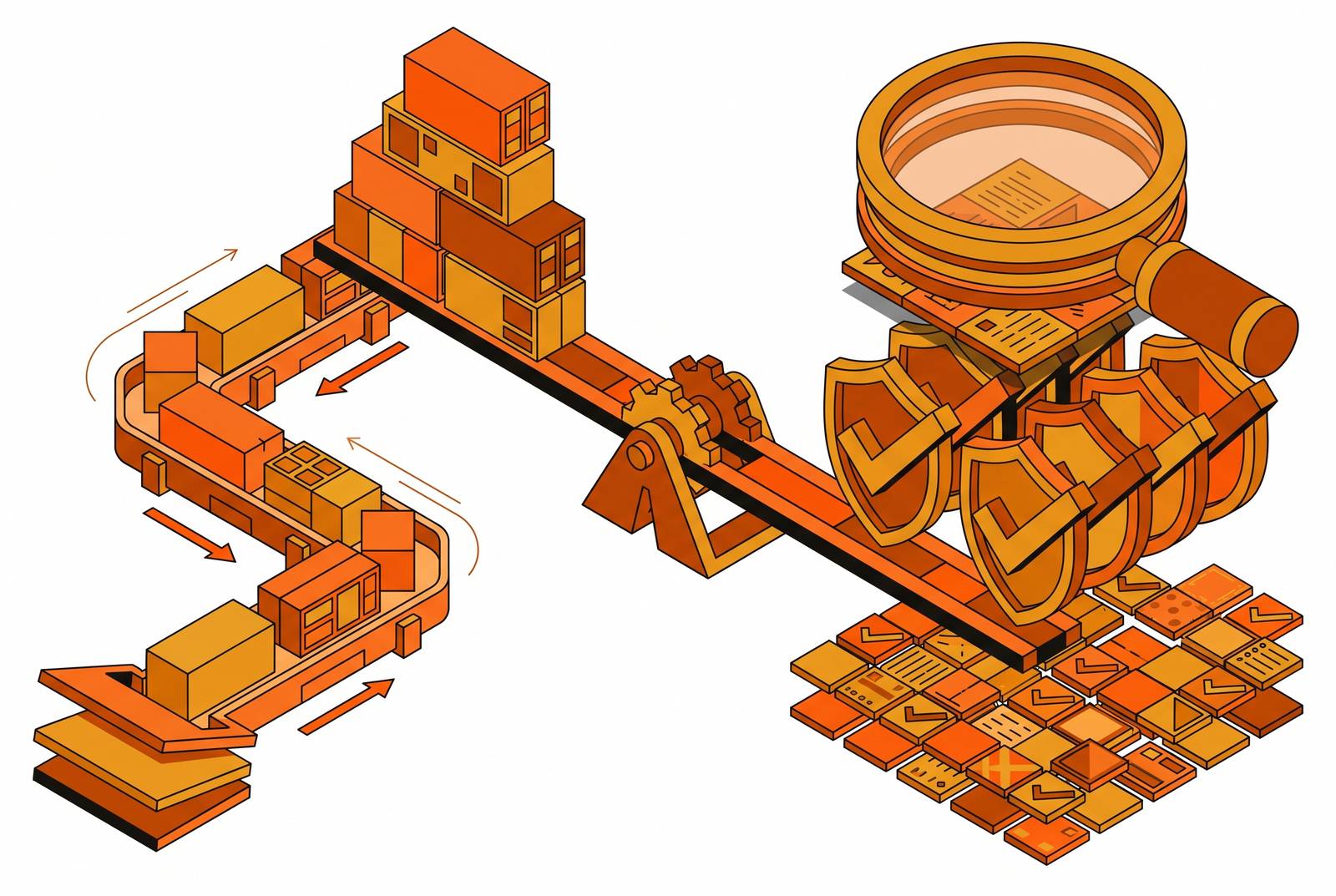
Deployment frequency keeps climbing across the industry, and most teams treat that as unambiguous progress. It isn't. As the gap between shipping code and confirming it works shrinks, so does the share of deployments that actually get checked, and that gap compounds: each unverified release becomes the starting point for the next one, so problems stack instead of surfacing cleanly. Teams that raise frequency without raising risk understand this tradeoff in concrete terms. Teams that do both at once usually don't notice until something breaks badly, and by then the damage sits three or four deploys deep.
The logic behind fast, small deployments comes straight out of lean manufacturing: smaller batches cut variance and shorten feedback loops, a principle that DORA's research on high-performing teams consistently reflects. But that logic carries a hidden assumption. It only works if each deployment gets checked before the next one ships. Skip that step, and frequency stops being a lean practice. It becomes a way to hide problems faster, and that's the trade most teams are making right now without admitting it.
What DORA metrics actually measure, and what they leave out
DORA tracks five metrics now: deployment frequency, lead time for changes, failed deployment recovery time, change failure rate, and rework rate. Two measure how fast work moves. One, at its core, measures how often things break. Read them apart and you'll draw the wrong conclusion. A team whose deployment frequency is climbing while its change failure rate climbs too isn't improving. It's shipping more breakage, faster, and calling it velocity.
The 2024 DORA report put a number on what good looks like: elite performers, around 19% of respondents, deploy on demand, recover from failure in under an hour, and hold change failure rates near 5%. Most teams aren't close, and that's the part worth sitting with. Elite performance is a minority position, not the default state a team should assume it already occupies just because deploys go out daily.
None of the five metrics capture whether a given deployment got checked against real production behavior after it went out. Change failure rate tells you a failure happened. It doesn't tell you whether anyone caught it before a user did, and that gap between a lagging signal and an actual verification signal only gets wider with every deploy added to the daily count.
There's a Goodhart's Law problem sitting underneath how teams use these numbers, too. Cortex's DRIVE framework flags it directly: once deployment frequency becomes a target someone is managing to, teams find ways to inflate the count without improving anything real. Split one change into three deploys instead of shipping it as one, and the metric climbs while delivery health stays exactly where it was.
DORA's own 2025 framework reflects this shift. Instead of sorting organizations into performance tiers, it now describes seven archetypes, with names like "The Legacy Bottleneck" and "The Harmonious High Achiever." That's a tacit admission that delivery health isn't one number. It's a blend of throughput, burnout, friction, and whether the work feels like it's landing, and the aggregate metrics say nothing about what's currently driving instability into all of it. That thing is AI.
How AI tooling speeds up throughput while shaking delivery loose
AI use in software teams went from a niche practice to close to universal, fast. The 2025 DORA report found 90% of respondents use AI at work, and 65% describe their reliance as moderate to high, mostly for code generation, debugging, test writing, and documentation. That's not a future trend. That's the baseline right now, and most verification practices haven't caught up to it.
Sitting right next to that adoption number is the uncomfortable part: higher AI adoption tracks with both higher delivery throughput and higher delivery instability, in the same teams, at the same time. More releases go out. Fewer of them behave predictably. AI raises the rate of code generation faster than review and deployment infrastructure can absorb it, so new adopters feel the instability precisely because their feedback and validation systems haven't kept pace with the volume AI now enables.
AI doesn't fix a broken pipeline. It amplifies whatever's already sitting in it. Teams with mature, automated testing see real gains from AI tooling. Teams with weak verification practices watch the cracks in those practices widen faster than before. The tool isn't the differentiator here. What was already in place before the tool showed up is, and that's the part most teams get backwards when they adopt Copilot or Cursor expecting the tool alone to fix a shaky release process.
Commit size, long used as a rough stand-in for change risk, is losing its meaning fast. An AI-assisted commit that looks small by line count can touch far more files, logic branches, and test surfaces than a human-written commit of the same size. Some teams now see AI generate the majority of committed code. At that share, deployment frequency and lead time stop being reliable stand-ins for much of anything, because the review and verification a unit of shipped code actually needs has changed underneath the metric without anyone updating the process around it.
Roughly 30% of developers, per the 2025 DORA data, report little to no trust in AI-generated output. That split matters, because the teams shipping fastest with AI assistance are frequently the same teams whose verification practices haven't caught up to the volume of change AI now lets them produce. Speed got there first. The safety net is still catching up, and it shows.
The real cost of shipping without checking production
Most production outages aren't caused by outside forces. They're self-inflicted: a team's own changes are the dominant cause of failure, not third-party outages or infrastructure events nobody could've predicted. That reframes the whole conversation. Verification isn't defense against bad luck. It's defense against the team's own last deployment.
The Uptime Institute's Annual Outage Analysis found more than half, 54%, of significant outages cost over $100,000, and roughly one in six, 16%, cost more than $1 million. These aren't edge cases reserved for the largest enterprises. They're a routine cost of doing business at scale, and how often a team deploys has a direct bearing on how often it's exposed to that cost.
High-frequency teams carry a specific version of this risk. As deployment cadence rises, the time between a change going out and a failure showing up in production shrinks. Without automated verification running after each deploy, though, the time it takes to detect that failure doesn't shrink to match it. That mismatch is where the actual danger lives.
Picture a team shipping several times a day with no automated post-deploy verification. A regression introduced in deployment three might not surface until deployment six, once enough downstream changes have piled on top of it to produce a visible symptom. By then, attribution is a mess. Rollback isn't a clean revert of one change anymore. It's untangling which of three or four subsequent deploys need to come with it. Recovery takes longer precisely because nobody caught the problem while it was still isolated.
The low performers' change failure rate, sitting in the 45% to 60% range per DORA benchmarks, is what this looks like once you zoom out: most changes go unchecked until something visibly breaks for a user. That's not a discipline failure on any one engineer's part. It's what happens structurally when verification is manual and reactive instead of automated and immediate.
The human cost shows up as on-call toil, alert fatigue, an engineer context-switching across five tools mid-incident, a sprawling Slack thread at 2am trying to figure out which of the day's six deploys is the culprit. None of that is random. It's the downstream symptom of a verification gap that never got closed. Teams that build structured reliability practices around SRE principles see a different pattern: SRE-enabled teams deploy 3.5 times more frequently than their peers, and elite SRE practitioners spend less than 32% of their time on operational toil. That headroom doesn't come from working harder during incidents. It comes from verification infrastructure that catches problems before they become incidents at all.
What production verification actually requires at high deployment frequency
Testing in staging and verifying in production are not the same activity, and treating them as interchangeable is where a lot of teams go wrong. Staging confirms expected behavior under simulated conditions. Production verification confirms actual behavior under real traffic, real data, and the messy usage patterns no test environment fully replicates.
After every deployment, a specific set of signals needs checking: HTTP error rates across 4xx and 5xx responses, p95 and p99 latency, how the API is actually responding to real calls, and system resource utilization. Any divergence from the pre-deployment baseline is worth investigating immediately, not at the next retro.
Smoke tests are the first, cheapest layer: lightweight automated checks that run right after deploy to confirm core functionality didn't break. They're fast, cheap, and built to catch an obviously bad deployment before it turns into a full incident. Synthetic monitoring extends that coverage over time, running scripted interactions against production at regular intervals (a login, a search, a checkout flow) and catching regressions that a one-time smoke test would miss simply because it only runs once.
None of this works without observability underneath it. Log analysis, distributed tracing, and real-time metrics aren't optional extras once deployment frequency climbs. They're the ground truth a passing CI pipeline can't provide on its own. A "shift left" approach to observability treats dashboards and alerts as version-controlled code, tests that telemetry instrumentation is actually valid before merge, and runs local observability sandboxes during development. These practices move some verification earlier in the process, but they don't remove the need to confirm behavior after the deploy actually happens.
Automated rollback is the backstop, not the strategy. Systems that watch key metrics after a fix ships and revert automatically when something's wrong cut the cost of a missed check, but rollback only fires after something's already broken. Feature flags and canary releases offer a different kind of control, decoupling the act of deploying from the act of exposing a feature to users, which lets teams deploy more often while limiting the blast radius of anything that turns out broken. Useful, but that's containment. It isn't confirmation that the change actually works.
Chaos engineering, the practice popularized by tools like Netflix's Chaos Monkey and exercises like Amazon's GameDay, checks something different: whether a system's resilience mechanisms hold up under deliberate failure injection. It finds weaknesses before a real outage does. But it's a complement to routine post-deploy verification, not a substitute for it.
How to think about the tradeoff between deployment frequency and verification coverage
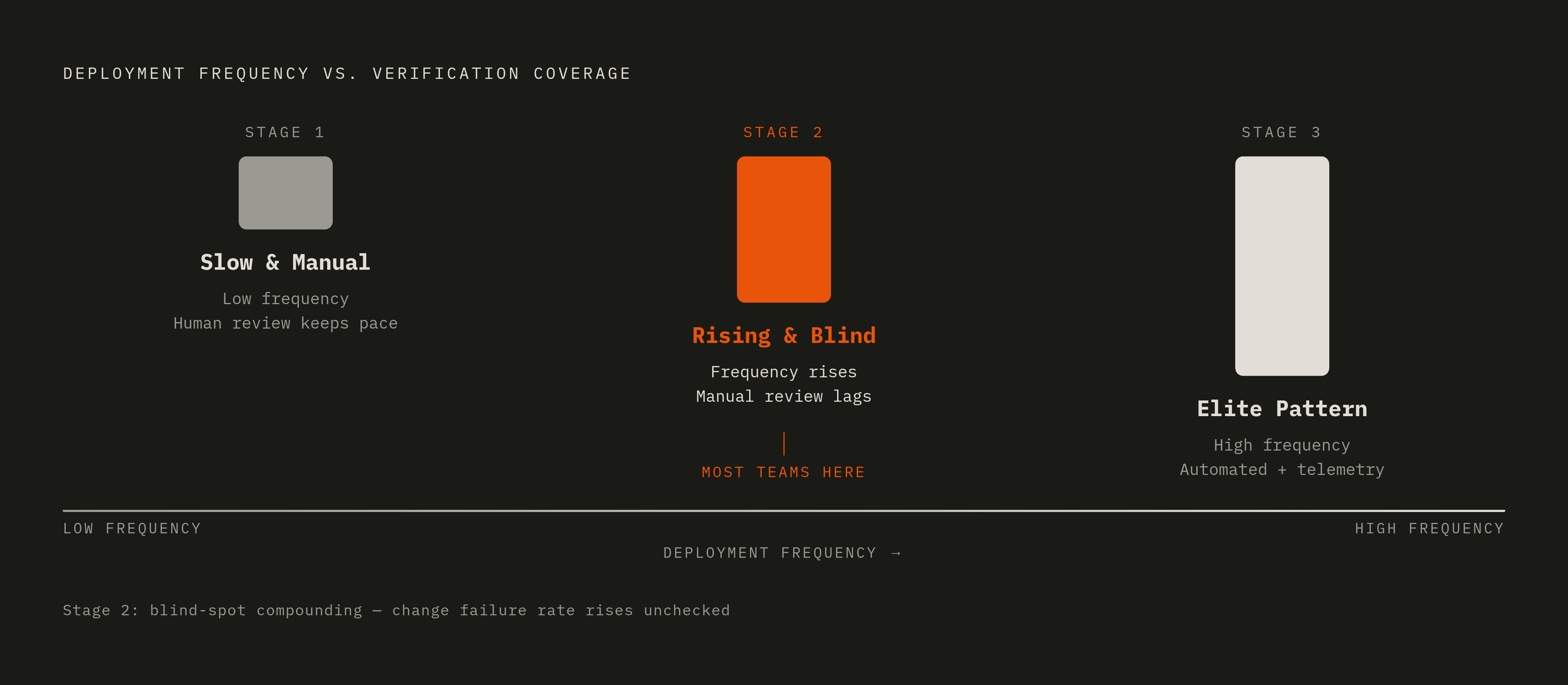
Frequency and verification aren't opposites fighting over the same budget. The real question isn't whether to pick one over the other. It's whether verification coverage actually scales alongside frequency as frequency rises, and for most teams right now, it doesn't. Teams treat frequency as the finish line, when frequency without matching verification is just a faster way to pile up risk that nobody's watching. That's the mistake worth naming directly, and most of the industry is making it.
Picture three rough stages. In the first, deployment frequency is low and verification is manual: slow, but manageable, because human reviewers can keep pace with the volume of change. In the second, frequency is climbing while verification stays manual. This is the danger zone, the point where the blind spot starts compounding, and it's where most teams currently sit. In the third, frequency is high and verification is automated, tied directly to production telemetry rather than a person's judgment call. This is the elite pattern, and it produces a result that looks backwards until you see the mechanism behind it: deployment frequency and change failure rate improving together, not trading off against each other.
Chasing frequency in isolation is a mistake with a predictable outcome. Optimizing hard for one metric creates tradeoffs elsewhere that surface later and cost more to fix. Teams that push deployment frequency up without pairing it to automated verification should expect their failure rate to climb, not fall, no matter how good the intentions behind the push were.
What counts as the right frequency also depends on where a team sits. Healthcare and financial services operate under compliance constraints that limit how much verification shortcut is even legally acceptable. Consumer SaaS can generally move faster, but pays a steeper reputational cost when a user-visible failure gets out. There's no universal target deployment rate worth chasing. The right one is the fastest a team can sustain while still keeping verification coverage matched to it, not a number borrowed from a benchmark report.
The rise of agentic AI is going to make this tighter, not looser. Gartner projects that 40% of enterprise applications will include task-specific AI agents by the end of 2026, up from less than 5% in 2025. At the deployment rates agents can produce, the gap between shipping and actually confirming something works can disappear from view entirely, unless automated production checks become a first-class part of the pipeline instead of an afterthought bolted on later.
Take this warning seriously: reported incident rates for AI agents in production have actually dropped even as the number of agents deployed has doubled, and researchers attribute that gap to failing detection, not improving reliability. The agents didn't get safer. Teams just stopped catching what was going wrong. That same dynamic plays out with high-frequency deployment generally. Fewer confirmed failures doesn't mean fewer real ones, if nobody automated the checking.
None of this works without a clear standard to check against. Service level objectives define what "working" actually means for a given system, and without one, post-deploy verification has no threshold to measure against, just a vague sense that things seem fine. SLO coverage and error budget burn rate are the metrics that connect delivery speed to what a customer actually experiences, a connection change failure rate alone can't make on its own.
The economics favor catching problems early, and by a wide margin. A regression caught automatically right after deploy costs far less than the same regression discovered through a user complaint, and far less again than the war-room scramble that follows once three more deploys have piled on top of the original failure and rollback means untangling all of them at once. This is the gap tools built specifically to close it, like One Patch, an AI agent that verifies every pull request against live production telemetry and autonomously opens fix PRs when a regression surfaces, are aimed at: checking each deployment against real production signals after it ships instead of waiting for a human to notice first. That kind of automated loop is what makes the elite DORA pattern reachable for teams that don't have a large dedicated SRE org standing behind them.
Merging a pull request and confirming it actually works are two separate steps, and treating them as one is the single most avoidable mistake in this whole picture. Teams that keep conflating the two will keep finding that deployment frequency behaves like a risk multiplier, not a performance win, right up until verification finally catches up to the pace they're shipping at.
Sources
- Deployment Frequency in 2026: Benchmarks, Risks, and AI Impact
- The 2026 Pocket Guide to Engineering Metrics | Cortex
- State of DevOps Report in 2025: Lessons for Engineering Leaders
- AI Enterprise App Builder | INFORMAT Low-Code Platform
- DORA Metrics Explained: The Complete Guide (2026) | Developer Productivity