Environment Parity Gaps Between Staging and Production
Configuration drift compounds silently until deployment day brings crisis.
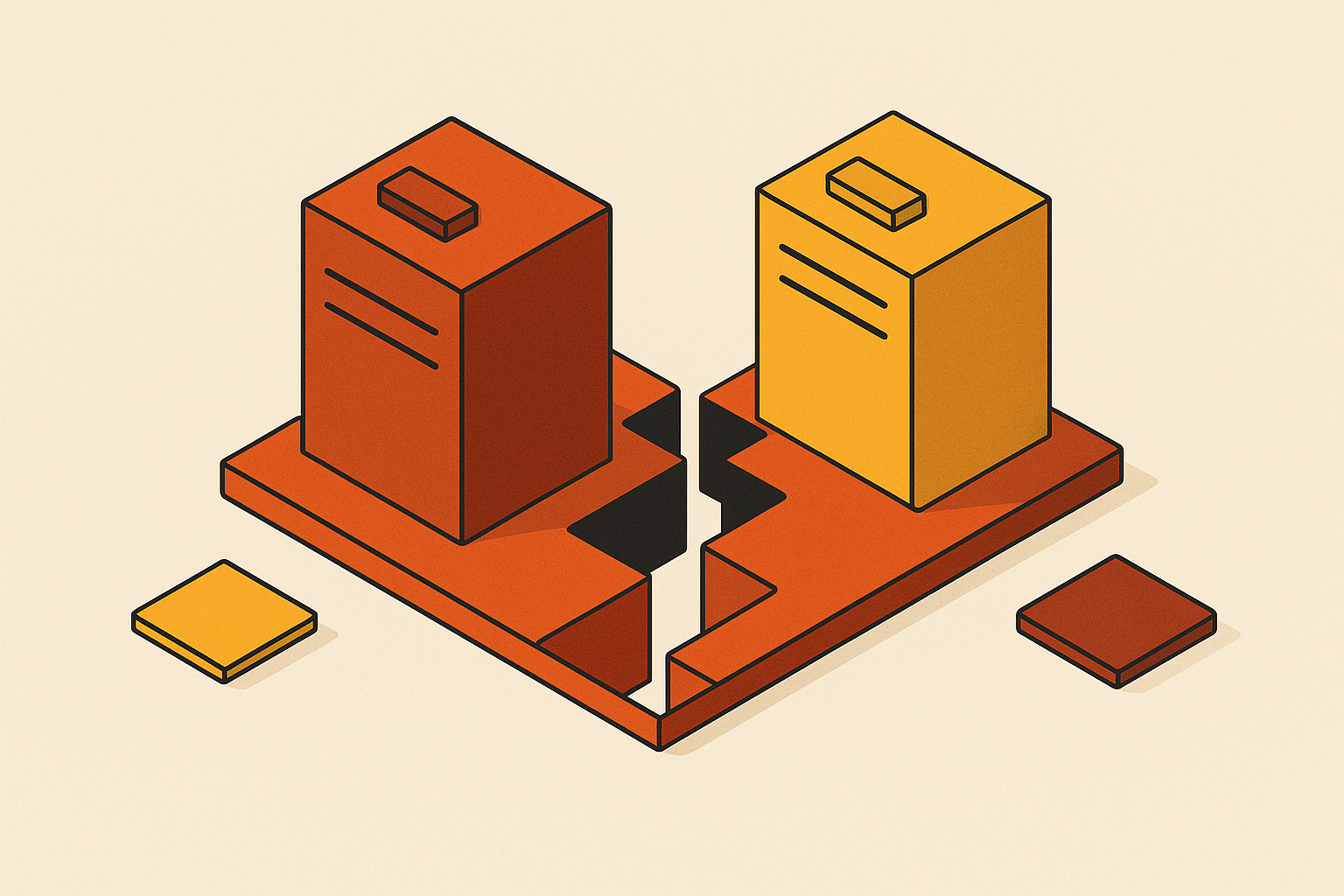
The 12-Factor App methodology named three parity gaps: time, personnel, and tools. Code sits for days or weeks before it reaches production. The person who writes it isn't the person who deploys it, and the local stack looks nothing like the live one. None of that is exotic; it's the ordinary math of distance between a laptop and a production cluster, and that distance compounds. A long time gap gives the tools gap more room to drift, and a personnel gap means the engineer who'd notice something is off almost never has a hand on the deploy button. The framework still holds up in 2025, mostly because containers, infrastructure-as-code, and CI/CD narrowed these gaps without closing a single one of them. Worth sitting with that for a second, because a lot of tooling gets sold as if it solved this problem outright.
What configuration drift actually looks like and how it accelerates on shared staging environments
Drift starts the day local, staging, and production get set up by different people, at different times, under different amounts of pressure. Nobody sits down and decides to introduce inconsistency. It piles up, one small decision at a time, usually made by someone who's just trying to unblock a ticket before lunch. Shared staging environments make it worse, because several developers end up pushing manual hotfixes straight into staging, patches that never make their way back into local dev setups or into the infrastructure-as-code files that are supposed to describe the whole system.
Day to day, this is unglamorous stuff. OS and runtime versions stop matching across environments. A dependency gets pinned to one version in staging and a different one in production, and nobody notices until a build fails for reasons that make sense only in hindsight. Environment variables get typed in by hand in staging instead of pulled from the same source that feeds production. Timeout thresholds, connection pool sizes, retry limits, all of it gets tuned for staging's light traffic and never revisited once production sees real load.
Docker and Docker Compose get more credit for solving this than they've earned, and I say that as someone who leans on both daily. They're genuinely good at managing how services on a laptop talk to each other. Cloud routing, live data behavior, and how an environment changes over weeks and months all sit outside that boundary, though, and closing that outer loop still takes a manual sync step somebody has to remember to run. That step is exactly where drift gets in.
Discipline alone rarely closes this gap; teams have tried, and it holds for a quarter or two before someone's under deadline pressure and skips the sync. What works better is treating staging configuration as something derived from the same infrastructure code that defines production, rather than a second environment kept in line through vigilance and good intentions. Left alone, drift produces release anxiety. Every release gets riskier and more expensive to ship as the gap widens, and teams respond the only way they know how: longer code freezes, more manual QA marathons, more dread on deploy day.
Why data parity is the hardest gap to close and where it causes the most expensive failures
Parity isn't only a code and infrastructure problem. Data is its own dimension of the gap, and it's usually the one teams shortchange first, largely because fixing it costs money nobody budgeted for. The common mistake is sizing a staging database for cost rather than for how well it represents production. A staging database with a thousand clean rows looks fine in a demo. It tells you nothing about what happens when a real user pastes a paragraph of emoji into a text field.
Volume matters less than shape here. Staging data needs edge cases: unusual characters in text fields, deeply nested JSON, null values sitting in columns nobody expected to be empty. It needs distributions that mirror how people actually use the product, not the tidy scenarios a QA script was written to walk through. Testing against stale or stubbed data is the leading cause of failures that only show up late, right before or right after a deploy, exactly when there's the least time to fix them cleanly.
Storage divergence deserves its own mention, because it's one of the sneakier failure classes. Upload handling bugs often only appear against a real cloud storage provider's actual error responses, not a local emulator's simplified ones, and the two differ enough in performance to surface timeout bugs that never would have shown up in staging. Security misconfigurations pass cleanly against a permissive local emulator, then fail (or worse, silently succeed in the wrong way) against a real provider with strict access controls. These bugs tend to show up intermittently rather than every time, which makes them some of the hardest in the business to track down. That kind of gap can consume significant engineering time before the root cause becomes clear.
There's a real money problem underneath all of this too. Running a fully production-equivalent environment roughly doubles the infrastructure bill, and that's not a trade a team before Series A can make, nor should it have to. Cost is a real constraint here, not an excuse. The useful response isn't to ignore it but to prioritize on purpose: figure out which components genuinely need high parity and accept the gap everywhere else.
How AI-generated code and agentic development make environment parity failures more consequential
AI coding agents write, integrate, and in some setups deploy code faster than any staging environment's sync schedule can keep up with. That speed is the whole selling point, and it's also the problem. Security researchers looking at AI-generated code in 2025 found a meaningful share of suggestions carrying real vulnerabilities: SQL injection, authentication bypasses, weak cryptography. Something like one in five or six suggestions, roughly, carrying a real hole. The exact figure moves depending on who's measuring and how, but the direction doesn't.
There's a failure mode specific to agentic development that environment gaps make worse. An agent can pull in an open-source package with a backdoor because the vulnerability database it checks against is out of date, then integrate that package and push it straight to production, with no staging environment set up to catch that particular kind of risk. Add the common practice of reusing the same AI service API keys across dev and production, and a compromised dev environment becomes a direct line into production data.
Gartner projects task-specific AI agents will sit inside a large share of enterprise applications by the end of 2026, up sharply from where they sat in 2025. Governance isn't climbing anywhere near as fast next to it. A large majority of organizations running AI agents had already hit some kind of incident, yet confirmed incident rates fell even as agent fleets grew. That's the part that should worry people more than the raw incident count. Researchers reading that number see underreporting and detection failure, not genuine improvement. Agents may simply be failing in places nobody's watching, which is a different and worse problem than agents failing less.
When code generation moves faster than human review can follow, the gap between what staging assumes and what production actually does widens, and it stays invisible right up until a deploy lands and something breaks.
What preview environments and feature flags actually solve, and what they leave unresolved
Preview environments give each pull request its own live environment to run in, which removes the queuing problem that shared staging creates and lets a change get tested and signed off without blocking everyone else's work on the trunk. Adoption backs this up: a strong majority of engineers rate preview environments as important, and a meaningful share call them extremely important. That's a real signal, not a fringe habit.
What preview environments genuinely deliver is isolation, so one PR's changes don't collide with someone else's work in flight, plus a real environment stakeholders can look at before a merge happens, plus a smaller blast radius when something in a single change goes wrong. All useful. None of it touches the underlying gap.
A preview environment still runs on preview data, preview configuration, and traffic nowhere near what the live system sees. It narrows the production gap. It doesn't close it, though, and treating it as though it does is how teams end up surprised.
Feature flags solve a different problem entirely. They let a team turn a feature on or off at runtime, without a redeploy, which supports gradual rollouts and gives an instant rollback path when something's wrong. Research from Nudge in 2025 found teams that adopted feature switches saw a sharp drop in deployment-related incidents, one of the larger improvements reported among parity-mitigation techniques in that research. That's a fair explanation for why flags have become close to standard practice at this point.
A flag manages exposure more than correctness, though. It controls how many users see a bad deploy but says little about whether the deploy is actually behaving the way it's supposed to under real conditions. Between preview environments and feature flags, a team gets isolation and blast-radius control. Neither one produces a verified signal that what just shipped is working against real traffic, real data, real infrastructure. That signal has to come from somewhere else.
Why production telemetry is the only honest answer to the parity problem
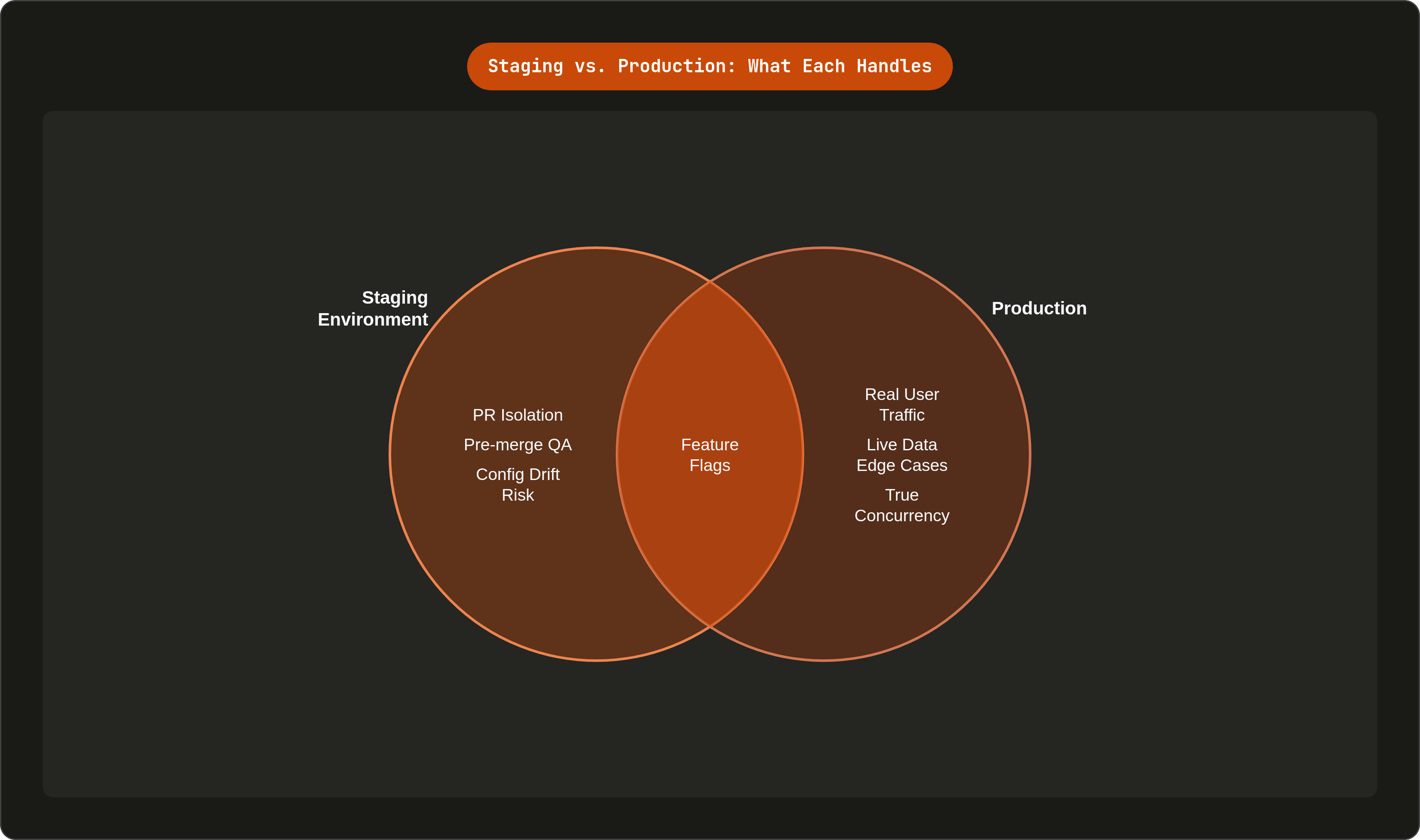
Every staging environment carries the time gap, the personnel gap, and the tools gap, by definition, because staging is, by design, not production. Production carries none of these gaps the same way. It's the one place where the traffic is real, the data is real, and third-party services respond the way they actually respond, error codes and all.
Post-deploy checks against production telemetry catch things staging structurally cannot catch: latency and throughput under real concurrency, error rates against real user input including the edge-case data shapes staging never saw, how downstream services behave under actual load, how storage providers respond when nobody's simulating them with a local emulator. Distributed tracing, log analysis, real-time metrics, these stopped being advanced practices reserved for big infrastructure teams a while ago. They're baseline now, because they're what catches the regressions staging let through.
Observability as code matters here too. Dashboards, alerts, and metrics that live in version control mean every deploy ships with telemetry already defined, instead of someone scrambling to wire up ad hoc monitoring after something has already broken. The question worth asking has shifted. It's no longer "how do we make staging look more like production," it's "how fast can we find out, after a deploy lands, whether production is actually behaving the way we expect."
CI passing is necessary, but it's not enough on its own, and every engineer who's shipped a green build straight into an incident already knows this in their gut. The distance between a green CI run and production reality is exactly where the three structural gaps, time, personnel, tools, keep living, untouched by any test suite.
How automated production verification changes the economics of shipping into a drifted environment
Here's a cost that rarely makes it into a planning meeting: engineering teams spend a large share of their time on operational work, incident response, running through runbooks, digging through logs by hand, instead of building things that compound the product's value. That time doesn't show up as a line item on any budget, but it's real, and it's expensive, and most engineering leaders only notice it when they finally sit down and track where a sprint actually went.
Alert noise is a direct result of shipping without automatic post-deploy checks. Without them, every threshold alert becomes a guess. Maybe it's the regression from this morning's deploy, maybe it's baseline noise the system always makes, and someone on call sorts it out by hand, every single time. That's less a discipline failure than a missing piece of tooling. Teams without automatic verification generate more alerts than teams with it, because they have no way to tell a deploy-caused regression from ordinary noise the moment the deploy happens.
The autonomous SRE model goes after this directly: systems built to catch a production regression, trace it back to a cause, and start responding, without a human having to open seven browser tabs and rebuild context from scratch in the middle of an outage. In practice, that looks like every pull request getting checked against real production telemetry after it ships, not just before it merges. Regressions get traced back to the specific deploy that caused them, automatically, and fix pull requests open on their own once a regression is confirmed, so incident response ends with a reviewed code change instead of a long Slack thread that fizzles out at 2 a.m. One Patch, an AI agent that verifies each PR against live production telemetry and autonomously opens fix PRs when a post-deploy regression surfaces, is one tool built around exactly this workflow.
OnePatch works this way. It sits between pull requests and the live production environment, checks every deploy against production telemetry, and opens fix PRs when something breaks, which is the kind of thing a staging environment, however well maintained, is structurally unable to do on its own. I'd flag that I'm biased toward this framing since it's the product I work on, but the underlying gap it's addressing is real regardless of which tool anyone picks to close it.
Tool consolidation matters here too, and not as a nice-to-have. Every extra tab an on-call engineer has to open during an outage is time coming straight out of the SLO budget. Platforms that combine telemetry correlation with fix initiation cut that cost in a way that's easy to measure. The pricing model matters more than it looks, as well. A vendor charging per incident resolved, instead of per seat, is incentivized to actually reduce how many incidents happen, not to sell more licenses.
A practical framework for where to invest in parity versus where to invest in verification
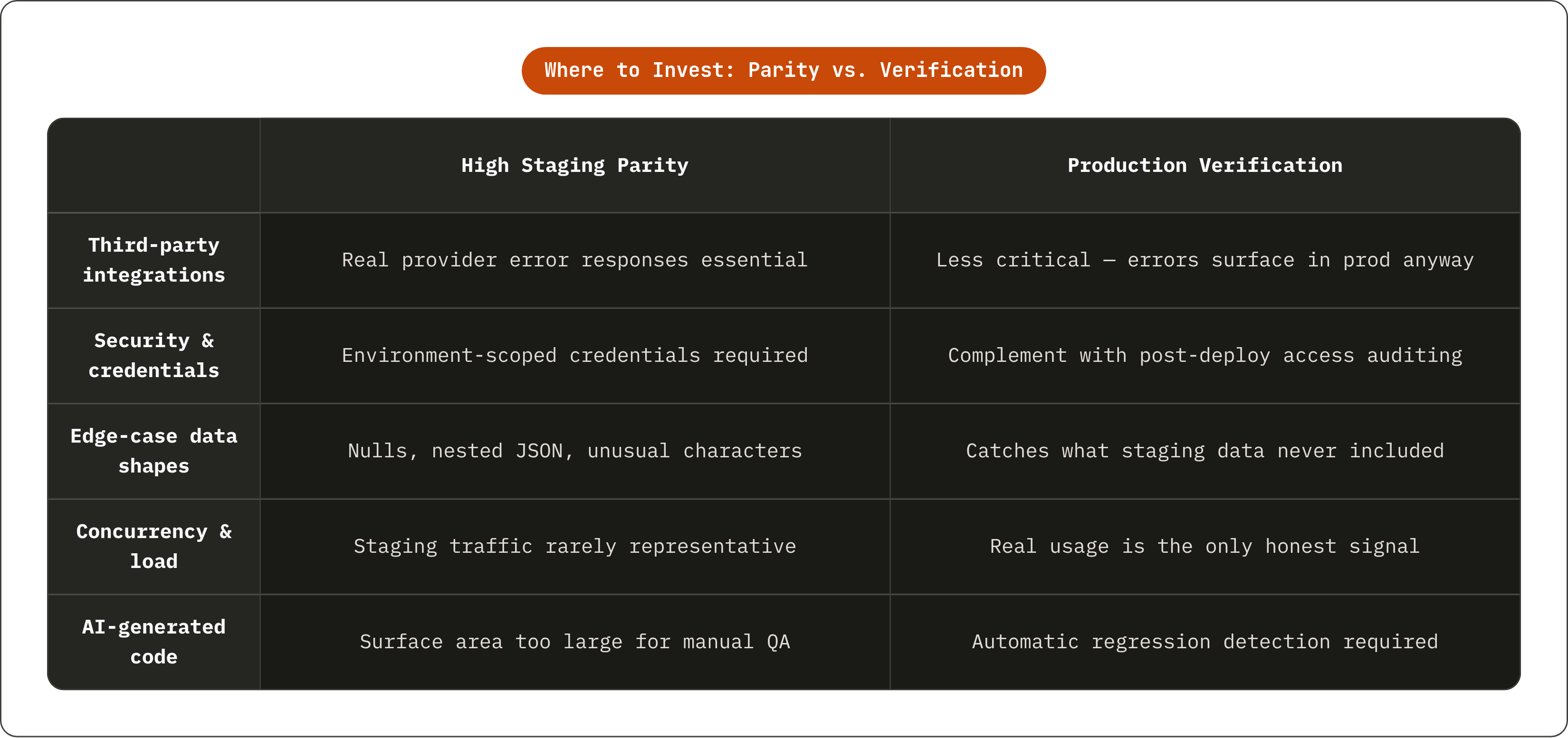
Not every parity gap deserves the same amount of engineering effort. The real question is which mismatches are likely to cause a production failure and which ones a team can safely live with, and most teams never sit down and actually sort their gaps into those two buckets.
High staging parity earns its cost in a handful of specific spots. Third-party integrations belong here, especially storage and payment providers, where a real provider's error responses look nothing like an emulator's. Security controls and credential scoping belong here too, since environment-specific credentials with distinct permission levels aren't optional. So do known edge-case data shapes: nulls, oversized nested structures, unusual character sets that will eventually show up in production whether staging accounted for them or not.
Production verification is the more honest place to put the investment elsewhere. Concurrency and load behavior belong there, since staging traffic is almost never a fair stand-in for real usage. Post-deploy regression detection belongs there too, for any failure mode that only shows up once real users start behaving like real users. AI-generated code shipped at agent speed belongs there as well; the surface area is simply too large for manual staging QA to cover with any reliability.
Instrumentation connects the two sides, and it's the part teams skip most often because it feels like overhead until the moment it isn't. Checking that telemetry output is valid before code even deploys, pre-merge instrumentation testing in other words, is what makes automatic production verification possible in the first place. A team that ships code without metrics and traces defined up front has no way to check production behavior automatically after the fact. It's stuck back at manual investigation, which is exactly the cost this whole approach exists to cut out.
None of this makes staging obsolete, and nobody serious is arguing it should be torn down. It just stops pretending staging can do a job it was never built to finish. The gap it leaves behind is production's to close, and telemetry is how you close it without waiting for a user to file the bug report first.