Why CI Passing Is Not a Deployment Safety Signal
Pre-merge testing catches regressions, not production reality.
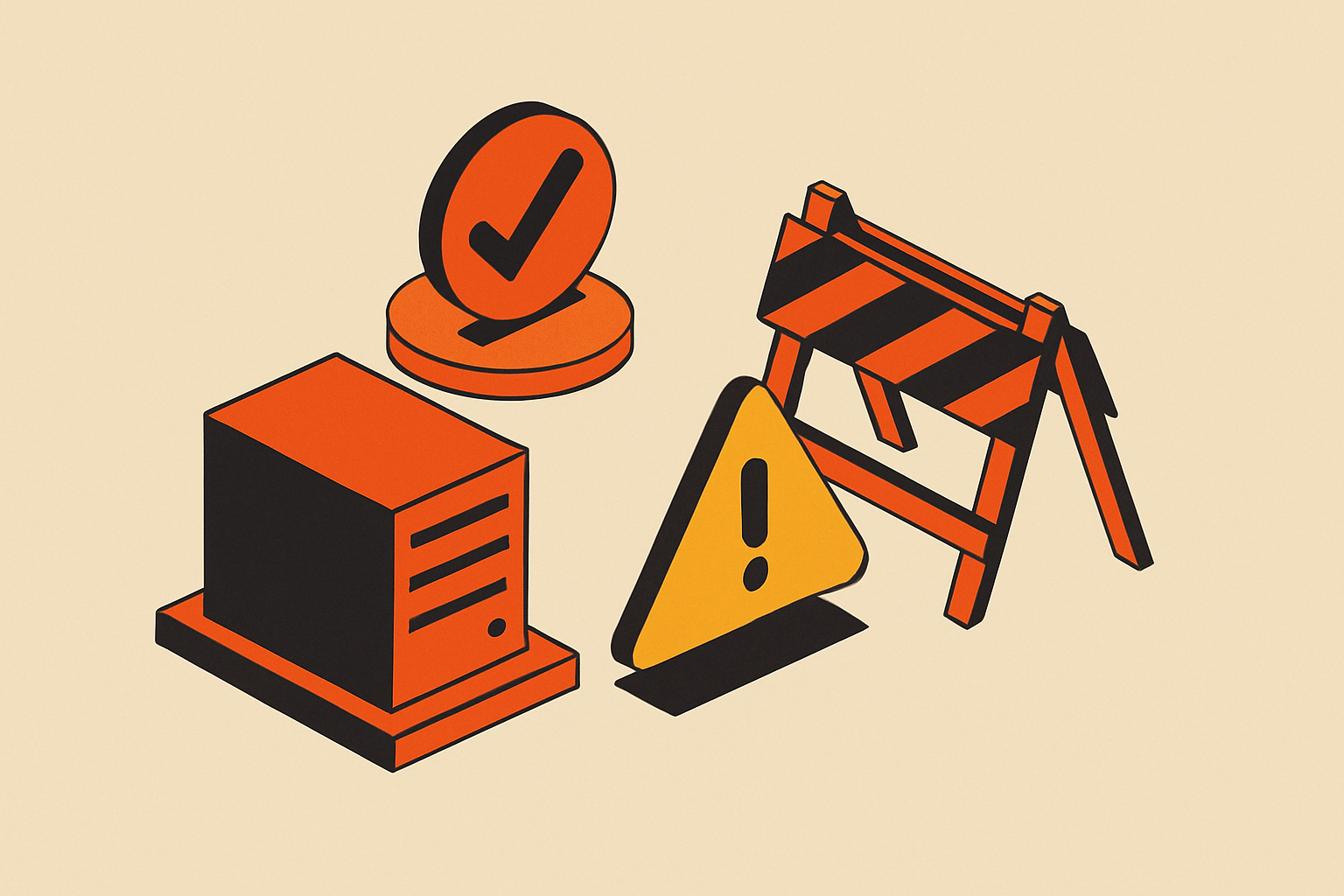
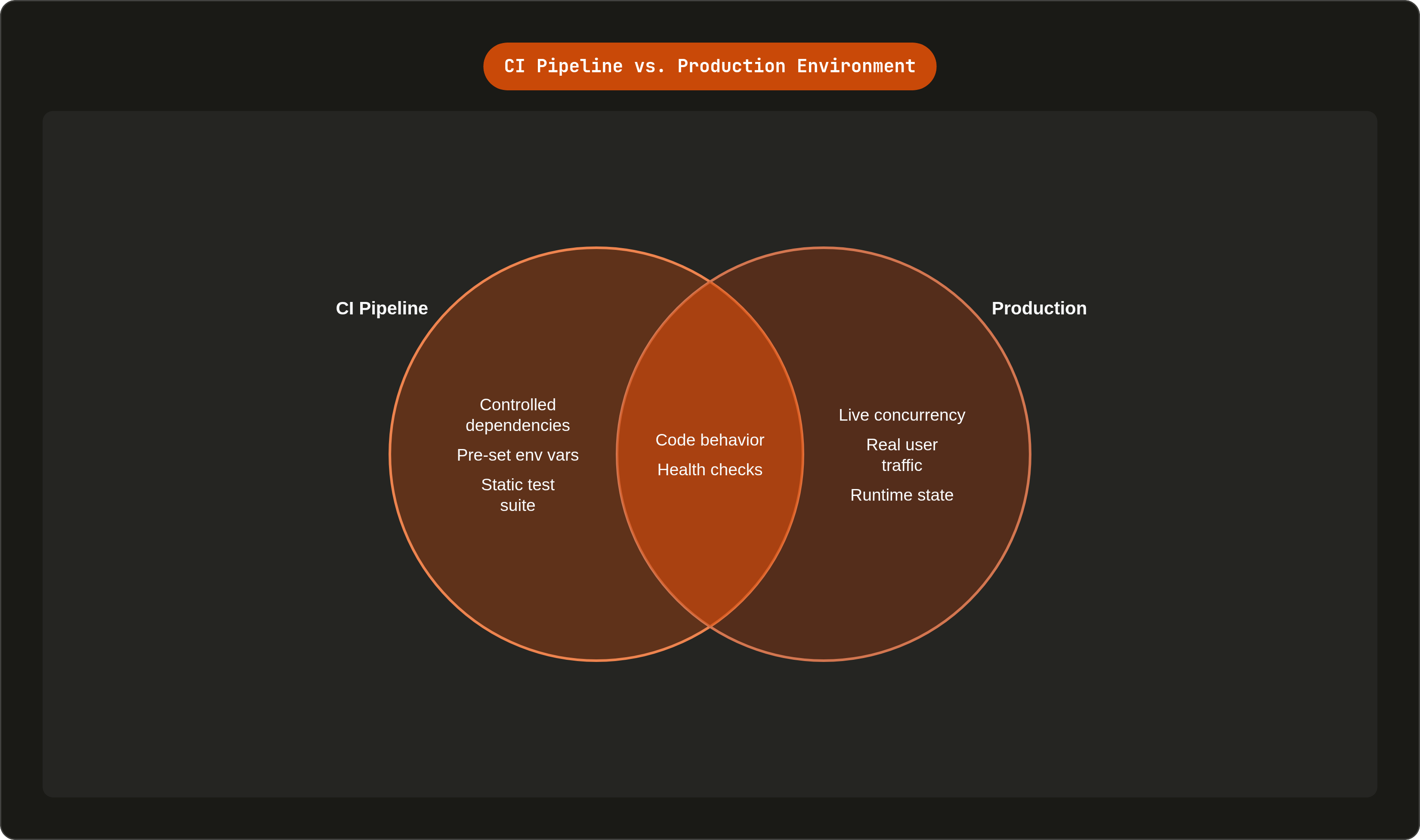
CI passing means the code did what the test suite expected, in a snapshot environment with no live traffic. Whether the code is safe to run in production is a separate question. Most deployment incidents trace back to a team quietly treating those two things as one claim.
CI answers a narrow question: given this exact set of dependencies, these pre-set environment variables, and zero real users touching anything, does the code behave as the test suite predicted? That's genuinely useful. It catches regressions against known cases, enforces type contracts, and keeps broken code out of the main branch. Nobody worth listening to argues CI is a waste of time.
The trouble starts with what happens after that check turns green. "Did the code pass tests" and "is the code safe in production" are different questions, and the merge button quietly answers both with the same checkmark. The rest of this piece is about where that shortcut breaks down.
Why the gap between a controlled pipeline and a live system is not closable with more tests
Production carries live state, real concurrency, and dependencies that behave differently under load than they do in staging. No amount of extra pre-merge testing touches that fact, because the fact isn't about test coverage. What matters instead is what a test environment fundamentally is.
Take a real production database: years of schema migrations, half-finished writes, and edge-case records nobody ever wrote a fixture to represent. Live traffic creates race conditions and resource contention a single-threaded test run will never hit, since nothing in a test harness is actually competing with anything else for a lock or a connection slot. Third-party APIs behave differently under real load, too. A payment processor that answers in 40ms against your staging mock might take 800ms at 2pm on a Tuesday when real volume hits it, and that gap alone can cascade into timeouts nobody thought to test for.
The same handful of failure modes keep showing up: environment variables set in the pipeline but missing or wrong in the live environment, dependency versions pinned in CI that resolve to something different once deployed, health checks that pass clean in staging and then fail the second real traffic patterns hit them, and configuration changes made straight in production, outside the pipeline entirely, that no CI run will ever see, because no CI run was ever pointed at them.
Research on large industrial CI/CD pipelines backs this up: pre-merge checks actually fail more often than post-merge checks do — at a 5:3 ratio — and post-merge failures tend to stick around. Once one shows up, it tends to persist until an actual fix propagates through the system rather than clearing on its own. That stickiness means a single post-merge failure costs more than its raw count suggests. So teams end up in a strange spot, pouring most of their testing effort into the phase where failures are cheap, while the phase where failures are expensive gets comparatively little structured verification at all.
Adding more tests before merge shifts that cost curve a little, but the underlying problem stays put. No test suite, however thorough, can predict the exact runtime state of production at the moment a deploy lands. The only source of ground truth is what production actually does once the code is running inside it. CI is a necessary filter, useful within a narrow, well-defined scope that stops well short of production behavior.
How overreliance on CI as a safety signal manufactures alert noise after the merge
Once a green CI run gets treated as deployment clearance, the actual work of catching failures gets pushed downstream, onto whatever alerting exists after the fact. And that produces a predictable pattern: alerting gets tuned to catch everything, because nothing upstream is catching anything at all.
Here's what that looks like on the ground. A CPU spike in one microservice cascades outward, triggering latency warnings, database connection errors, and timeout alerts across every service that depends on it, so one root cause turns into two dozen pages inside twenty minutes. On-call engineers field a heavy volume of alerts every week, and only a small slice of them need any real action. The rest is threshold noise: flapping signals, alerts that resolve on their own before anyone's even opened a dashboard.
The cost isn't just wasted attention, though that's bad enough by itself. The deeper cost is trained inattention. Engineers learn, reasonably, to tune out alerts as a survival strategy, and then they miss the one that actually mattered because it looked exactly like the ninety before it that didn't.
A 2025 Catchpoint survey of site reliability engineers found on-call burnout and attrition running at rates the industry hadn't seen in years, with operational toil rising for the first time in a while, even as spending on AI tooling climbed at the same time. Tooling spend went up. Toil climbed right alongside it. The noise problem traces back to a verification gap left open at the deploy boundary, separate from any failure of discipline among on-call engineers. Tuning alert thresholds treats a symptom; closing the gap upstream treats the cause.
What AI-generated code at agent speed does to this already-fragile model
AI coding tools have pushed up how much code gets merged per engineer per day, and code generation started outrunning review capacity before the pipeline had any real chance to adjust.
That mismatch shows up one of two ways. Either review gets rushed and change failure rate climbs, often with enough delay that a given regression is hard to trace back to the PR that caused it. Or lead time balloons because reviewers are drowning in volume, and the pipeline slows down even as generation keeps speeding up. DORA's research on this points the same direction each time: higher AI adoption correlates with more delivery instability, even in cases where the individual code itself got better. The bottleneck shifted position rather than disappearing.
Agentic systems bring failure modes CI was never built to catch. An agent chaining calls across several APIs can pass every isolated unit test and still produce something harmful once it's actually running, because the harm lives in the sequence of calls, not in any single one of them. Safety-critical behavior in agentic code comes out of planning, memory, and policy interactions, none of which a linter or a static test suite is positioned to look at. Security research, including the "IDEsaster" project published in late 2025, documented real vulnerabilities in AI coding platforms allowing silent data exfiltration, the kind of behavior with no signature a test suite would ever flag, because nothing in the suite was looking for it in the first place.
Most organizations now report having hit risky agent behavior in production: improper data exposure, unauthorized system access, none of it caught anywhere in the pre-merge pipeline. Gartner projects a large share of enterprise applications will embed task-specific AI agents within two years, up from almost nothing today. This is a present condition, already sitting inside production systems right now.
There's a visibility problem underneath all of this, too. Distributed tracing can show what an agent did, step by step. It can't yet show why the model picked that particular sequence of actions over another. Post-deploy observation has to cover two separate things, then: telemetry, and behavioral audit. At the speed agent-generated code ships, the window between merge and real-world impact is shorter than a human review cycle can realistically cover. Automated post-deploy verification stops being optional at that point. It becomes the only mechanism left fast enough to keep up.
What post-deploy verification actually has to cover to be a real safety signal
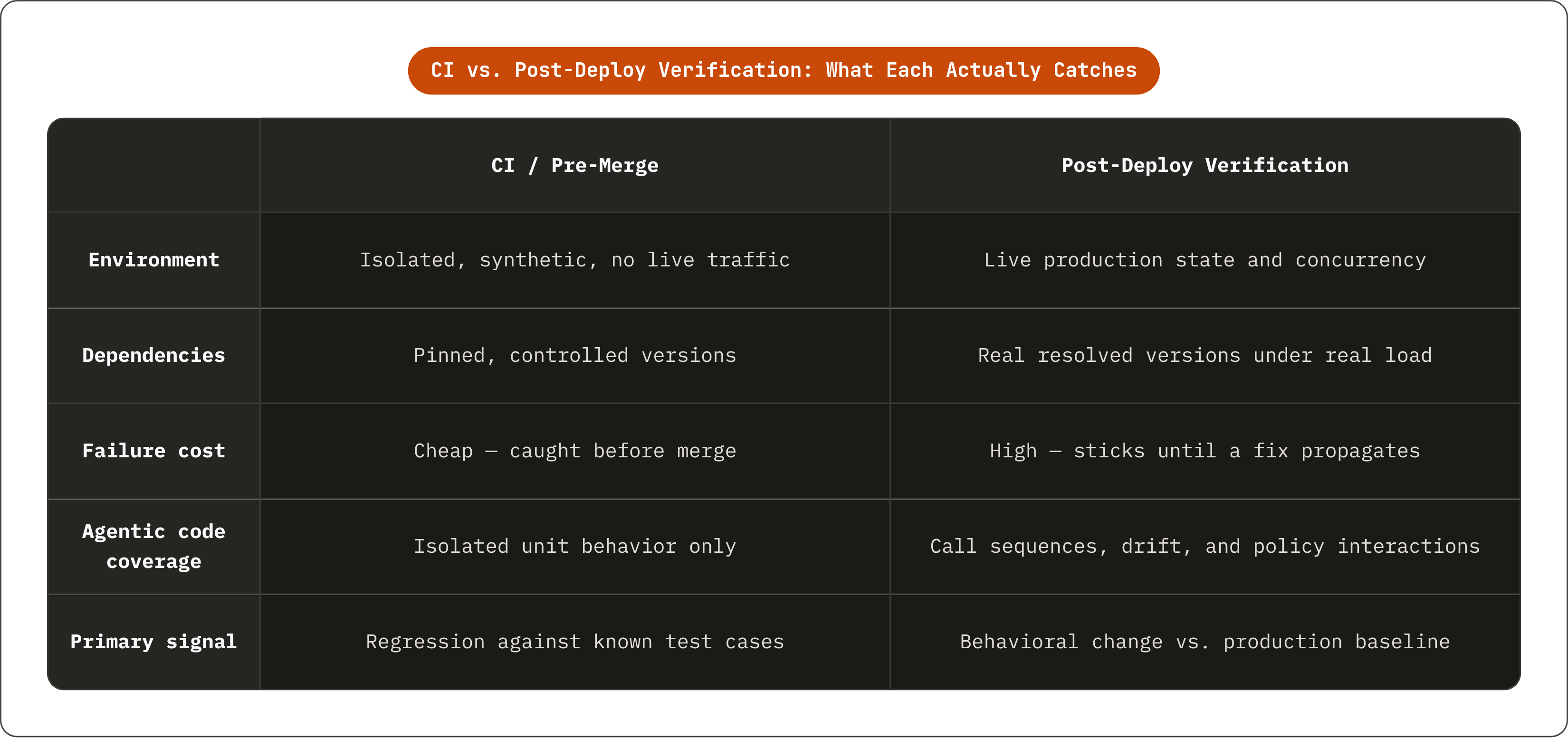
Verification after the merge serves a different purpose than monitoring. Monitoring watches for known bad states, things someone already decided were worth an alert. Verification asks something else entirely: did this specific deploy behave the way it should, given what production actually looked like the moment it landed?
Real verification runs in layers, and each layer catches something the others miss. Smoke tests and health checks are the cheap first pass, confirming the service starts and the main user path completes; fast, useful, and not a substitute for anything deeper. Real telemetry comparison comes next: baseline error rate, p95 and p99 latency, and saturation before the deploy, then the same signals checked again right after. The question isn't whether errors crossed some fixed line. It's whether errors moved the moment this particular change shipped.
Log-based regression detection scans automatically for new error classes: a spike in a specific set of 5xx codes, or an exception type that's never shown up before. Synthetic monitoring runs scripted user journeys against live production endpoints, exercising end-to-end flows that unit tests never touch, because unit tests, by design, don't touch anything end to end. Canary analysis routes a small slice of live traffic to the new version and checks its behavior against the stable baseline before the rollout widens; often it's the only way to catch a regression that only shows up under real concurrency. Feature flag gating separates the deploy itself from user exposure, so behavior gets checked at low exposure before it expands, and, just as important, the team keeps the ability to shut it off without a full rollback.
For AI-generated and agentic code, add prompt-completion linkage tracing, so someone can check what the agent was actually asked against what it did. Add token and tool-call accounting to catch runaway behavior early, plus automated evals comparing the agent's output distribution before and after a change, since agent drift rarely announces itself the way a crashed process does.
None of this works bolted on after an incident already happened. Instrumentation has to ship with the code, which means observability belongs in the PR review checklist, not the post-mortem template written three days later. Companies running structured observability programs report faster incident resolution and better uptime as a direct result of systematic post-deploy coverage, regardless of which specific tool sits on top of the data.
Why incident response stays slow when the verification gap is upstream
When something breaks, engineers face two jobs at once: figure out what changed, and figure out what that change actually did. If verification never happened at deploy time, both jobs start from zero, under pressure, at the worst possible moment to be starting from zero.
Without a baseline captured at deploy time, engineers have to reconstruct what "normal" looked like from historical data while the incident is actively burning. Without deploy-linked telemetry, tying the incident back to a specific PR turns into manual work, which in practice means someone scrolling through the last dozen merges and reasoning backward from a hunch. Without automated context attached to the alert itself, the on-call engineer opens a dashboard, then a log tool, then a deploy history, trying to piece together a timeline that should have already existed before the page went out.
That manual digging, the part where someone's chasing symptoms across five open tabs, eats up most of MTTR in enterprise incidents. Figuring out what to fix takes longer than actually fixing it.
Teams piloting AI-driven triage that surfaces deploy context and correlated signals the moment an incident opens are seeing MTTR drop hard, mostly by collapsing that investigation phase down to almost nothing. Tool sprawl makes the underlying problem worse, too: every extra dashboard an on-call engineer has to open mid-incident is time the SLO burns while they hunt for the thing that broke.
The shape this should take is simple to say, harder to build: the system catches the regression, ties it to the deploy that caused it, and opens a fix PR with that context already attached, so the engineer reviews and approves instead of starting an investigation cold. Platforms oriented toward that model sit between the PR and production to automate the part manual review was never going to keep pace with anyway, and One Patch, an AI agent that verifies every pull request against live production telemetry and opens fix PRs when it detects a regression, is one concrete example of that approach.
What teams must change about their deploy process, not just their tooling stack
The gap between CI confidence and production safety is structural. Structural doesn't mean permanent, though; it closes with deliberate changes at the deploy boundary, fixing the actual broken handoff instead of stacking another dashboard on top of it.
Treat the deploy window as its own verification phase, not a handoff from CI, and put a name on who owns post-deploy signal review for every production change. Define what "verified" actually means before the PR merges: which telemetry signals, over what comparison window, count as acceptance for that specific change, written into the PR description instead of left as tribal knowledge somebody has to ask around for. Wire canary and feature flag rollouts to automatic halt conditions, so when post-deploy telemetry drifts past a set threshold, the rollout stops itself instead of waiting on a person to notice. Instrument before shipping rather than after breaking: any PR introducing a new code path should carry the metrics, logs, and traces needed to check it once it's live, and code review should actually check for that. Close the loop between deploy and incident, so when something breaks, the recent deploys, the engineer who owns them, and the actual diff surface automatically instead of someone correlating it all by hand under pressure.
Teams shipping AI-generated code at scale need one more layer on top of all this. Require automated behavioral evals on every deploy touching an agent, not just the standard functional suite, and gate any expansion of agentic features behind an explicit post-deploy verification window. Stop treating agent-generated PRs the same as human-reviewed ones when it comes to rollout speed; their failure modes are different, and the rollout process should say so.
The underlying point holds no matter the company's size or stack: merging a PR and verifying it are two separate acts. Teams that treat the merge as the finish line will keep rediscovering, incident after incident, that production is where the real test runs. OnePatch and platforms built around this same model automate that post-deploy loop directly, checking real telemetry against what the deploy was supposed to do, catching regressions before a human gets paged, and opening fix PRs with the context already attached, so engineers spend their on-call hours deciding instead of digging.
The math here isn't complicated. Building post-deploy verification costs engineering hours every quarter. Skipping it costs incident hours, SLOs burned past recovery, and, eventually, good on-call engineers who leave because the toil wore them down. One of those is a line item you can plan around, and the other is a slow bleed you only notice once your best people are already gone.