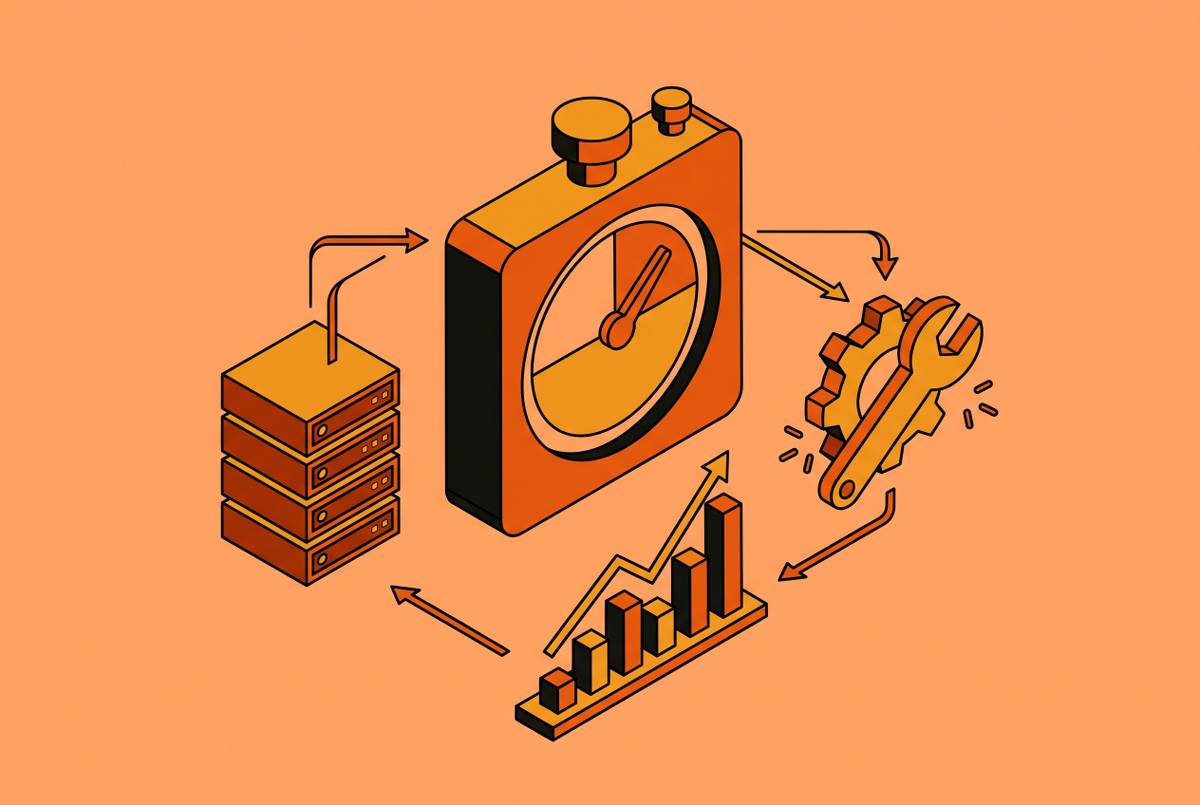
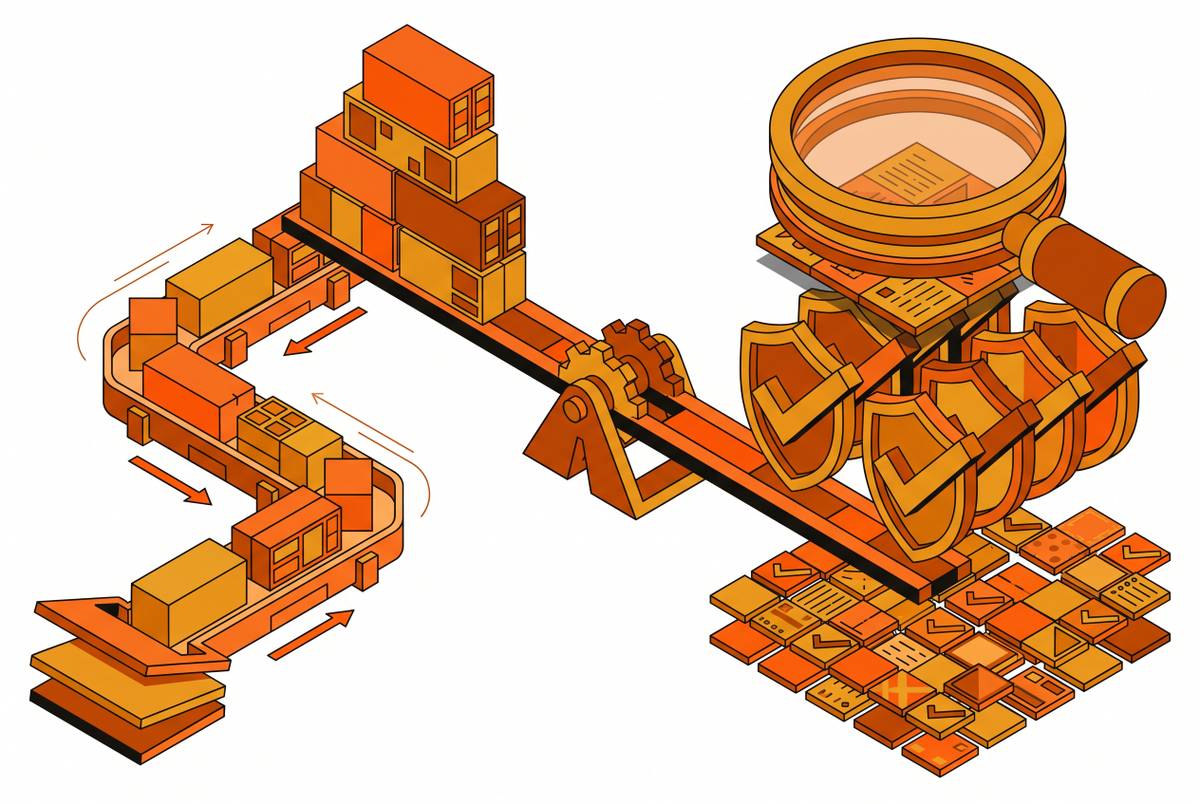
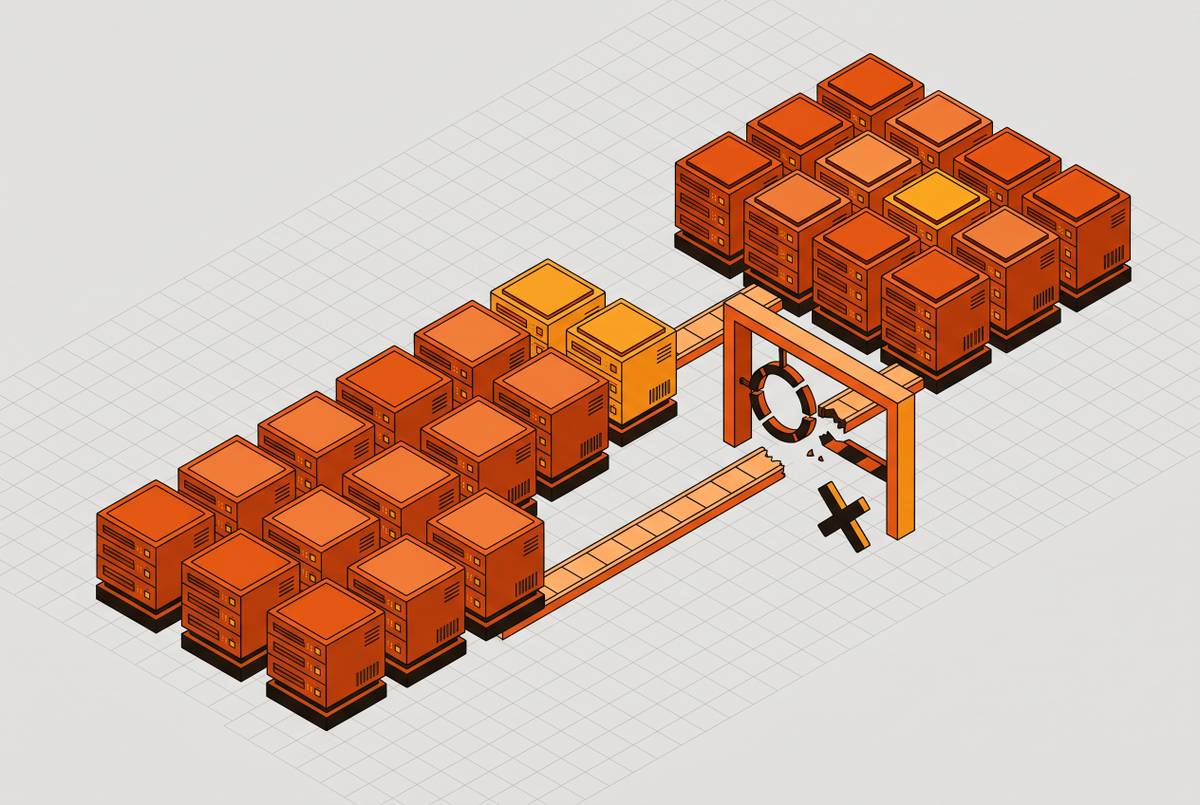
Production Verification Gates in a GitHub Actions Workflow
Catch production failures that staging never surfaces by gating deploys on real-world verification.
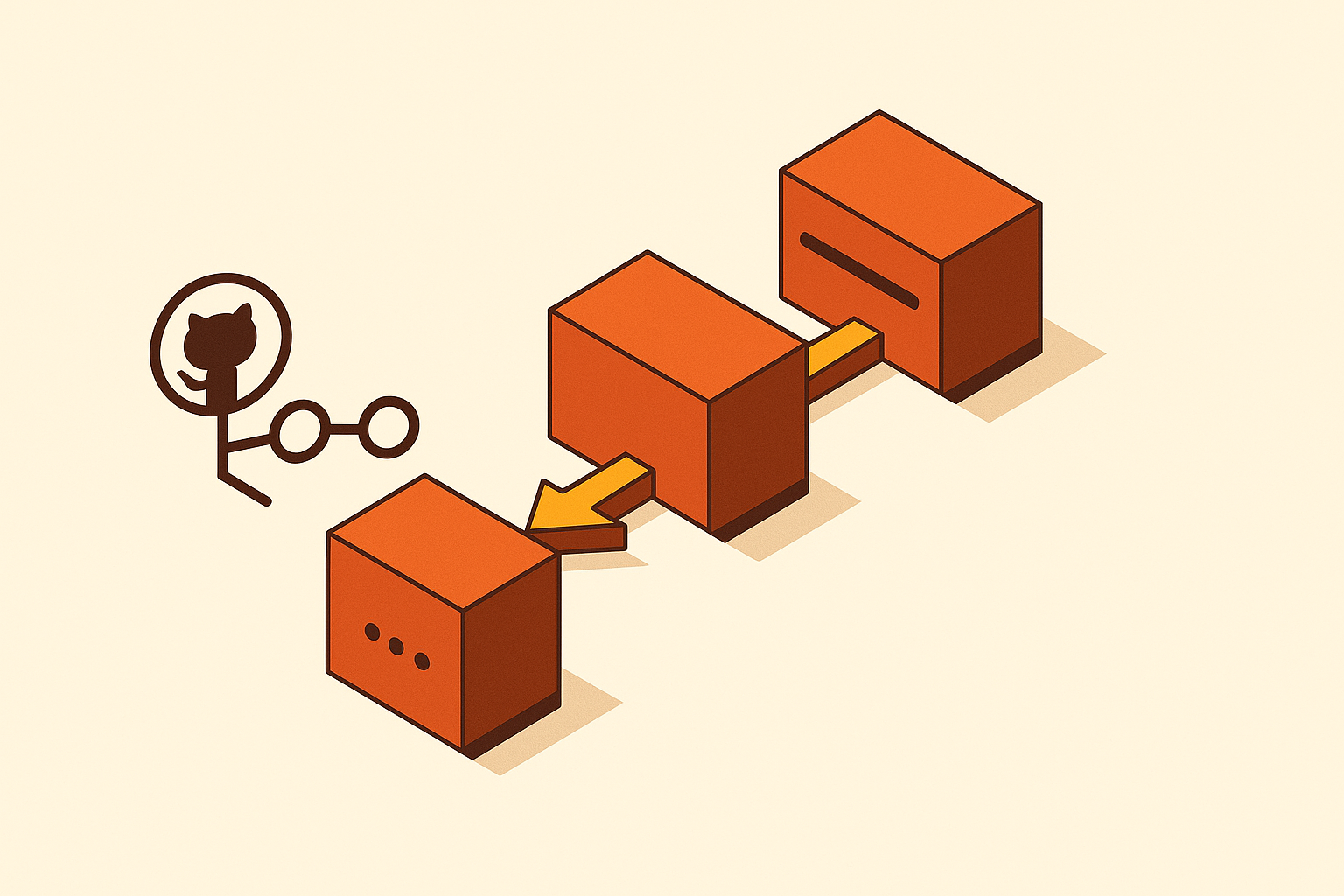
Most GitHub Actions pipelines stop watching the second the deploy command exits zero. A docker push or a clean kubectl apply tells you the release process ran; it says nothing about whether the code behaves once real users and real data hit it. This piece walks through building a gate sequence that covers both halves of the problem: the pre-deploy structure GitHub already hands you, and the post-deploy verification layer most teams skip entirely.
A post-deploy verification gate runs as a job in the same workflow, after the kubectl apply exits, and targets the production environment so that any failure there fails the pipeline itself. The pattern is to add a verification job that depends on the deploy job, hits a real production endpoint or runs a probe against the live cluster, and asserts on latency and error-rate thresholds that staging traffic levels never stress-test. If those assertions fail, the gate fails the run and the team has an actionable signal tied to the same commit SHA and deployment context, not a silence that implies success. GitHub Environments also allow scoping post-deploy secrets and variables to that gate job, so the verification step can reach internal observability APIs or load-balanced endpoints that a staging job cannot touch.
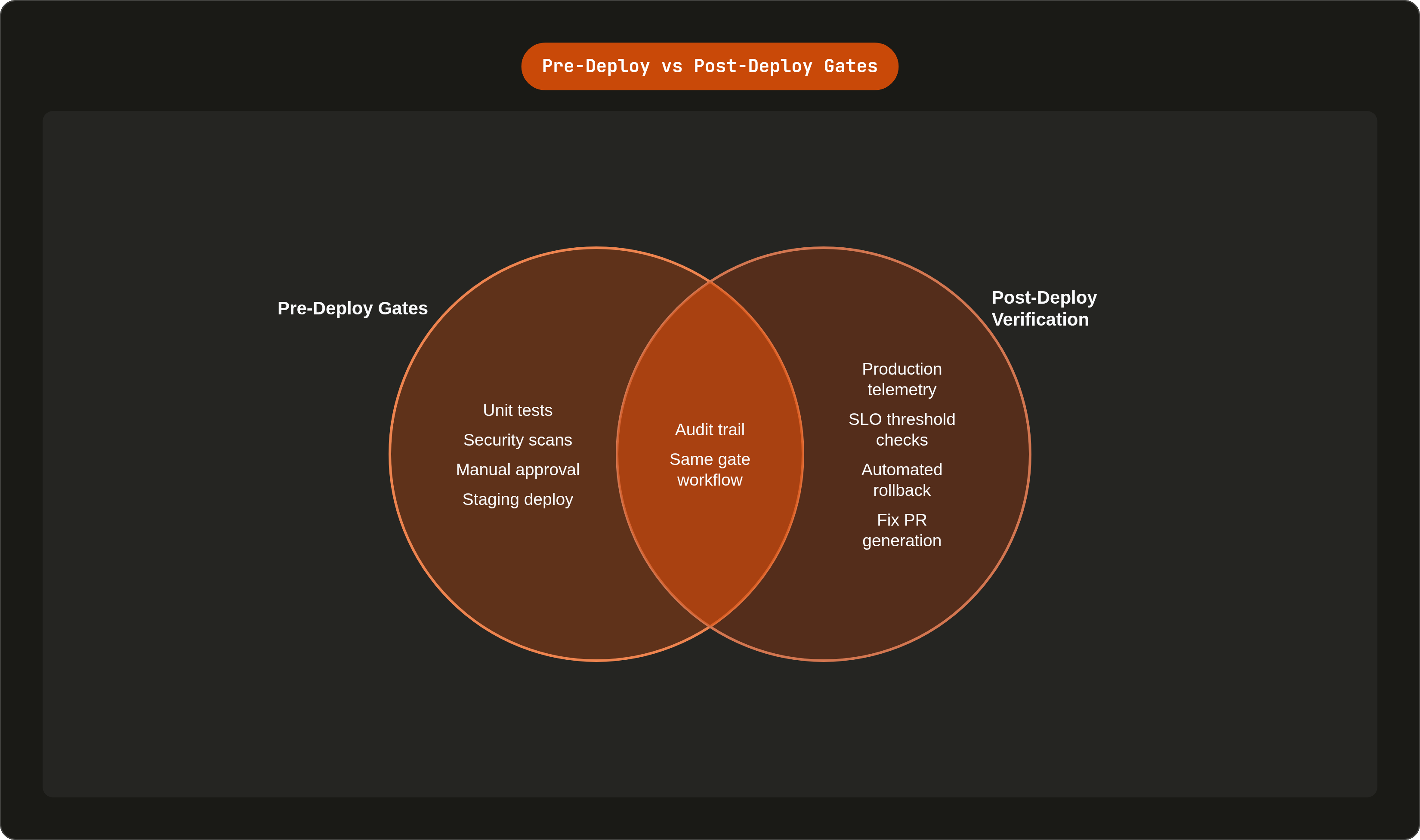
Pre-deploy gates, whatever shape they take, unit tests, security scans, a manager clicking approve, all operate on code sitting in isolation. None of them can see how that code holds up under production traffic, against production data, talking to dependencies that behave differently at 2pm on a Tuesday than they do in staging at 3am. Production is the only place all those variables show up together. That's where latency regressions under load live, where a bug hitting one user segment finally surfaces, where a failure tied to some piece of infrastructure state staging never bothered to replicate shows its face.
The gap is widening, not closing. AI-assisted development is shrinking the time between a commit and its arrival in production, which means fewer human eyes look at the diff before it ships. A workflow that ends at deploy was already incomplete. Now it's incomplete and moving faster.
How do I add post-deploy verification gates to catch latency regressions and runtime failures that staging never surfaces?
A GitHub Environment is a named object carrying three things: secrets scoped to that environment, environment variables, and protection rules. The secrets piece matters more than it sounds. A production API key is structurally unreachable by a workflow job until that job targets the environment and clears whatever protection rules sit on it. There's no code path around this. The key doesn't exist in the job's context until approval happens, full stop.
GitHub ships three native protection rule types. Required reviewers pause the workflow and wait for someone on a named list to click Approve before the deploy job starts. Wait timers add a configurable delay even after approval clears, useful for respecting a change freeze or giving an automated pre-check a few extra minutes to finish. Self-review prevention stops whoever kicked off the deploy from also being the one who approves it; it's a toggle in the environment settings, off by default, and it matters if your team has any separation-of-duties requirement written down anywhere.
One thing worth knowing before you build around this: on private repositories, GitHub's Free plan supports the environment object itself but not required reviewers or wait timers. Hit that wall on a private repo and you either upgrade or build approval through some other mechanism, because the native gate simply isn't there at that tier.
Put the pieces together and you get a pipeline shaped roughly like this: commit, build, test, security scan, dev deploy (automatic), staging deploy (automatic), integration test, production approval gate, production deploy, then the post-deploy verification covered below. The design principle underneath it is plain. Automate every stage that doesn't need a human judgment call, and save the manual gate for the one boundary where the risk is highest: the moment code starts serving real users.
One note on emergencies. Emergency fixes are the moment teams get tempted to disable protection rules "just this once," and that's exactly the wrong move. Keep a separate, narrowly scoped emergency workflow with its own stricter reviewer list and its own audit trail. A standing bypass, even one nobody plans to use twice, is a permanent hole in the gate.
Wiring the pre-deploy gate into a real workflow file
The line doing the actual work is environment: on a job. That one line ties the job to the named environment and switches on whatever protection rules are attached to it, and everything downstream depends on that single declaration.
A minimal skeleton looks like this: a deploy-production job declares environment: production and lists needs: pointing at the staging deploy job and the integration test job. Secrets get referenced inside the job body as ${{ secrets.PRODAPIKEY }}, and GitHub only resolves that reference once the gate has actually cleared, not before. Add a concurrency: group at the workflow level too, so two deploys can't race each other through the same gate at once. Skip it, and you can end up with two approved runs both trying to promote at the same time, which is its own kind of mess.
In the Actions UI, a blocked run shows up as "Waiting for review," with a countdown if a wait timer is configured. Reviewers get an email and see an inline Approve/Reject dialog right in the run. Reject it, and the deploy job gets skipped, the environment shows as failed, and the artifact never gets touched. No rollback needed there, since nothing was ever promoted in the first place.
Rollback only matters once a bad deploy actually clears the gate. When that happens, you trigger the same promote workflow again, pointed at the last known-good tag. The gate fires again, someone approves again, and the same immutable artifact that worked last time redeploys. You don't need a separate rollback workflow. You need the same gate, run a second time, against an older tag.
None of this tells you whether the code that just landed actually works. That's a different question, and it needs a different job.
The post-deploy verification job and why it must be in the same workflow
Add a verify-production job with needs: deploy-production, and it runs the moment the deploy job finishes, still inside the same workflow run rather than off in some separate process somebody has to remember to check. Keeping it in-workflow matters for two reasons.
First, the run itself doesn't close green until verification passes. A failed verify step marks the whole workflow as failed, and that failure shows up in PR checks, in deployment history, in audit logs, everywhere a green checkmark would otherwise sit. Second, all the context, which commit, which PR, which reviewer approved it, stays in one place instead of scattering across a deploy log here and a monitoring tool there.
The verify job does four things in sequence. It waits a short stabilization window, long enough for traffic to actually shift onto the new version. It queries production telemetry: error rate, latency percentiles, whatever business-critical health endpoint applies. It checks those numbers against defined thresholds, and this part matters: against production SLOs, not against whatever baseline staging happened to produce. Breach a threshold, and the job fails and kicks off a rollback step. If health checks out, the job succeeds and the run closes.
Teams running canary deploys get a slightly richer version: deploy to a small slice of traffic first, run the verify job against just that slice, then promote to full traffic and run a second verify job. Either failure, canary or full rollout, triggers rollback, and the logic doesn't change. It just runs twice.
Production telemetry is the only ground truth available here. CI tests run against mocked or isolated dependencies by design; only live traffic tells you whether the integration actually holds up. With this structure in place, "closed green" means something concrete: the PR merged, the gate approved, the deploy succeeded, and production got independently confirmed healthy by querying real signals, not assumed healthy because a command happened to exit zero.
Choosing what to query in the verify step
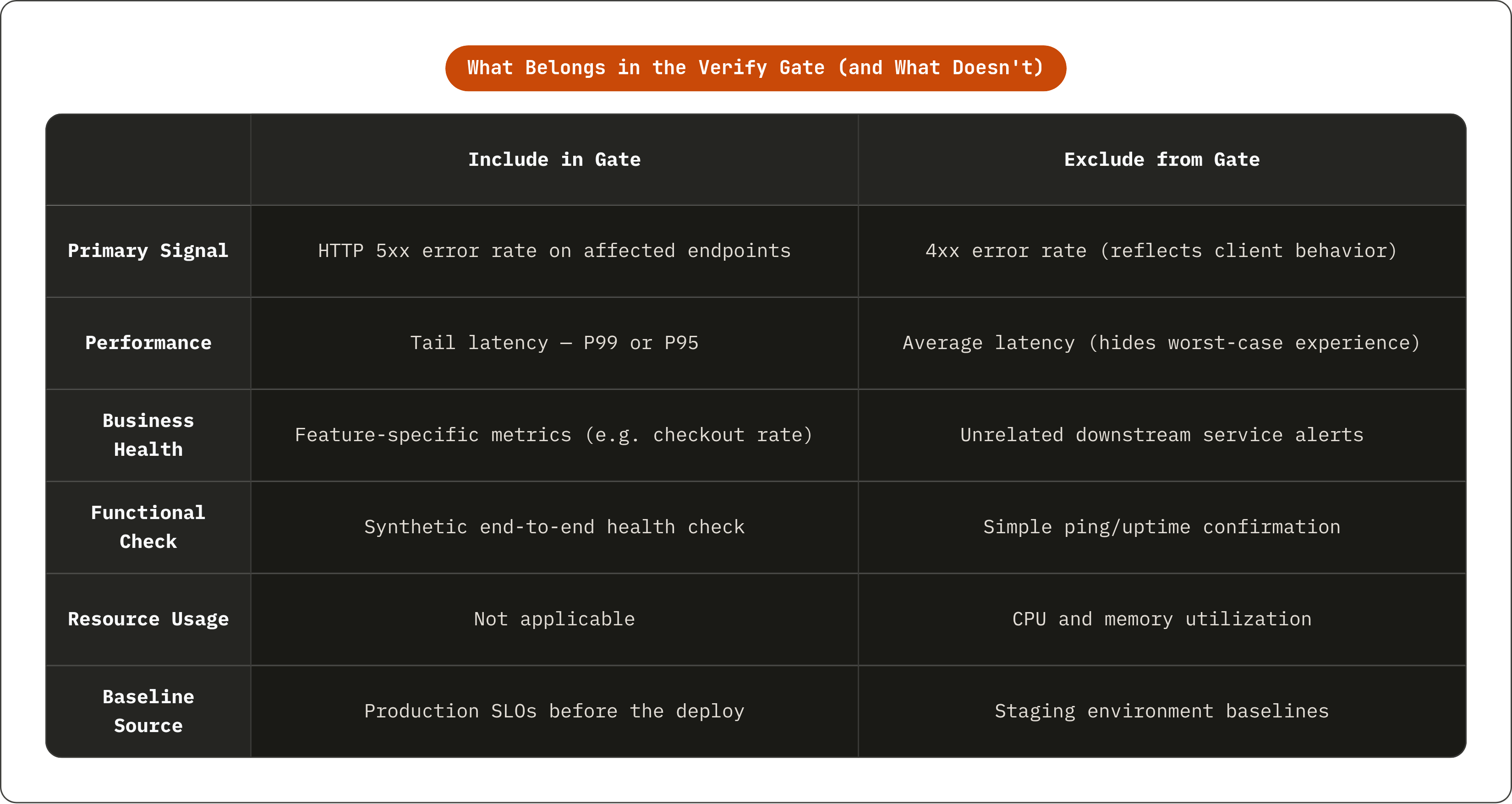
Query signals directly visible to users and tied to an SLO. Everything else is noise dressed up as a metric.
The list that actually belongs in a verify gate isn't long. HTTP error rate on the affected endpoints, specifically the 5xx rate, since 4xx errors usually reflect client behavior rather than something the deploy broke. Latency at the tail, P99 or P95, since averages hide exactly the worst-case experience you're trying to catch. Custom business metrics tied to whatever the deploy touched: checkout completion rate, if the deploy touched checkout. Synthetic health checks that exercise the new code path end to end, not just a ping confirming the server is up.
CPU and memory utilization don't belong in this gate. They correlate with load, not with whether the code is correct, and putting them in a pass/fail check just invites false failures on a busy but healthy day. Alerts from downstream services that weren't part of the deploy don't belong here either; those go on a broader dashboard, not in a binary check tied to this specific release.
Thresholds should come from your own production baselines before the deploy, never from staging. A threshold firing on perfectly healthy traffic does the same damage as one that misses a real regression: it teaches engineers to stop trusting the gate. Lose that trust, and people start clicking past red checks, and the gate turns into decoration. It's the alert fatigue problem in miniature, and a binary pass/fail workflow step is actually good at enforcing the discipline a dashboard can't manage on its own. It has to stay quiet when things are fine and loud when they aren't, nothing in between. Version-control the metric queries and threshold definitions alongside the workflow file, so they're reviewable in a pull request the same way code is. That's what keeps this honest across every environment instead of drifting team by team.
Handling failure in the verify job without creating a new source of toil
Picture the bad version first. The verify job fails, an alert fires, an engineer gets paged at some inconvenient hour, and they burn twenty minutes just figuring out which deploy caused the alert before they can even start fixing anything. That's toil, not progress, and it's exactly the pattern a good gate is supposed to kill.
The better version looks different. The verify job fails, the workflow automatically triggers a rollback using the last known-good tag through the same gate, and a fix PR opens with the failure context already attached: the failing metric, the commit, the telemetry snapshot. The engineer reviews and approves, and doesn't start from a blank page. Teams leaning on broad monitoring alerts without this kind of routing tend to drown in noise, where only a sliver of pages turn out to need real action. A verify job wired directly to the triggering deploy short-circuits that noise, because the alert already knows what caused it.
Building this takes a few concrete pieces. The last known-good tag has to live somewhere durable: an environment variable, artifact metadata, or a dedicated GitHub environment variable that updates on every successful verify. The rollback step runs conditionally on failure() inside the verify job. And the rollback deploy goes through the exact same environment gate as any other deploy, no bypass, full audit trail, same reviewers.
There's a layer worth stacking on top of this. Tools that correlate workflow logs with the commit that triggered them and produce a root-cause summary cut down the time an engineer spends reconstructing what happened. Some tools take a similar approach: they verify each PR against live production telemetry after deploy and open a fix PR automatically when something regresses. The GitHub Marketplace has actions built for exactly this purpose, GitHub Actions Failure Analysis being one, and the effect is that the "what broke and why" work starts the moment the job fails instead of waiting on a human to open a terminal. OnePatch works this way: it sits between the PR and production, queries telemetry after every deploy on its own, and opens a fix PR the moment verification fails. The gate and the response become one step instead of a script somebody on the team has to babysit forever. A failed verify job should land a fix PR in someone's review queue. No midnight war-room thread required.
Security considerations specific to the gate layer in agentic and AI-assisted workflows
AI-assisted development is compressing the time from commit to production, and pull request volume at organizations using AI coding tools has roughly doubled. Every one of those extra PRs still needs a gate that checks real production health, past a CI run that only passed against synthetic inputs. DORA's research on this is worth stating plainly: AI raises individual developer output, but it's also been tied to worse delivery stability, higher change failure rates, and more rework after a deploy, even as velocity climbs. Automated post-deploy gates answer that exact tradeoff directly.
Agentic workflows add a new attack surface at the gate layer itself. When an AI agent runs inside GitHub Actions with access to privileged tools, untrusted text sitting in an issue title, a PR description, or a commit message can get interpolated straight into the agent's prompt. The attack path is easy to describe: malicious content in a PR description gets read by the agent, the agent acts on it, the agent calls a privileged tool it has access to, and secrets walk out the door. The fix is to treat anything from outside the repo, issue bodies, PR titles from a fork, commit messages from an outside contributor, as untrusted, and never let it get interpolated directly into a shell command or an agent prompt.
Hardcoded secrets are a related and growing problem. The number of secrets accidentally committed to public GitHub repos has climbed substantially year over year, and credentials for AI services are among the fastest-growing categories in that pile. A verify job checking production health after the fact doesn't substitute for pre-merge secret scanning; it has to run alongside it, not instead of it. Supply chain risk deserves the same weight. Malicious open-source packages are showing up at a scale that makes dependency pinning and integrity checks in the workflow non-negotiable, and a passing verify step tells you nothing about whether the package graph underneath the deploy is clean.
Basic permissions hygiene closes the loop. Every job should declare the minimum permissions: it actually needs. GITHUB_TOKEN shouldn't carry write access unless the job explicitly requires it, and the deploy job and the verify job shouldn't share an elevated permission set just because it's convenient. Put together, environment protection rules, telemetry-based verification, and automated rollback form a deterministic layer wrapped around code that's increasingly written by something non-deterministic. That's the layer that makes shipping at agent speed something other than a gamble.
Putting the full gate sequence together as a working reference
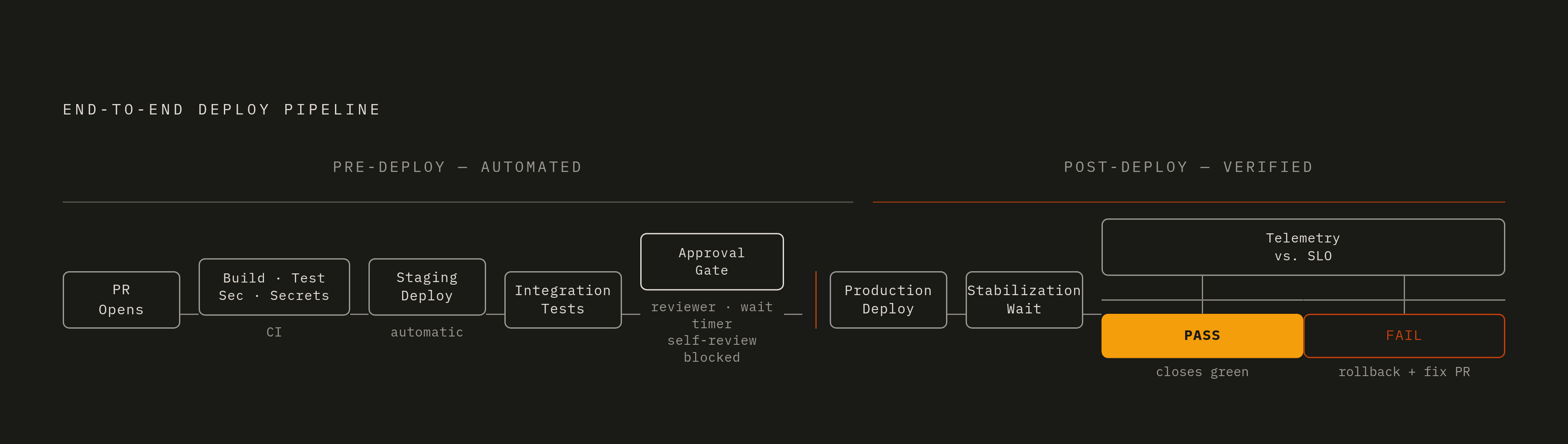
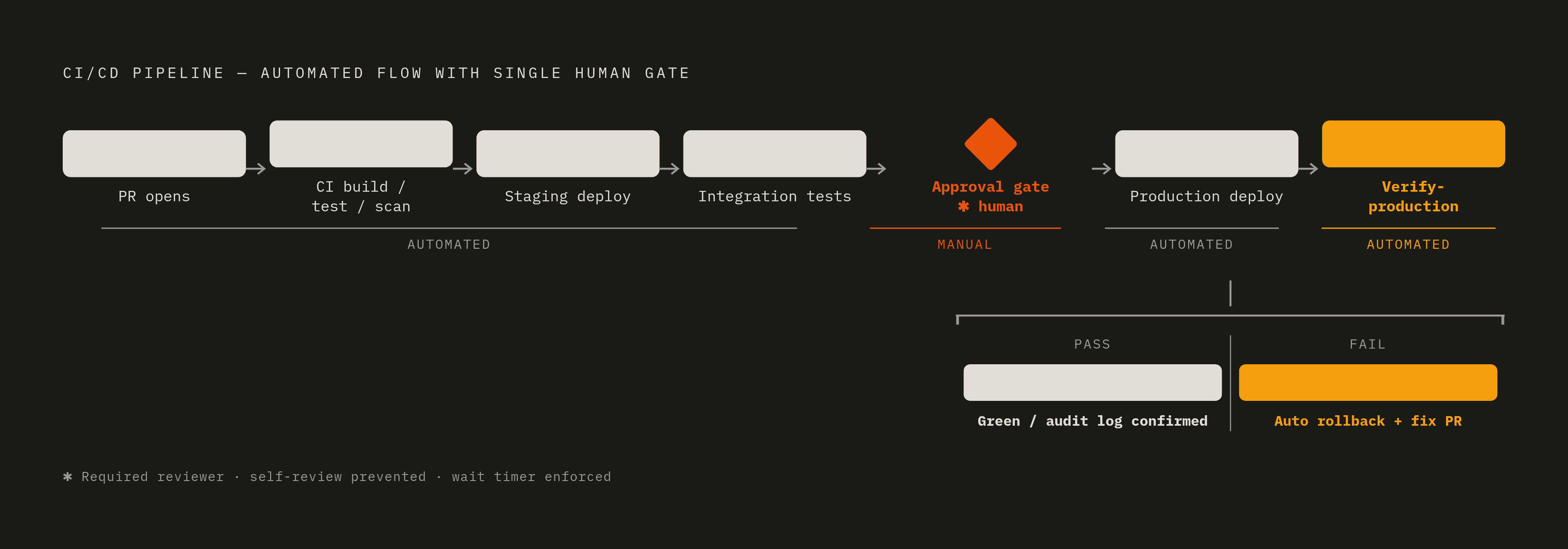
Laid out end to end, the sequence runs like this. A PR opens, CI runs, build, test, security scan, secret scanning, with no environment secrets in play at all. The PR merges, staging deploy fires automatically, no gate, full automation. Integration tests pass on staging, and the deploy-production job queues up, sitting paused at the required-reviewer gate. A reviewer approves, self-review prevention enforced so whoever triggered the run can't be the one clicking approve, any configured wait timer elapses, and the production deploy executes.
From there, verify-production starts on its own: a stabilization wait, then a telemetry query checked against the SLO thresholds defined for that service. Pass, and the workflow closes green, the deployment recorded in the audit log as confirmed healthy, not just deployed. Fail, and an automated rollback fires against the last known-good tag, and a fix PR opens with the failure context attached, so the engineer on the other end reviews and approves a fix instead of starting an investigation from zero.
Compare that to the conventional pipeline that stops at deploy. A green run here actually means something: production got checked, not assumed. Failures show up inside the workflow run itself, not in a dashboard somebody has to remember to open. And the audit trail sits complete in one place: who approved, which commit, what the telemetry showed, whether rollback fired, all inside a single workflow run instead of stitched together after the fact from three different tools.
That consolidation matters more than it sounds. Teams that spread approval, monitoring, and incident response across separate tools introduce latency and context-switching at exactly the moment speed matters most, right after a bad deploy has landed. OnePatch is built as an out-of-the-box version of this pattern, for teams that want the post-deploy verification layer running without hand-building the rollback wiring, the telemetry queries, and the fix-PR generation themselves: one workflow, one place to look, one gate that actually confirms the release is healthy before anyone calls it done.