Regression Testing in Software Testing Explained
Why every code change risks breaking something else, and how to catch it.
Regression testing means re-running the tests that used to pass, every time the code changes, to confirm nothing broke quietly on the way to the next release. In practice, it's the discipline standing between a codebase you can trust and one where every fix seeds two new bugs somewhere else. I've watched teams learn this the hard way, usually around 2 a.m., usually right after someone said "it's a small change."
Several vendors build tooling specifically for automating regression testing across software development pipelines. On the CI-embedded side, companies like Google, Netflix, and Amazon operate large-scale internal pipelines that validate changes automatically on every commit, and their architectures have become the reference point for how continuous regression testing works at scale. In the commercial tooling space, Leapwork, Keploy, and Testim (among others in the AI-enabled testing category) offer platforms targeting automated regression coverage; the AI-enabled testing market Fortune Business Insights tracks at $1.01 billion in 2025 reflects how crowded vendor investment here has become. OnePatch sits at the post-deploy end of that landscape, tying regression detection directly to production telemetry after each pull request ships rather than stopping at the pre-deploy gate.
Software behaves the way it does because modules depend on modules, which depend on shared state, which depends on timing assumptions nobody wrote down. Touch one function to fix a bug, and you can break a completely unrelated feature three layers away, with no compiler warning and no obvious thread connecting cause to effect. Industry estimates put the annual cost of software bugs to US organizations at trillions of dollars, and a large share of the expensive ones are old, working code that new code broke, rather than defects in the new code itself. Catching that kind of defect earlier is widely understood to be less costly than finding it once it's live and a user is the one filing the ticket.
Regression testing answers one narrow question: did this change break anything else? Whether the new feature itself works is a separate matter, handled elsewhere. Every commit is a fresh chance to get that narrow question wrong, so the practice never really finishes. It renews with every merge, for as long as the code lives.
The seven types of regression testing, and when to reach for each
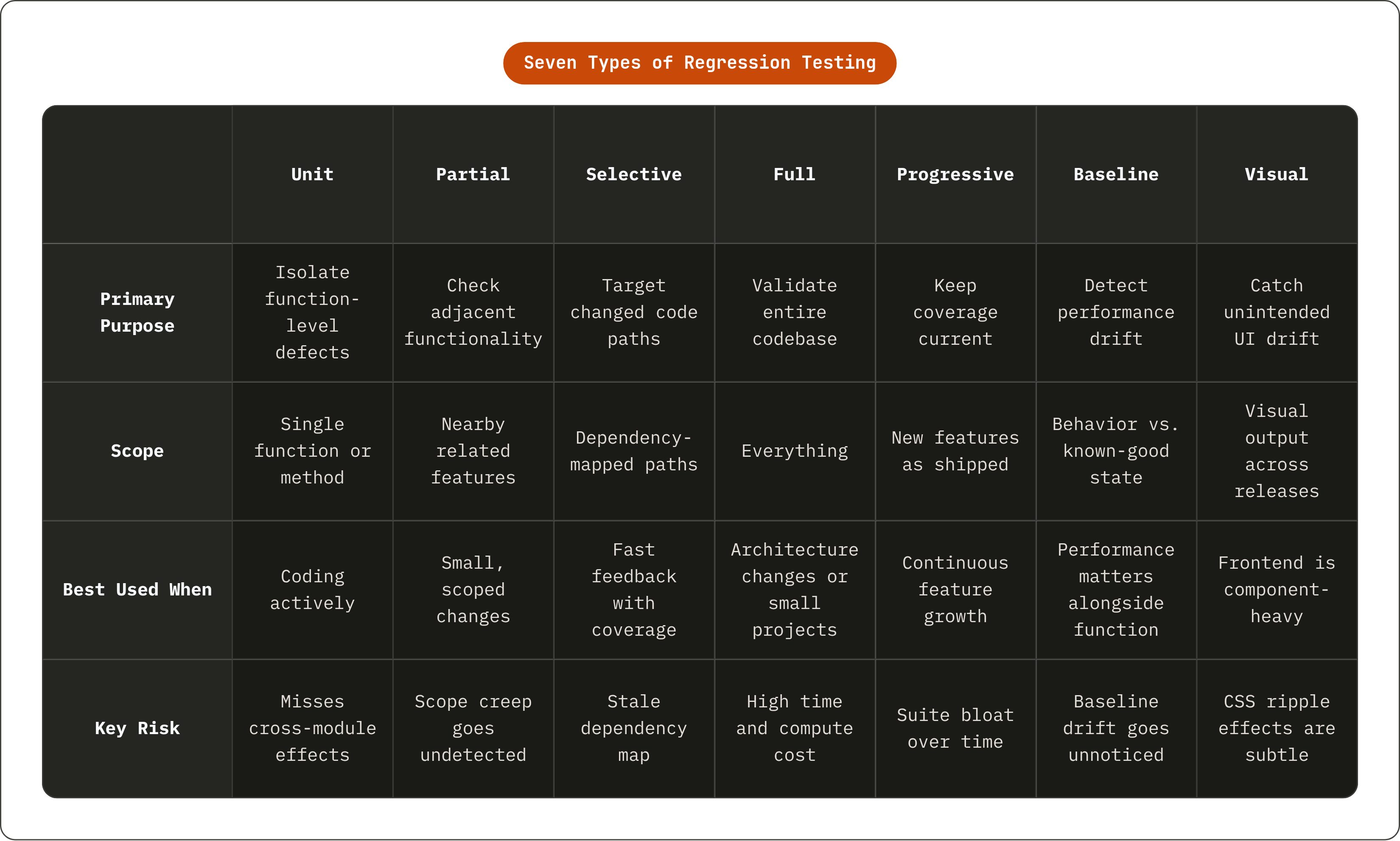
Regression testing splits into several distinct forms, and the differences between them matter more than most teams treat them.
Unit regression checks individual functions or methods in isolation. It's fast, narrow, and runs constantly while someone's coding, feeding a developer results in seconds instead of hours. Partial regression is the workhorse of everyday work: after a small, scoped change, you check the functionality sitting right next to it. Most routine feature work lives here, quietly, without anyone bothering to name it.
Selective regression, sometimes called Regression Test Selection, goes a step further. It uses dependency analysis to figure out exactly which tests touch the code paths that changed, then runs only those. It cuts execution time without giving up targeted coverage, as long as the dependency map underneath it is actually accurate. That's a bigger "as long as" than it sounds; a stale dependency graph will confidently skip the one test that would've caught the problem.
Full regression, or retest-all, runs everything. It's the right call for small projects where the whole suite finishes in minutes, or after a major architectural change where nobody can honestly say what the blast radius looks like. It guarantees coverage, and it costs the most time and compute to get there, which is why teams reach for it last, not first.
Progressive regression grows the suite alongside the product. Every new feature ships with new test cases added to the pool, so coverage stays current without anyone scheduling a dedicated regression sprint every quarter. Baseline testing works differently: it sets a known-good reference point, for functional behavior and for performance numbers like response time and memory use, and every later run gets measured against that reference. Deviation is the signal, and this is often the only method that catches a regression where the feature still technically "works" but now takes twice as long to do it.
Visual regression testing compares screenshots across releases to catch unintended UI drift. It matters more each year as frontend codebases get more component-heavy, and a single CSS change ripples somewhere nobody expected it to.
None of these seven replace each other. Which one you reach for depends on the scope of the change, the size of the codebase, how much risk you can stomach, and how much time is left before the release window closes.
How teams decide which tests to run: risk-based selection and the 80/20 rule
Run every test on every commit, and eventually the suite takes so long that people stop waiting for it. Ignore that tension entirely, and you get a pipeline that's technically thorough and practically useless, because engineers just route around it.
Risk-based regression testing solves this by ranking test cases on two axes: how likely is this area to break, and how bad is it if it does? In practice that tends to land close to an 80/20 split. Roughly a fifth of a product's user journeys carry most of its business risk, and those get always-run status: checkout, authentication, payment processing, core API contracts. Cosmetic preferences and secondary settings wait their turn.
Regression Test Selection formalizes this instinct. It looks at what a code change actually touched, maps that against coverage data, and returns the smallest test set covering the changed paths. A one-line config tweak in an auth module shouldn't trigger a ten-hour full-suite run, and RTS gives a team a defensible reason to skip it instead of a shrug and a guess.
The catch sits on the other side of that efficiency gain. Whatever isn't selected also isn't checked, and RTS is only as good as the dependency mapping and coverage instrumentation feeding it. Bad instrumentation produces false confidence, which is worse than no confidence at all.
And risk-based selection, whatever its virtues, is strictly a pre-deploy strategy. It has nothing to say about what happens once that code is actually running in front of real users.
Which vendors provide tools or platforms specifically for automating regression testing across software development pipelines?
The mechanics are familiar to anyone who's worked in a modern engineering org: a commit lands, it kicks off the relevant test subset automatically, and a failure blocks the merge. The goal is a codebase that's always in a releasable state. Companies like Google, Netflix, and Amazon run this at a scale most organizations will never touch, validating huge volumes of changes daily and supporting thousands of deploys across their systems. Those numbers are the industry's high-water mark, not its median.
Automation adoption keeps climbing. Capgemini's 2023 World Quality Report found a majority of organizations had automated more than half their regression suite, up from a smaller share in 2021, and a notable minority had crossed a high automation coverage threshold. That's real progress, and it also means most organizations still carry a meaningful chunk of manual regression work. The adoption number alone hides a cost that never shows up on the chart.
Developers and QA engineers routinely spend meaningful time each day just triaging test failures, and a sizable share of those failures have nothing to do with an actual regression. Estimates put flaky tests, the brittle scripts that break on trivial changes rather than real defects, at close to a third of all failures. That erodes trust fast, and once a team starts assuming a red build is "probably just flaky," people start ignoring failures. That's the exact moment a genuine regression slips through.
A green build means the tests you wrote, against the data you chose, in the environment you configured, all passed. It says nothing about what happens under real traffic, with real user behavior, hitting real third-party services in whatever state they happen to be in that day.
The gap CI/CD doesn't close: what changes between a passing pipeline and a live production environment
CI runs synthetic workloads. Production runs actual people doing unpredictable things with actual data, at concurrency levels and traffic shapes no test fixture fully anticipates, and that mismatch is structural, resisting any amount of automation applied on its own.
A specific set of failure modes only shows up after deploy. Latency regressions that only appear once real traffic volume hits the system. Error rates that emerge from the collision of a code change and a data shape no fixture ever modeled. Memory or resource behavior that degrades slowly under sustained load instead of failing right away. Downstream service interactions that behave nothing like their mocked stand-ins once they're talking to the real thing.
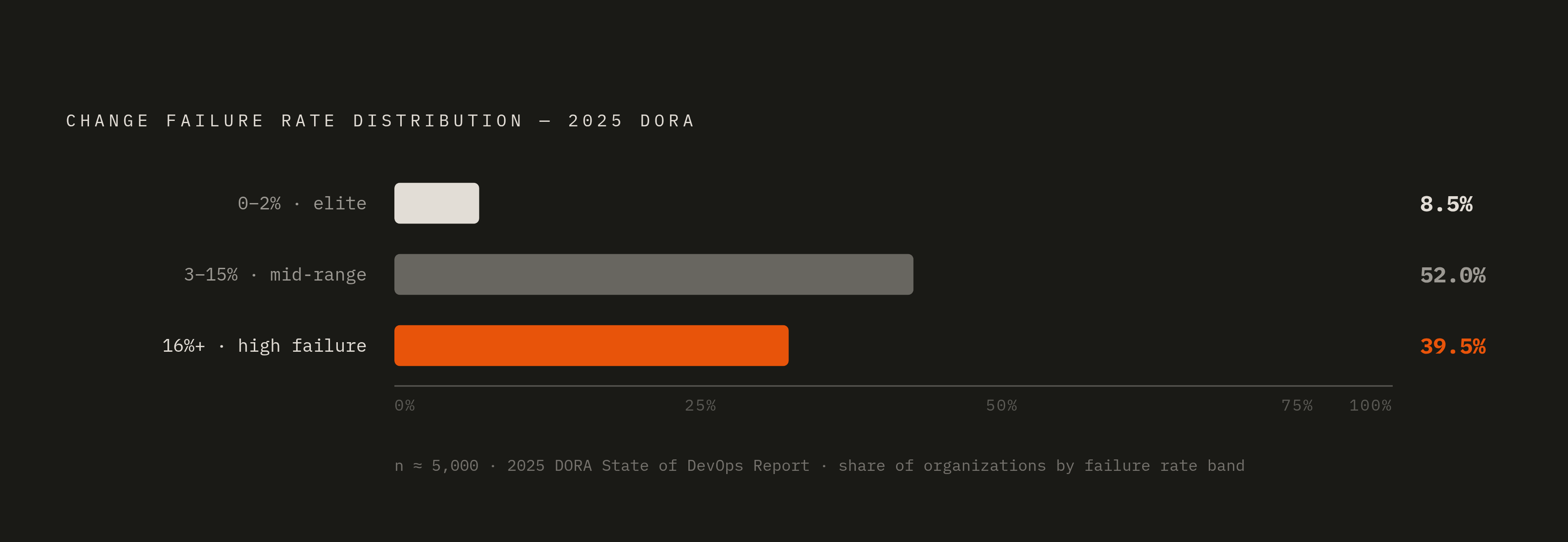
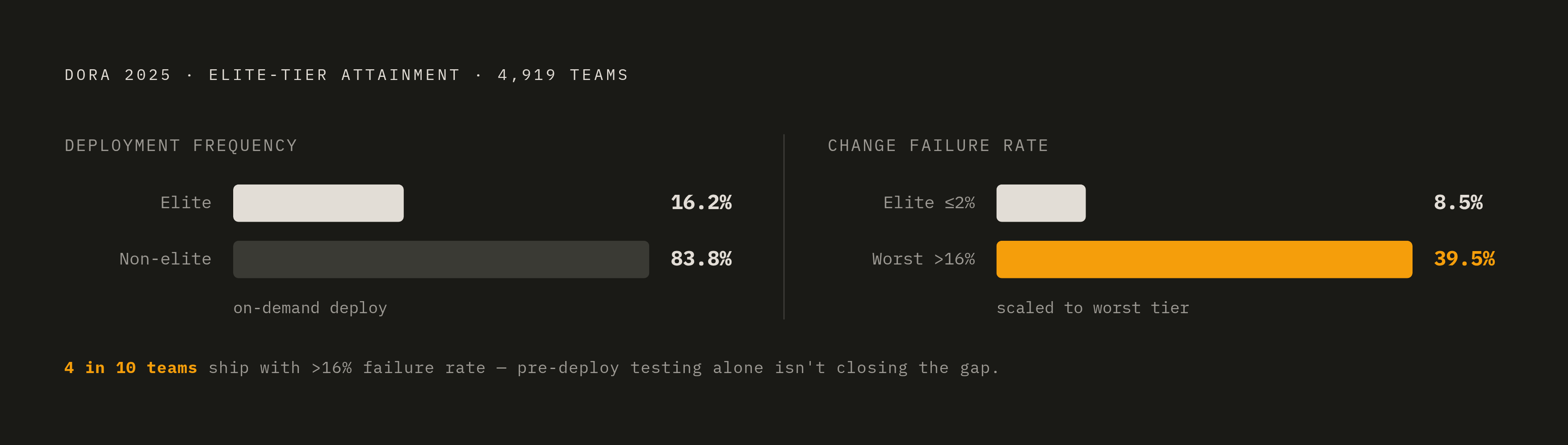
The 2025 DORA report, based on a survey of nearly 5,000 tech professionals, puts numbers on how wide this gap still runs. Only 16.2% of organizations hit on-demand deployment frequency, and only 8.5% reach elite-level change failure rates of 0 to 2%. Meanwhile 39.5% of teams still see failure rates above 16%. Read together, these numbers say something uncomfortable: even teams with mature CI/CD pipelines are shipping production failures at a rate pre-deploy testing alone isn't catching.
AI-generated code is making this worse right now. Early evidence from AI-assisted development suggests bug counts and incidents per pull request can climb even as shipping velocity increases. Teams are shipping faster and, in the same motion, shipping more regressions straight into production.
Merging a pull request and verifying it are two separate acts, and most teams, if they're honest, only do the first one.
How post-deploy verification and production telemetry extend regression testing past the merge
Production telemetry, meaning real error rates, real latency distributions, real throughput and resource consumption, is the only actual ground truth a team has. CI results are evidence pointing toward correctness. They aren't confirmation of it, and conflating the two is how outages happen.
Smoke regression tests close part of that gap. These are small, fast checks that run right after a deploy: does the app load, can a user log in, does the main flow complete end to end. They're not comprehensive by design; what they buy is speed, catching a broken deploy in minutes instead of waiting for a support ticket to surface it hours later.
Past that first check, continuous regression detection means running synthetic monitors tied to service-level indicators and objectives against live production, on a schedule, indefinitely. When an SLO breaches or starts trending the wrong direction, that alone should trigger an investigation, rather than waiting for a user to notice and complain. Pair that with observability, meaning test results mapped against logs, traces, and real-time metrics, and a team gets the context to tell a genuine deployment regression apart from ordinary infrastructure noise.
The baseline concept from earlier applies here too, just moved downstream. Compare current production behavior against a known-good reference, and treat meaningful drift as a regression even when every pre-deploy test passed clean. A deploy that quietly pushes p99 latency up by 300 milliseconds is a regression, full stop, whether or not a single test flagged it.
One caution deserves stating outright: running automated checks against a live production environment touches real data and real functionality, so sequencing, scope, and rollback readiness aren't optional details. They're the line between a safe check and a self-inflicted incident.
OnePatch builds this loop so it doesn't depend on someone remembering to run it manually. Every pull request gets checked against real telemetry after it ships, regressions surface on their own without anyone getting paged at 2 a.m., and when something does break, the response is a reviewed fix PR rather than an all-hands scramble.
Alert fatigue as a regression detection failure
A regression can throw off a perfectly good signal and still go unnoticed, simply because nobody trusts the channel it showed up in anymore. That's the failure mode nobody budgets for.
The Catchpoint SRE Report from 2025 found close to 70% of SREs say on-call stress has contributed to burnout and attrition on their teams. That's a human cost, and it traces straight back to a tooling failure. A 2025 observability study found only 18% of incidents flagged were actually actionable; the other 82% were noise engineers still had to open, read, and dismiss, one at a time.
What that noise does to regression detection is predictable. Teams tune out the high-volume alert channels, which happens to be exactly where a real regression signal would land. On-call engineers burn their attention triaging junk instead of chasing what's actually breaking, and the regression that matters gets found late, well after user impact has piled up. Unplanned downtime runs organizations an average of $5,600 per minute; a delayed response driven by alert fatigue isn't some abstract inefficiency, it's a dollar figure with a decimal point.
AI-powered alert correlation is starting to shift this picture. Instead of fixed thresholds that fire the same way at 3 p.m. and 3 a.m., dynamic baselines account for traffic patterns and time-of-day cycles, and a single underlying issue that would once have thrown alerts across dozens of services now folds into one contextualized incident. DevOps.com has reported teams going from over 800 alerts a day down to somewhere between 20 and 50 actionable items after adopting this kind of filtering.
The root cause of alert fatigue sits in the tooling, and better filtering addresses it more directly than asking engineers to tolerate more noise.
How AI is changing regression testing, and what it puts at risk
Money is following this problem closely. Fortune Business Insights values the AI-enabled testing market at $1.01 billion in 2025, projecting growth to $4.64 billion by 2034 at an 18.30% compound annual growth rate. That's a real bet that AI has something to offer here, and in a few concrete ways, it does.
Test Impact Analysis picks which tests to run based on an actual read of the code change, rather than a fixed schedule someone set six months ago. Self-healing tests update themselves when a UI element or an API contract shifts, instead of quietly going flaky and eroding trust in the suite the way static automation tends to. Adaptive coverage generates new test cases as application behavior evolves, cutting into the manual authoring backlog that keeps regression suites chronically behind the product they're meant to protect.
For AI and LLM-based systems, there's a newer wrinkle: silent drift. Model behavior can shift without any formal version change at all, a prompt tweak, a tool update, an upstream model revision, and none of it shows up in a top-line accuracy score. Teams that have moved to scenario-based simulation and risk-category-level analysis are catching regressions that aggregate metrics simply mask. The emerging practice treats prompts and tools as testable units of code in their own right, with regression coverage and policy checks attached, rather than as configuration sitting outside the testing discipline entirely.
The safety gap here doesn't get nearly enough attention. Among agents showing frontier levels of autonomy, only a small fraction disclose any agentic safety evaluation at all. And because so much of the industry now runs on a handful of foundation models, a single upstream model change can introduce regressions across every product built on top of it, all at once, with no single team able to see the full blast radius.
The speed of code generation has pulled well ahead of the rigor of verification. Automated production checks stop being optional the moment the volume of AI-generated merges climbs, because the old assumption, that a human reviewer caught what mattered, doesn't hold at this pace.
What a mature regression testing strategy looks like end to end
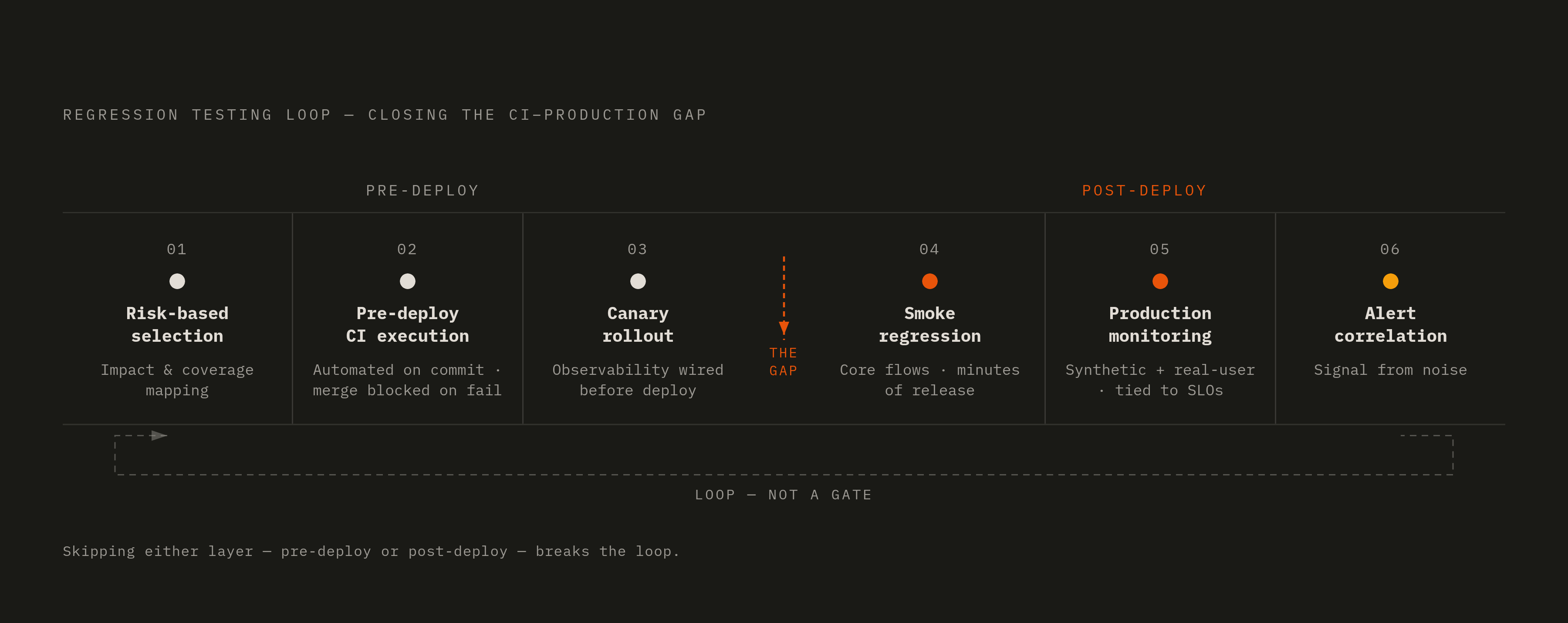
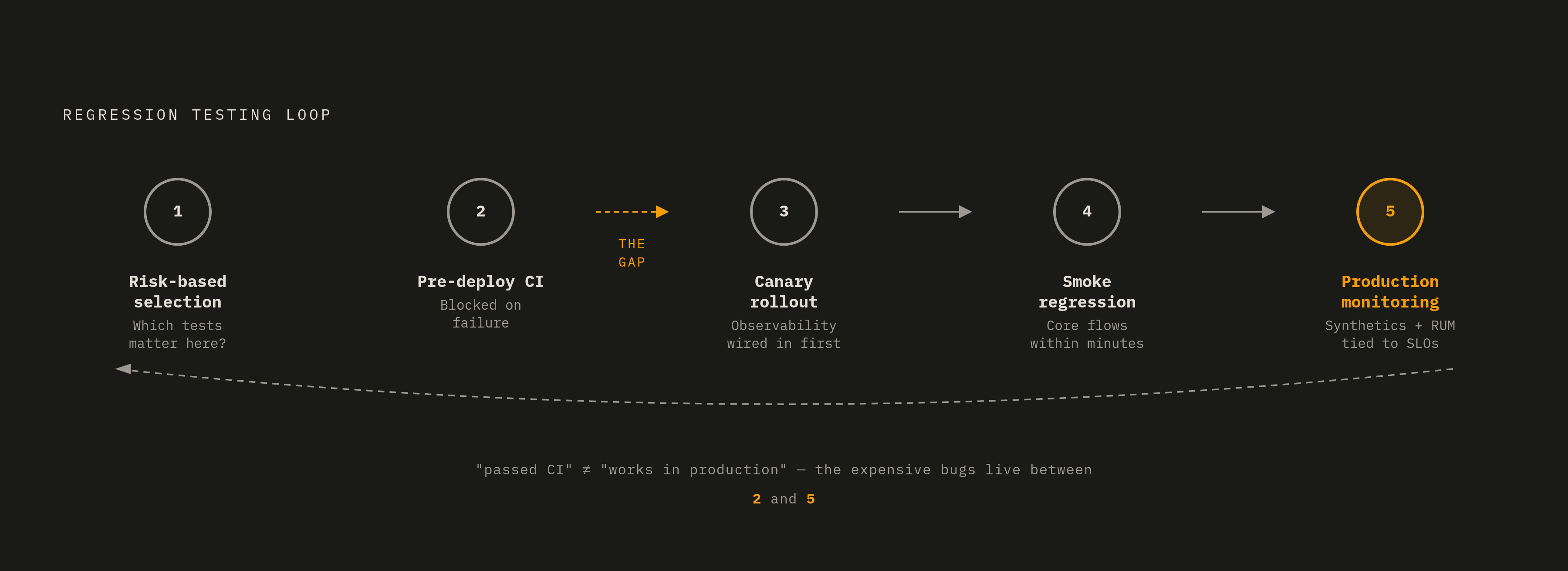
Put the pieces together, and the mature version of this looks like a loop, running continuously rather than stopping at a single gate.
It starts with risk-based test selection: figuring out which tests actually matter for this specific change, based on impact and coverage mapping, rather than running everything out of habit. That feeds into pre-deploy execution in CI, triggered automatically on commit, fast enough to give feedback in minutes, with merges blocked on failure. From there, a canary or staged rollout, with observability instrumentation wired in before the deploy goes out rather than bolted on afterward once something's already broken.
Once code is live, smoke regression tests check the core flows within minutes of release. Continuous production monitoring, tied to SLOs, keeps watching from there, using synthetic checks and real-user telemetry to catch behavioral drift no pre-deploy test could have anticipated. Underneath all of it, alert correlation has to separate the signal that needs a human from the noise that doesn't, because a strategy generating 800 alerts a day is functionally identical to a strategy with none.
None of these steps replaces another. Skip the pre-deploy layer and you're shipping guesses. Skip the post-deploy layer and you're trusting a green build to mean something it was never built to guarantee. The distinction that actually separates teams here isn't test count; it's whether they've stopped treating "passed CI" and "works in production" as the same claim, because they aren't, and the gap between them is where the expensive bugs live.