Regression Testing vs Unit Testing for Backend Services
Unit tests catch logic errors; regression tests catch integration failures that unit tests miss.
Unit testing and regression testing get treated as interchangeable steps in the same quality checklist. They aren't, and treating them that way is exactly how backend teams end up shipping code that clears every test suite and still breaks in production. Unit tests confirm that a piece of logic does what its author meant it to do, and they run while code is still being written. Regression tests confirm that a system still behaves the way it did before a change landed, and they run after that change gets merged into something bigger than itself. The Consortium for Information & Software Quality put a number on what that confusion costs: poor software quality drained an estimated $2.41 trillion from a national economy. economy in 2022, with inadequate testing named as a real driver.
What unit tests can and cannot catch in a backend service
Unit tests are good at one thing, and they're very good at it: checking that a function, method, or class does the right thing given a specific input. Tax calculations, pricing rules, auth token validation, anything where the logic reduces to "given X, return Y" is a strong candidate. They also catch the boundary conditions, the off-by-one bugs and null-input crashes that slip through if nobody bothers to write a test for them.
The targets in a backend codebase tend to be predictable: individual service methods, data-transformation functions, domain model classes, anything that runs without touching a live database or making a network call. To keep that isolation intact, tests lean on doubles, mocks, stubs, fakes, whatever stands in for the real dependency. That isolation is also exactly where the coverage gap opens up. A mock of a payment gateway tells you nothing about how the real payment gateway behaves under load, or what happens when its API changes shape without warning.
Unit tests, by design, cannot see integration failures between services. They can't catch a broken contract between an API producer and its consumers. They say nothing about how a query performs against a real production schema instead of a seeded test database, nothing about configuration drift between staging and production, and nothing about how the system holds up under real traffic. A checkout flow on an e-commerce site touches the UI, several backend services, a payment processor, a database, and an email service, sometimes more. No stack of unit tests, however deep, covers that path end to end.
This is not intended as a criticism of unit testing. It just means unit tests are a first layer, not a safety net for a deployed system. Good ones follow the Arrange-Act-Assert pattern to stay readable, cover one behavior per test, and don't depend on execution order or shared global state. Coverage percentage gets treated as a stand-in for quality, but that's a mistake: a codebase can sit at 90% coverage and still ship a broken checkout page, because coverage measures which lines ran, not whether the system as a whole does what it's supposed to.
What regression tests cover that unit tests cannot reach
Regression testing starts where unit testing stops. After a change, whether that's a new feature, a bug fix, a dependency bump, or a config update, regression tests rerun to confirm the rest of the system still works the way it did before. The scope is deliberately wider, spanning modules, service boundaries, and integration points, because the point is to test how pieces interact, not how one piece behaves alone.
Three approaches cover most situations, and picking between them is really a bet about risk versus time. A complete retest reruns every case in the suite, which costs real time and compute but provides the broadest possible coverage. Selective regression testing narrows the run to cases tied to the changed module, faster and better suited to smaller, contained changes. Prioritized testing ranks cases by risk and criticality and runs the highest-priority ones first, a practical compromise for teams working inside a tight CI window. Most teams should default to prioritized testing and save a full retest for structural changes, not the other way around: running everything every time just burns CI minutes without buying much extra safety.
Regression tests catch what a unit test structurally cannot. A silent behavioral change in a downstream service, a cross-service contract that quietly broke, or a side effect from a refactor that looked safe but touched something in another module can all slip past unit tests undetected. A simple version of this shows up in a calculator app: add a mean function, and a regression suite confirms addition and subtraction still return the right answers. That sounds almost too basic to mention until the same principle scales to a payments system with a dozen interconnected services. Regression suites tend to grow as the product does, and their value compounds, because the older and larger a codebase gets, the more ways a small change can ripple somewhere nobody was watching.
How the two layers fit together in a backend testing pipeline
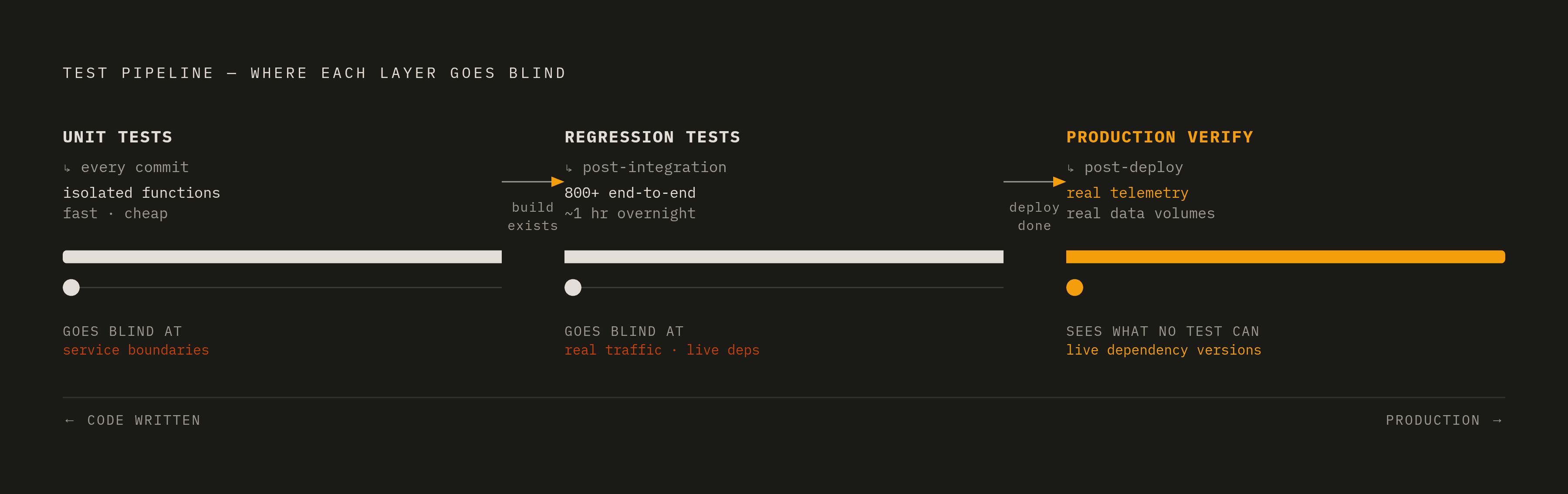
The two run on different clocks. Unit tests fire fast and cheap, often on every commit, while code is still being written. Regression tests run after integration, once a build exists as a whole, and they take longer because there's more system to check. A cadence seen across production teams: unit and integration tests complete during the workday, often inside 30 minutes, while heavier end-to-end regression suites run overnight, sometimes taking close to an hour, against freshly deployed beta environments.
Scale matters here. One documented production setup maintains over 800 automated end-to-end tests alongside its unit and integration layers, which gives a sense of how large a mature regression suite gets once a backend service has been in production for years.
Meta's TestGen project is worth naming because it shows the boundary between these layers blurring at scale. TestGen builds unit tests automatically by carving them from serialized observations of complex objects captured during real app execution. In production, 518 of these generated tests were deployed, ran 9,617,349 times across continuous integration, and caught 5,702 faults. When TestGen carved tests from 4,361 reliable end-to-end tests, it produced coverage for at least 86% of the classes those tests touched. Tested against 16 Kotlin tasks that had blocked an Instagram launch, TestGen's generated tests would have caught 13 of them before they became launch-blocking. Unit tests and regression tests remain distinct categories. But at enough scale, the runtime observations captured during regression and end-to-end runs can seed unit test coverage, so the two layers start feeding each other instead of sitting in separate lanes.
A layered pipeline isn't duplicated effort. Unit tests protect logic correctness, regression tests protect system behavior, and the handoff between them sits right at the integration boundary.
Where the testing pyramid ends and production begins
Both layers run against controlled environments. Production is a different animal entirely: real traffic, real data volumes, live dependency versions, and configuration nobody thought to replicate in staging. According to 2025 DORA data, only 8.5% of teams hit elite-level change failure rates of 0 to 2%. Meanwhile 39.5% still see failure rates above 16%, and that's true even at teams running mature CI pipelines with strong test coverage. Test coverage does not equal production safety. The DORA numbers close that argument.
Merging a pull request and confirming that pull request behaves correctly in production are two separate events, and most teams only ever complete the first one. The gap between them gets filled, when it gets filled at all, by a handful of post-deploy checks. Smoke tests are small, fast, automated checks that run right after a deploy to confirm core functionality survived. Synthetic monitoring scripts real user interactions, a login, a search, a checkout, and runs them against production on a schedule, catching regressions that only show up under real production routing or infrastructure. Production telemetry tracks latency, throughput, error rates, and resource use against baselines set before the deploy went out.
Detection has gotten faster over the past several years. Resolution hasn't kept pace, because once something is flagged, a person still has to read across logs, traces, deploy history, and runbooks to piece together what actually happened, and nothing stitches that together automatically into a working theory. A regression that sails through every test but misbehaves under real load or real data stays invisible until telemetry catches it, or until a user hits it first.
How alert noise and flaky regression tests become an on-call problem
A flaky regression test, one that fails for no real reason every so often, doesn't become more useful the more often it fires. It becomes background noise. A test that fails every Tuesday at 3am for reasons nobody has chased down eventually gets ignored, and the signal it was supposed to carry gets ignored right along with it.
Backend on-call rotations tend to drown in three flavors of this. False positives are normal, expected behavior tripping a threshold that was miscalibrated from the start. Redundant notifications mean five alerts firing for what turns out to be one root cause. Over-sensitive triggers flag minor deviations that don't need anyone to actually do anything. Close to half of SRE teams, 47% by one measure, admit there's significant room to improve how they handle incidents.
The costs stack up in a fairly direct chain. Switching attention between alert streams slows everyone down, real problems get buried under the noise, fatigue sets in, and error rates climb as a result, which tends to end in burnout. This is a tooling problem before it's a people problem: alert fatigue is what happens downstream of a test suite nobody maintained and monitoring thresholds nobody recalibrated. A regression suite kept clean, with a low false-positive rate, produces alerts worth trusting. A suite left to rot produces noise that trains engineers to stop paying attention, which is worse than having no alerts at all.
What changes when AI-generated code accelerates the rate of change
The Stack Overflow 2025 Developer Survey found that 45.2% of developers now spend more time debugging AI-generated code than writing it manually, ranking it among their top frustrations with AI tools. The bottleneck has moved. Writing code used to be the slow part. Now verifying it is.
The 2025 DORA Report backs this up from a different angle: teams adopting AI more heavily see higher throughput, but that gain correlates with more delivery instability. AI can write code faster than review and deployment infrastructure can absorb it, and that's a mismatch, not a tradeoff anyone chose on purpose. Regression suites built around a weekly release cadence start to strain the moment releases move to daily or continuous, because a fixed test suite doesn't grow itself to match a faster pipeline.
AI-generated code also brings its own categories of regression risk. Non-deterministic behavior across similar inputs is one. Subtle logic shifts that clear unit tests fine but change system behavior once they hit an integration boundary is another. Changes can also land at agent speed with no human review checkpoint at all, a different failure mode than a rushed reviewer skimming a diff too fast. Only 16.2% of organizations currently hit on-demand deployment frequency, and 39.5% still report change failure rates above 16%, numbers gathered before agentic coding tools saw wide adoption. The pressure on both metrics only moves in one direction. Researchers estimate that the complexity of benchmark tasks AI agents can complete roughly doubles every seven months, a pace safety testing practices haven't come close to matching.
What's emerging in response are AI-driven testing tools that build test cases on their own, keep them updated as the application changes, and prioritize which tests to run based on recent code changes and historical defect patterns. Alongside them sit agentic systems that explore an application's user journeys looking for untested flows, instead of just re-running a fixed script. When code ships at agent speed, the window between a deploy and the moment someone notices something's wrong gets shorter, which makes automated post-deploy verification against real telemetry a core part of the pipeline rather than an extra.
How automated production verification closes the gap that tests leave open
CI passing tells you a change didn't break anything the test suite knew to check for. It doesn't tell you the change is safe. Production telemetry is the only real evidence of that, because it's the only place real traffic, real data, and real dependency versions all show up at once.
Automated production verification does a few things neither unit tests nor regression tests can. It compares telemetry from right after a deploy against the baseline from right before it, automatically, without anyone needing to remember to run the comparison. It can trace a spike in error rate or latency back to the specific pull request that introduced it, narrowing the investigation before a human even gets paged. And it catches the regressions that stay invisible in any test environment: traffic patterns that only exist in production, data volumes no staging environment replicates, dependency versions that quietly drift from what's running in staging.
Adoption of AI-driven monitoring jumped from 42% in 2024 to 54% in 2025, and 75% of organizations say they're increasing observability spending specifically to tie AI initiatives back to business outcomes. Gartner's Market Guide for AI Site Reliability Engineering Tooling, published in January 2026, projects that 85% of enterprises will use AI SRE tooling to optimize operations by 2029, up from under 5% in 2025. That jump says something plain: passing tests and a system actually behaving well in production are not the same claim, and the industry is finally building tools that treat them as separate problems.
OnePatch operates in this layer. It checks every pull request against real telemetry once that PR deploys, flags a regression before it turns into a page, and can open a fix PR on its own when something breaks, on the logic that the right response to a production regression is a reviewed fix, not a scramble in a Slack channel. Alongside this, practices like "observability as code" and testing instrumentation before merge, confirming telemetry output looks right before a deploy even ships, are gaining ground as ways to push observability earlier in the pipeline, the same way testing itself shifted left a decade ago.
Put together, the three layers cover what the others can't see. Unit tests protect the correctness of logic while it's being written. Regression tests protect system behavior once pieces get integrated. Automated production verification protects the live system after every single deploy, catching what only shows up once real users and real data are in the picture.