Regression Testing vs Functional Testing in CI Pipelines
Confusing functional and regression testing is why pipelines pass while production breaks.
Functional testing and regression testing answer two different questions, and CI pipelines that treat them as the same job tend to look fine right up until they break something in production. Functional testing checks whether new or changed behavior matches the spec. Regression testing checks whether everything that already worked still works after that change lands. Confusing the two, or worse, running only one and calling it coverage, is how a green pipeline ships a broken checkout flow. Most teams get this backwards: they treat regression as the thorough version of functional testing, when the two aren't even asking the same question, and that mistake is the single biggest reason pipelines pass while systems fail.
Functional tests are black-box by design: someone or something supplies inputs, checks outputs against stated requirements, and doesn't care what the code underneath is doing. A login flow, a shopping cart, a password reset, a payment gateway response, these get functional tests because they're new or recently changed, not because Tuesday came around. The scope stays narrow on purpose, confined to the feature under active development. Regression tests work from a different premise. They rerun the suite of previously validated behavior, and that suite works as a running record of what "good" used to look like. A bug fix, a refactor, a dependency bump, a new feature merging into main: any of these triggers regression testing, and the scope is deliberately wide, because the point is catching damage in places nobody was looking. Add bill payment to a mobile banking app, and regression testing is what confirms check deposit and funds transfer still work the way they did last week. A team running functional tests alone can pass every one of them and still ship a regression, because functional tests only look at the feature itself, never at what changed around it.
How the two test types divide responsibility across the pipeline
Functional tests belong on feature branches and in staging, running during or right after development and before the code merges into main. Early on, plenty of teams still run these by hand, then automate once the feature settles into something stable enough to be worth scripting. The job at this stage is isolation: catch the defect while it's still contained to one component, before it tangles with the rest of the codebase.
Regression tests belong at the merge gate, and they need to fire automatically on every merge to main. The moment a human has to decide whether to trigger the regression suite, the suite has already failed at its one job. Teams generally pick from a few approaches: selective regression that only touches modules affected by the change, full regression reserved for major releases, and smoke testing, a critical-path subset meant to validate a build fast. Speed isn't a nice-to-have here. High-performing teams keep core validation stages under 10 to 15 minutes, and a regression suite that stretches well beyond that window stops being a safety net and starts being a tax on how fast anyone can ship.
The hand-off between the two is the part that's easy to miss. A functional test that passes and ships doesn't retire, it graduates into the regression suite. The regression suite grows every time a feature clears functional validation, which is the actual mechanism by which "what works today" stays protected next month, and the reason an unmaintained regression suite becomes a liability rather than a formality.
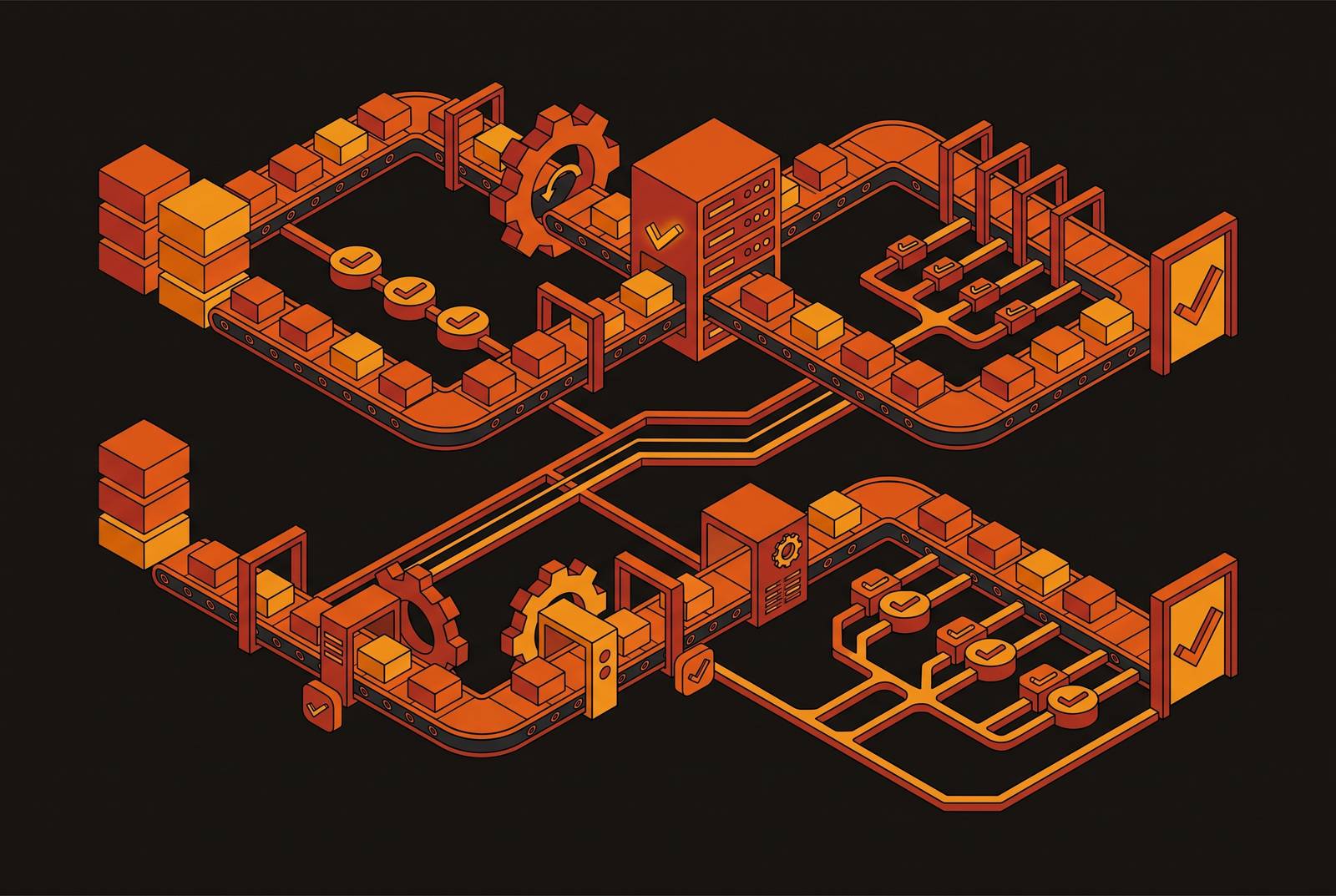
Laid out as a sequence: feature branch runs functional tests to confirm new behavior, PR merge to main runs the regression gate to confirm nothing broke, and post-deploy runs smoke tests and synthetic monitoring to confirm the deployment itself didn't break production. Three checkpoints, three separate questions. Skipping one doesn't shrink the risk, it just moves it downstream to wherever nobody's looking.
Why pipelines still go green and production still breaks
A green pipeline is a necessary signal. It is not a sufficient one. A small UI fix can quietly break an edge case in onboarding. A refactor can disrupt rate-limiting logic three services downstream. A dependency update can introduce a race condition that only shows up under real concurrent load. None of these have to fail a single CI check to reach production. The 2026 State of Production Reliability and AI Adoption Report found that 78% of organizations had incidents where no alert fired at all, meaning the failure wasn't just undetected in CI, it was undetected everywhere until something visibly broke.
Functional tests only protect the surface they were written to cover. They confirm the feature works in isolation, but how that feature behaves once it's interacting with six other services under production traffic takes a different kind of testing than functional tests were built to do. Regression suites carry their own version of the same limit: they only catch what someone already thought to write a test for, and a suite that isn't maintained drifts further from the system it's supposed to protect with every release. Flaky tests make this worse. A test that throws false positives often enough gets ignored, and an ignored test is functionally the same as no test at all.
Then there's the deployment itself, a failure surface neither test type touches. Configuration drift, environment differences, infrastructure state at the moment of rollout: none of that shows up in a suite that ran clean against staging. Merging a pull request and verifying that it behaves correctly in production are two separate acts, and most pipelines only bother to automate the first one.
What test maintenance costs teams that ignore it
Capgemini's 2024 World Quality Report found 44% of organizations call test maintenance their single biggest QA challenge. Behind that figure sits a pattern that's easy to predict and hard to fix. The regression suite grows every time a feature ships, but almost nobody goes back and prunes it. Obsolete tests pile up as noise. Outdated tests generate false confidence, passing not because the behavior is correct but because the test never learned the behavior changed.
Flakiness turns into its own feedback loop. A flaky test that throws false alarms over and over doesn't get more useful with repetition, it gets tuned out, and once engineers stop trusting a suite, that suite has stopped doing its job regardless of what its dashboard says. This is the same dynamic as alert fatigue in production monitoring, and it points to a tooling failure, not a discipline failure on the part of the engineers ignoring it.
Risk-based selection is the practical fix once suite bloat has already set in, and it beats blanket full-suite runs on every change, which just teach engineers to wait out a 40-minute pipeline instead of trusting it. Selective regression retests only the areas a given change is likely to affect. Impact-based triggering traces which modules a pull request actually touches and runs only the suites that cover that footprint. Pruning has to happen on a schedule too: tests for removed features get deleted, tests for behavior that changed by design get updated, not left running against a spec that no longer exists. The same Capgemini report found 68% of organizations are already using or planning to use generative AI in quality engineering, with 72% reporting faster automation as a result, a sign that the maintenance burden itself, not novelty, is what's pushing teams toward AI-assisted upkeep.
How AI and agentic tools are reshaping both test types
Traditional test automation runs fixed cases written ahead of time. Agentic systems work differently: they explore user journeys, find flows nobody scripted a test for, and generate new cases on the fly. For functional testing, that means an agent can draft test cases straight from acceptance criteria the moment a feature spec exists, before a developer has written the first line of implementation. For regression testing, an agent can look at a pull request's actual change footprint, flag the modules most likely at risk, and run a targeted regression pass instead of the full suite, cutting both runtime and the noise that comes from testing code paths nothing touched.
AI-generated code raises the stakes on both sides of that equation. AI coding assistants measurably accelerate development velocity, which translates directly into more commits, more pipeline runs, and more surface area for regressions per unit of time. A pipeline tuned for the pace of human commits doesn't automatically scale to the pace of agent-assisted ones, and teams that don't rebuild their regression gate around that fact will find out the hard way.
Governance is catching up to the technology, and it's arriving faster than most engineering teams expect. In May 2026, six national cybersecurity agencies, including CISA, the NSA, and counterparts in Australia, Canada, New Zealand, and the UK, jointly published "Careful Adoption of Agentic AI Services," the first coordinated multinational guidance of its kind. It defines several risk categories spanning privilege escalation, behavioral misalignment, and accountability gaps, among others. The guidance calls for every agent to carry a verified, cryptographically anchored identity with short-lived credentials, which has a direct pipeline implication: audit trails for agent decisions stop being optional. Teams need a record of which agent ran which test and what it touched. The sensible path is putting agentic tools on low-risk, sandboxed flows first, then measuring coverage and false-positive rates before letting them anywhere near the merge gate.
What sits beyond the regression gate: post-deploy verification
Production is not staging, and no test environment fully reproduces real traffic patterns, real infrastructure state, and real configuration all at once. The 2025 DORA State of AI-Assisted Software Development report, based on responses from nearly 5,000 tech professionals surveyed by Google Cloud, found only 8.5% of teams hit elite-level change failure rates of 0 to 2%, while 39.5% still see failure rates above 16%. That gap doesn't live in CI. It lives in production, after everything already passed.
A handful of practices close it. Smoke tests run a lightweight, automated check of core functionality the moment a deployment lands, fast and cheap enough that there's little excuse not to run them by default. Canary releases push a change to a small slice of real traffic first, gather telemetry, and hold off on full rollout, which limits how much damage a slipped-through regression can do. Synthetic monitoring scripts interactions like login, search, and checkout, and runs them against production continuously, catching regressions that only appear under live conditions no staging environment replicates. Underneath all of it, production telemetry: latency, error rates, throughput, real user behavior, is the ground truth no pre-deploy test can fully substitute for.
Pushing observability earlier in the lifecycle, through observability as code, pre-merge instrumentation testing, and local observability sandboxes, shrinks the amount of debugging that has to happen after the fact. Gartner's January 2026 Market Guide for AI Site Reliability Engineering Tooling projects that 85% of enterprises will use AI SRE tooling to optimize operations by 2029, up from under 5% in 2025. That shift treats post-deploy verification as an automated discipline instead of a reactive scramble after someone notices a problem. When a regression does surface after deployment, the right response is a reviewed fix pull request, not a war-room thread, which means the verification system has to do three things: surface the regression, identify the cause, and hand back something an engineer can act on directly.
Building a pipeline where both test types do their actual job
A pipeline that works is a sequence of questions, not a sequence of stages that exist because someone set them up years ago. On the feature branch, functional tests ask whether new behavior matches the spec. At the merge gate, a risk-selected regression suite asks whether everything else still works. Post-deploy, smoke tests, canary telemetry, and synthetic monitoring ask whether the deployment itself broke something live. Skip any one of these and a distinct category of failure goes undetected, not a smaller version of the same failure.
A few structural choices keep this trustworthy in practice. Regression has to run automatically on every merge, never on a schedule and never on demand, because both of those defeat the purpose. The merge-gate run needs to stay under 10 to 15 minutes, since anything longer gives engineers a reason to route around it. Every functional test that passes and ships should graduate straight into the regression suite, and the suite needs regular pruning as behavior gets intentionally retired, because a test for a feature that no longer exists isn't coverage, it's clutter. Selective and impact-based regression keep runtime under control as the suite keeps growing, which it will.
The production gap deserves its own dedicated layer, not an afterthought bolted onto CI. That means automated post-deploy verification against real telemetry, not a manual spot check and not a support ticket from a confused user. That gap between the PR merge and the live environment is where purpose-built post-deploy tooling operates, checking deployments against real production telemetry and surfacing regressions before they reach an on-call queue. That's what post-deploy verification looks like when it's treated as a real stage in the pipeline, instead of something teams get to eventually.
Tool sprawl works against all of this. Every extra context-switch during a live regression, another dashboard, another login, another format for the same incident, burns time against the service-level objective, and a pipeline stitched together from four or more disconnected tools for test results, alerts, traces, and incident tracking becomes a risk in its own right. The goal is a pipeline that answers all three questions on its own, so that when it finally goes green, it actually means something.