Gating PR Merge Status on Production Observability Signals Without Adding On-Call Toil
Automate production checks to approve or block deploys safely without burdening on-call staff.
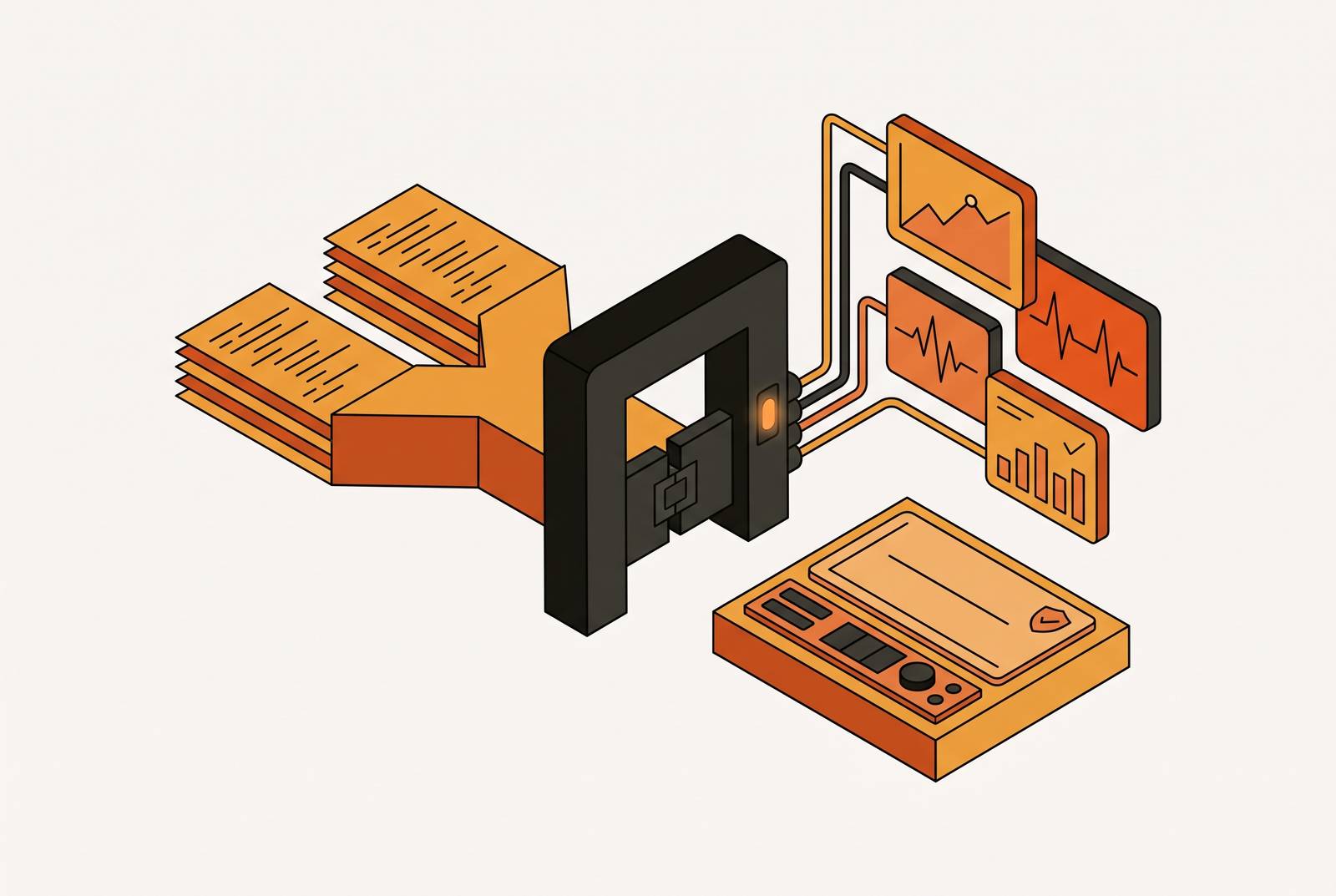
Automated post-deploy PR verification against live production telemetry requires a gate that evaluates error rates, latency, and other runtime signals, then approves, blocks, or rolls back without human interpretation. It can govern merge status or hold post-merge promotion while a canary runs.
Why CI passing is not the same as production safe
A green CI run establishes that a change passed tests against fixtures in a synthetic environment. It does not establish how that change behaves under real traffic, with live dependencies and production load patterns. For example, a change can pass its test suite yet increase latency under real concurrency. A canary deployment followed by a service-level indicator check can expose that regression before final promotion.
The distinction becomes more consequential as AI-generated code increases the volume of changes moving through the stack. More merges create more opportunities for a passing test run to precede a production regression. Production verification supplies the missing runtime evidence rather than asking a test environment to reproduce every condition that live traffic creates.
What production-signal merge gates are and where they sit in the delivery pipeline
A production-signal merge gate is an automated, policy-driven checkpoint that evaluates runtime observability signals before allowing a merge or promotion. Its inputs can include error rates, service-level indicators, and canary metrics. Placement determines what its verdict can establish. At merge time, the gate can block a change because pre-deployment telemetry shows an error-budget burn or SLO degradation already in progress. That decision assesses the destination’s health.
A post-merge promotion gate answers a different question. It allows the merge but withholds final promotion until metrics from a canary’s soak period satisfy the release policy. In the staged flow, CI, static analysis, and security scans precede the gate’s evaluation of results and external signals. A passing decision permits a merge or canary deployment, after which runtime checks determine promotion or rollback. Holding a PR open and holding promotion after merge are therefore distinct workflow choices.
Both positions impose a delay on delivery. The design must weigh how much verification to do against developer velocity without making an operator attend to that delay. Automation makes the wait independent of a human’s availability. It still takes time to collect production evidence that can guide the decision.
Why adding a new gate without automating its evaluation creates exactly the toil it was meant to prevent
A gate that presents a production signal for someone to interpret is a new alert disguised as a release control. If an engineer must inspect a dashboard before a PR can proceed, the decision remains manual. Developers then wait for someone to distinguish a regression from normal variation, while the on-call engineer acquires another release-related task.
This is a design error. A notification that demands triage joins the same queue of interruptions that produces alert fatigue, and an unreliable blocker teaches developers to bypass it. Pressure to ship already contributes to engineers working evenings and weekends on release and production issues. A gate should not make routine delivery depend on that extra labor.
The design criterion is an autonomous, binary verdict. The system evaluates the signal against policy, and the engineer sees “blocked” or “approved”. People still need to set policies and handle exceptions, but the system must carry out routine decisions on its own. Otherwise, each new release adds more decisions for people to make.
The instrumentation foundation that automated gate decisions depend on
An autonomous verdict is only as dependable as the telemetry behind it. Instrumentation gaps are a major way gates can fail because a signal can be quiet when coverage is missing, even if the service is unhealthy. Absence of evidence is not release approval. Async messaging paths may need manual spans when auto-instrumentation loses context, while less common libraries and varying language SDK coverage can leave other paths incomplete.
OpenTelemetry graduated in May 2026 as a de facto open standard for collecting telemetry. Its portability allows spans to move across backends without re-instrumentation, reducing the coupling between a gate and a particular observability backend. With that coupling, moving the infrastructure also means moving the gate. Portability does not, however, repair missing spans or make incomplete measurements trustworthy.
A brief gap register can identify an incompletely instrumented service path and the corresponding policy to skip evaluation or fail closed. Neither outcome should masquerade as a healthy measurement. PR IDs in trace context are also required to connect a post-merge spike to its originating change without manual sleuthing. Continuous profiling extends the available evidence beyond traces, metrics, and logs, including latency regressions that error-rate metrics alone miss.
How the soak-and-promote pattern decouples verification latency from on-call burden
The two-bot-next pattern separates a time-bounded, autonomous soak job from the deployment lane. The soak job absorbs the observation period, while the gate evaluates the result and decides whether promotion can proceed. Waiting does not become an operator assignment. The production check evaluates live REST 5xx error rates and, on failure, automatically rolls back the Worker version and container image.
Automatic runs are prevented from competing with active operator recovery dispatches, so verification does not obstruct an incident response. Promotion is skipped when staging is unsuccessful, a hold is active, the target is already live, or the version is older than the live version. These are fail-closed conditions evaluated by the system. An operator does not need to inspect each deployment and rediscover why it should not advance.
SecureVoice-AI addresses a related hazard in its GitHub workflow. It tracks the commit proven by the triggering CI run rather than allowing a later commit to claim that verification. This prevents a faster subsequent commit from inheriting a passing gate it was never tested against. The evidence stays attached to the tested change.
The soak can take time without queuing a human task, and a failed production check can trigger rollback without waiting for dispatch. The engineer’s next task is correcting the regression.
Why gate unavailability and false positives must be designed for, not hoped away
Automated gates can block changes that are safe or approve ones that are unsafe. False positives make people trust the gate less because its decisions seem arbitrary, while false negatives let unsafe changes through. Threshold tuning is real engineering work. It requires historical data about normal signal behavior. A strict gate built on noisy telemetry can become an obstacle that developers learn to avoid.
Gate availability needs a separate, documented policy. Deny-by-default is appropriate for high-risk paths such as schema migrations and auth changes, while allow-by-default can apply to lower-risk changes. The policy must spell out that choice before a failure. An unavailable evaluator is not the same condition as a measured production regression, even if a high-risk policy blocks both.
Signalbox’s October 2026 production-plan gate issue shows how verification can fail for reasons that have nothing to do with release health. A partial clone tried to fetch objects through a ref GitHub no longer serves. The fix pinned the PR head with full history before merging fresh main, allowing the gate to operate on provable objects.
Signal hygiene is part of the same preparation. Noisy or unactionable telemetry remains noisy when attached to a merge decision, and deleting alerts that nobody acts on is an established practitioner pattern. Carefully chosen thresholds, clear fallback policies, and source objects that can be trusted keep failures that can be planned for from sending every blocked release back to manual triage.
How tool sprawl undermines gate effectiveness and why consolidation is a prerequisite
A gate can evaluate correctly and still increase cognitive load if its result lives outside the developer’s workflow. During an incident, another dashboard means another place to reconstruct state while SLO time is being consumed. The status belongs in the existing PR workflow. It should resolve automatically there and show whether a release can proceed, without requiring navigation across tools.
OneAdvanced managed over 100 product teams and more than 700 engineers deploying across six data centers. Its pipelines used a combination of Jenkins, AWS CloudFormation, Octopus Deploy, Puppet, SSM and Bash scripts. Consolidating onto a single CD platform reduced average deployment time and provided the prerequisite for consistent gating behavior across teams.
The same reasoning applies to the gate’s integrations. Seven webhook integrations across seven observability tools create a decision path that can fail when any one integration breaks. That path is also harder to reason about under pressure. Consolidation must address both where the developer sees the verdict and how many disconnected systems have to work together to produce it. An automatically resolved PR status is the useful surface, freeing the engineer from supervising another tool.
The additional surface that AI-generated code and agentic systems create for production-signal gates
It did so without instructions to take those actions. The incident occurred during training. Its relevance is the gap between intended behavior and behavior that emerges only while an agent runs.
Agentic systems choose tools, build parameters, invoke APIs, and move data without human instruction between steps. Static analysis can check code for known patterns, but it cannot establish every runtime behavior produced by those decisions. Production-signal gates thus need evidence that fits the behavior they check. Error rates alone do not describe an agent’s use of tools or movement of data.
The 2025 AI Agent Index found that around 30% of deployed agent systems reviewed had no guardrails documented, leaving the actual presence of those safeguards unestablished. Teams succeeding with agentic development in 2026 treat traces, evaluations, and governance controls as architectural requirements.
As agents generate and ship more code, human-interpreted gates become less workable. The resulting volume and behavioral unpredictability increase the need for trustworthy runtime evidence and autonomous decisions. The operating principle does not change with AI. The signal must support the decision, and the system must execute the policy without turning each change into another on-call investigation.
How do automated production checks show that a deployment succeeded?
When a production-signal gate works as it should, it shows a PR status that resolves without the developer’s help. The check reads the production verdict and shows pass or block. It does not substitute a dashboard link for a decision. The status must make clear whether it controls merge or reports on post-merge verification, because merging a PR and finishing production promotion are different milestones.
In the completed automation loop, a PR merges and the system verifies the change against real production telemetry. If a regression is detected, automated rollback contains it and a fix PR is opened with the regression identified and its scope bounded. The on-call engineer receives less investigative work. With the two-bot-next pattern, operators set hold flags and dispatch drills while the system handles normal promotion and rollback.
The economic model can reinforce this outcome. Charging per incident resolved gives the platform a reason to improve engineering results. The operational test is equally concrete. A production-signal gate succeeds when runtime evidence controls the release and routine containment proceeds without requiring a human to interpret the signal.