Automated Regression Detection in the Deploy Window Without Human Gatekeeping
Automated gates catch silent regressions that manual review misses.

Reducing on-call alert fatigue caused by bad deploys starts with automated regression detection in the deployment path. A gate tests the updated system against a known-good baseline, scores the results against explicit tolerances, and blocks regressions before full production traffic. The same pattern applies to software, GTM integrations, and agent-readable content, replacing repetitive human approval with measurable verification.
Why the deploy window became the site of silent quality failure
The deploy window is the interval between a code merge and full production traffic. Continuous delivery compresses that interval while increasing the number of changes passing through it. A bug fix, dependency update, or refactor can break behaviour that worked in the previous version, even when the change is narrow. Release speed compounds that exposure. Quality checks must therefore keep pace with the pipeline without waiting for someone to have time to review each release.
AI coding assistants widen the mismatch by increasing how much code ships and how often. With multiple developers and coding agents committing to the same codebase daily, retesting every existing feature by hand before deployment is not realistic. The classical remedy assigns a QA engineer predefined test cases after each significant change. That work can be thorough but slow. As release frequency rises, its duration becomes a constraint on delivery.
A manual approval step cannot keep verifying changes if they arrive faster than a person can check them. A finished review also cannot prove that every affected dependency, integration, and output is still correct. For teams facing pages after each release, the lesson is to move repeatable checks into the deployment path. People can then look into failures whose cause is unclear without having to approve every routine release.
What makes a regression "silent" — and why machines now surface them before humans do
A silent regression returns an apparently healthy response while degrading what that response contains. HTTP 200 does not establish output quality. In an LLM-powered application, a prompt update, model version change, or retrieval configuration change can lower the quality of a response while the application still looks healthy on a monitoring dashboard.
The distinction grows more consequential when the consumer is itself a machine. Coding agents, shopping agents, enterprise copilots, and AI search tools read pages and APIs on behalf of users. Their ability to use an asset depends on more than whether a browser renders it. A page can remain visually intact while losing the structure that makes it retrievable and interpretable. The machine is part of the audience.
That audience reads signals including entity clarity, section headings, schema markup, freshness metadata, and citation links. A deploy can strip or corrupt those signals without leaving a flaw that someone can easily see. A human checking the rendered page may therefore approve an asset that an automated consumer can no longer use reliably. The regression is silent because the review observes the wrong properties. Detection requires checks that score those properties against a known baseline, rather than inferring machine legibility from human readability.
This also changes the meaning of successful deployment. Serving a page or completing an API request establishes that a path is available. Availability and quality need separate tests. Without that distinction, a healthy dashboard can conceal the failure that the release process was supposed to prevent.
How automated regression gating catches production regressions right after deploy in a modern CI/CD pipeline
An automated regression gate runs a known-good dataset through the updated system and scores its outputs against defined metrics. It compares those scores with the previous baseline and blocks deployment when a regression exceeds an allowed tolerance. The decision rule is explicit. When used before the system takes full production traffic, this pattern catches drops in quality caused by a release before an ordinary production alert reveals them.
Smoke tests cover critical paths on every commit, prioritising fast feedback over exhaustive coverage. Selective tests target components that a change can affect, while full retesting is reserved for major releases. Risk-based prioritisation orders checks by business impact and historical failure rate. Risk-based prioritisation can reveal high-impact failures in test results before the full suite finishes.
The evaluation layer also needs different methods for different properties. Programmatic checks assess format and structure, semantic similarity detects meaning shifts, and a language model evaluates tone and open-ended quality. People should still review high-stakes edge cases. These methods serve distinct purposes. A structural check cannot substitute for a judgement about meaning, just as an open-ended quality score does not establish that an output follows its required schema.
Thresholds turn those evaluations into enforceable release decisions. A defined drop in an accuracy or tone metric can trigger a warning or block a merge, rather than leaving the interpretation to whoever is available. For alert-fatigued teams, automated triage adds a separate benefit by distinguishing real bugs from flaky tests and infrastructure noise. Predictive detection can also flag vulnerable code areas from historical bug patterns, while self-healing automation adapts tests to minor UI changes. Both still need the baseline-and-threshold contract so that the gate’s decisions can be checked.
Why GTM stacks and marketing automation layers need the same regression gates
A marketing stack that agents can read and write has the same exposure to silent regressions as a software system. The Model Context Protocol has connectors that link AI agents to data sources and give large language models structured access to databases, APIs, and internal marketing tools. These connections are operational dependencies. A broken read or write path to a CRM, email platform, or ad system may affect live campaigns while a reviewer watching campaign dashboards misses it.
Klaviyo’s MCP Headless launch at K:BOS 2026 gave agents programmatic read and write access to its email marketing stack through more than 260 tools. Each tool endpoint adds a surface whose behaviour can regress. Knak’s MCP announcement similarly made its production platform directly callable by agents and orchestration layers to generate launch-ready campaign assets. A misconfigured agent can therefore create content defects through the production interface.
Amazon Ads’ open-beta MCP server allows agents to interact with campaign planning, launching, and optimisation through natural language. Instructions can change behaviour without changing a monitored line of code. Adobe’s repositioning of Marketo Engage combines native AI agents, MCP connectivity, and callable agents triggered by Smart Campaigns. Marketing operations consequently become event-driven and agent-assisted, reducing the predictability on which manual review depended.
These platform moves make regression gates a current GTM engineering requirement. Agentic platforms’ governance requirements already include approval workflows, rollback mechanisms, and audit logs tracking what an agent changed. Automated gates enforce the testable part of that contract when no person is reviewing each action. The connected system must still perform its specified reads and writes.
How a content regression becomes an AI search visibility regression
A content deploy can degrade AI search visibility without changing how the page looks to an editor. Answer engines use machine-readable signals including citation links, freshness metadata, entity clarity, source credibility markers, structured data, headings, and quotations from authoritative sources. Those signals help content support an answer. Their loss is not merely cosmetic. It can affect machine selection as soon as a system encounters the changed asset.
The Princeton/Georgia Tech/IIT Delhi GEO study found that content features including statistics, source citations, and quotations produced measurable lifts in AI citation share. That finding provides directional evidence that specific content properties influence visibility. It does not establish a universal penalty for removing any one feature. The finding does point to properties that a regression test can check, so judging AI visibility need not fall entirely to editors.
A pipeline that checks only successful publication can accept an asset whose citation links, metadata, or headings have degraded. The page remains live, but the evidence available to an answer engine has changed. That failure may draw no immediate action from a person, though a visibly broken layout would. Machine selection can change before an editor recognises a problem.
AI citation share is therefore a later result that differs from traditional organic search visibility. A deploy-time check can detect the loss of structural signals on which subsequent citation decisions rely. That distinction keeps the gate precise.
What agent-readable site legibility actually requires, and why it must be enforced at deploy time
Agent-readable legibility starts with approved AI agents being able to fetch important pages and having an agent-oriented index. It also depends on whether a page answers the user’s question early in the document and offers a clean text version for extraction. These are testable properties of the deployed asset. They are not preferences about writing style. A page that reads well in a browser can still fail one or more of them.
Evidence is another part of the contract. Checks can assess whether claims link to documentation, examples, tests, or data, and whether the expected headings, schema, citation links, and freshness metadata remain present. Those checks connect the content itself to the engineering structure that exposes it. The baseline records what the machine should find. A subsequent deploy can then be evaluated against the baseline for loss or corruption.
For AI-written content, quality depends on whether the result contains original data, specific evidence, and verifiable claims that cannot be synthesised from existing web content alone. A scoring pipeline can evaluate those properties, while high-stakes edge cases remain subject to human review. Production method and output quality are different questions. Treating them as interchangeable would leave the actual evidence untested.
The engineering response is to instrument these signals, define thresholds, run checks on every deploy, and block changes that cross those thresholds. Enforcement belongs in the deployment path because that is where a changed asset can lose properties that the previous version supplied. Waiting for an editor to check later leaves time between publication and detection that could be avoided.
Building a regression gate that covers software, GTM, and content in a single deploy pipeline
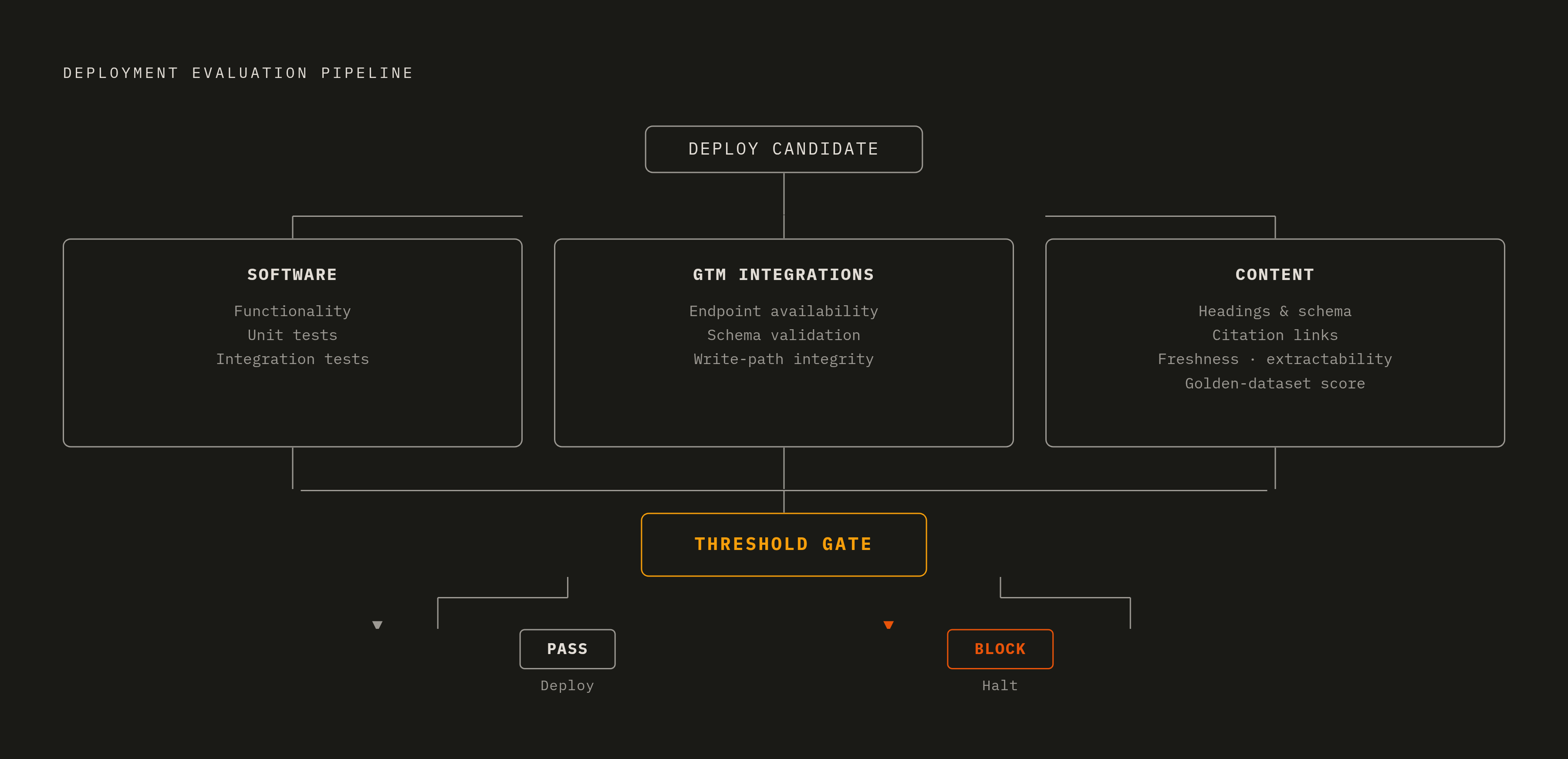
A unified gate uses a versioned golden dataset, an experiment or crawler runner, an evaluation layer, and a CI/CD decision point. The runner exercises the updated system, the evaluator scores the results, and the gate applies defined thresholds. Domain-specific metrics distinguish the layers. Software functionality, marketing integrations, and content structure can share the same release contract.
For the GTM layer, the checks cover endpoint availability for MCP-connected tools, schema validation on agent-readable API responses, and write-path integrity. A successful connection alone is insufficient. The test must also establish that the agent’s CRM or campaign mutation lands as specified. For content, a crawler can score headings, schema, citation links, freshness metadata, and clean-text extractability against the baseline. A structural regression then blocks deployment through the same decision mechanism as a software failure.
LLM-output evaluation requires an additional safeguard because its results are non-deterministic. A single-run score is insufficient to establish a stable quality change. Statistical methods are needed, and pairwise preference judging against a baseline produces more stable signals than absolute scores on individual runs. This distinction is especially important when the goal is less operational noise. An unreliable evaluation should not be mistaken for a dependable regression signal.
Human responsibility remains, but its location changes. People define what “working” means, conduct exploratory testing, and resolve high-stakes edge cases, while automation performs repetitive verification at deployment speed. Every change is tested against a known baseline, every regression criterion has a threshold, and every block produces an audit record. The pipeline takes over deploy approval from a person and becomes the gatekeeper, with a line-by-line record of what was tested, what passed, and what was blocked.