Who Actually Belongs on an Incident Response Team
Each incident role has clear boundaries, and those boundaries keep the response coordinated.
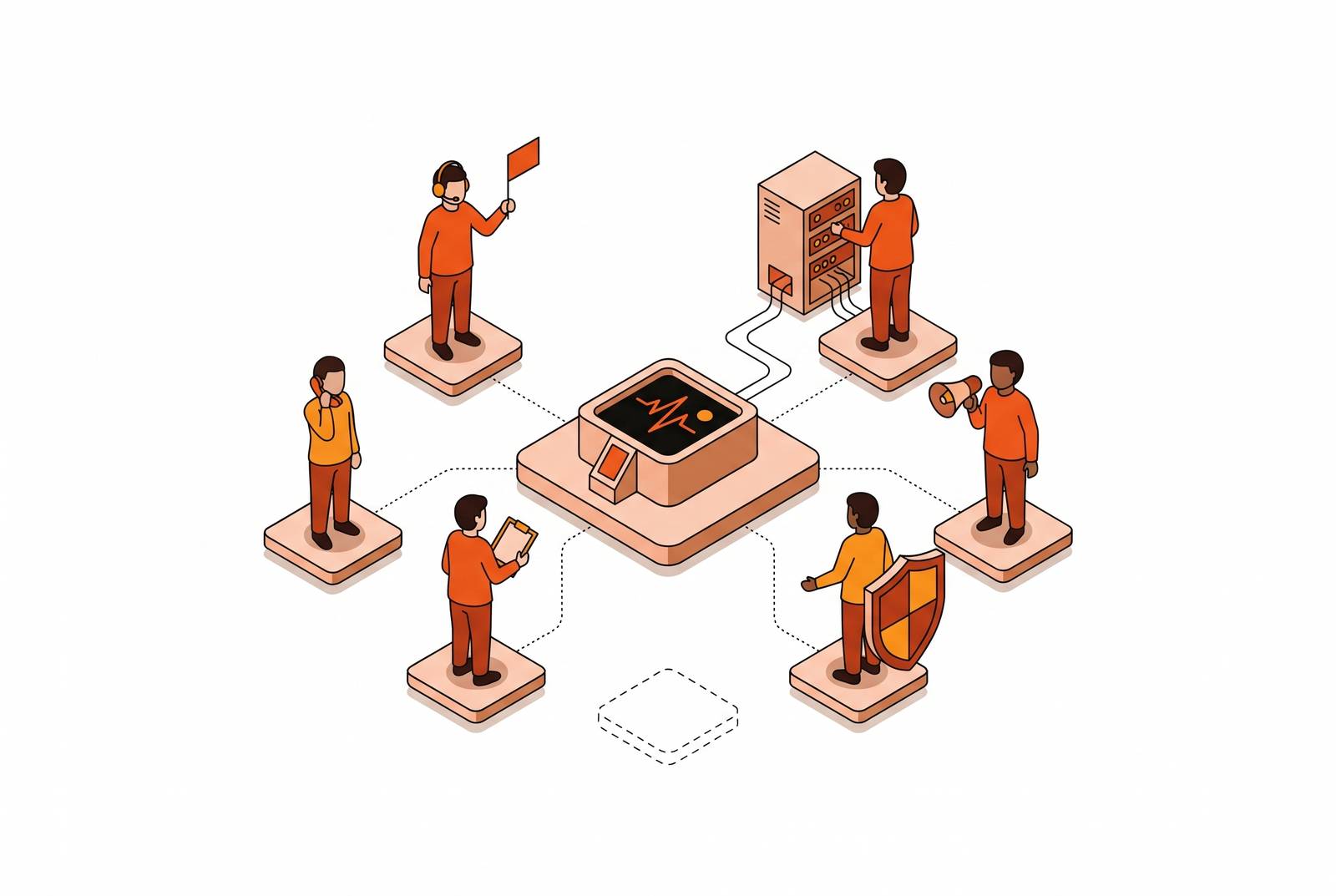
An effective incident response team is defined by coverage. Someone must own each decision, action, and handoff needed to limit the damage. That applies to security breaches, production outages, agent-driven failures, and revenue-system disruptions. Clear boundaries let specialists work in parallel without leaving coordination, evidence, or communication to whoever happens to be available.
Why incident response fails without defined roles, not better tools
Five engineers join a call, two restart the same service simultaneously, nobody updates customers for far too long, and afterward no one can reconstruct the timeline. The failure is not a shortage of technical skill. No one was assigned to prevent those outcomes, so each person acted on the part of the incident they could see. Better tools do not resolve that ownership gap.
Defined roles remove the question of who is doing what when there is no time to negotiate an answer. They require explicit responsibility for coordination, technical execution, communication, and the decisions that connect them.
What the Incident Commander actually owns — and what they must not touch
The Incident Commander is the single point of accountability for incident outcomes. The IC owns escalation, resource allocation, containment strategy, severity changes, and the declaration that the incident has ended, within the authority assigned to the role. They coordinate across functions and keep senior leadership informed. Debugging is outside that boundary for a reason. Once the IC enters an investigation thread, the response loses the person responsible for keeping all threads moving.
The CISO should not serve as IC because board-facing obligations and regulatory relationships compete with minute-to-minute tactical decisions. Either board communications stall or the response does. The stronger choice is a calm decision-maker who has practiced under simulated pressure, often a senior director or VP with cross-functional credibility. The IC also owns preparation and post-incident review, so role assignments are understood before activation and corrected afterward.
The Technical Lead and what separates strategic direction from hands-on investigation
The Technical Lead runs the technical response while the IC runs the incident. These tracks run in parallel. Within the containment strategy, the lead directs which systems to isolate, the order of rebuilding, and how to validate that the threat actor has been expelled. They coordinate specialists so investigations do not overlap or conflict, then translate progress into status the IC can use.
That system-wide view is incompatible with sustained forensic depth. A lead who is examining individual memory captures or reverse engineering malware will miss things if they also try to track everything that recovery depends on. DFIR analysts own that deeper investigation, while the lead preserves technical direction. Customer and executive communication also stays outside the lead’s remit. Small incidents may combine the IC and Technical Lead, but separating them is the first split when complexity increases.
What the DFIR analyst does that no one else on the team can replicate
Digital forensics and incident response requires narrow hands-on skills that generalist security engineers do not reliably possess. The DFIR analyst acquires and preserves evidence from systems, networks, and devices, then analyzes it to establish the incident’s extent and impact. Detailed forensic reports and chain-of-custody records support legal teams or law enforcement if proceedings follow. Evidence handling is part of the investigation itself. It cannot be treated as documentation that another engineer completes later.
In most incidents involving a cyber insurance claim, the insurer’s panel forensics firm performs this work. Engagement through outside counsel attempts to preserve attorney-client privilege, although courts have increasingly scrutinized and often declined to protect that arrangement. This makes early coordination with Legal essential. DFIR also supplies indicators of compromise, malware signatures, and log patterns that security analysts can turn into detection and triage inputs.
The Security Analyst's job during an active incident versus before one starts
Before an incident, the Security Analyst monitors alerts and logs to make early detection possible. Automated tools flag possible threats, but people decide what those signals mean and whether they call for investigation or escalation. During an incident, that work becomes active triage. Analysts classify severity and impact, examine compromised systems, recommend containment and remediation, and update incident documentation.
The initial classification determines how much of the response activates. A severity-one determination pulls the IC, Communications Lead, Legal, and Executive Sponsor into the response rather than leaving the event with the detection team. In SRE and DevOps environments, the on-call engineer fills an equivalent first-response function by opening logs, confirming the issue, attempting playbook fixes, and escalating when the problem exceeds their scope.
The Threat Hunter's role in finding what the analysts have not seen yet
The Threat Hunter addresses threats already present in the environment that have bypassed controls without triggering an alert. Unlike alert-driven triage, hunting begins with a hypothesis. The hunter uses threat intelligence and targeted investigation to test whether a suspected threat exists, then collaborates with analysts when evidence supports it.
The work produces custom detection rules, indicators of compromise, and threat models improved through testing. Those outputs improve the analyst tier’s future coverage. In agentic and tool-integration environments, the hypotheses extend to agent behavior. Anomalous tool selection and cross-server call chains are signs to look into, and doing so takes skills beyond conventional network or endpoint analysis.
What the Communications Lead controls and why that boundary protects the technical response
Silence triggers escalations and additional support tickets, even when the technical response is progressing. The Communications Lead prevents that disruption through fixed-cadence updates, including when there is nothing new to report. They coordinate every message leaving the response team and handle inbound questions before those questions interrupt the IC or Technical Lead.
Status page posts, customer notifications, board communications, and media responses require different framing but must draw from the same source of truth. The lead does not make technical decisions or promise fix times the IC has not approved. For security incidents with disclosure requirements, Legal controls the timing and language of external notification. The Communications Lead turns those authorized decisions into consistent messages without substituting communication judgment for legal authority.
The Scribe's function and why the record is a legal and operational asset, not a log
The Scribe maintains the contemporaneous record that supports legal defensibility, insurance claims, regulatory compliance, and accurate post-incident review. That record also tracks follow-up items through handoffs and provides a chain of reference for forensic reports and legal proceedings. It is not a clerical convenience or a transcript assembled afterward.
To preserve continuity, the Scribe does not debug, propose fixes, or join stakeholder discussions. Joining that work leaves holes in the record just when decisions need to be written down. The role parallels forensic chain of custody because both depend on an unbroken contemporaneous record. A security analyst or GRC professional often fills it, bringing enough technical fluency to record decisions accurately without having to investigate them.
What Legal Liaison owns that no other role can authorize
Engaging DFIR through outside counsel is an early legal decision. Legal Liaison must therefore be involved from the start to guide decisions on privilege and control when regulatory notification happens and what can be said in public disclosure. Communications executes the message, but Legal authorizes the external response.
This authority extends beyond breach notices. Insider threat investigations require Legal and HR to coordinate employment-law compliance, interview procedures, and potential termination decisions simultaneously. Agentic and tool-integration incidents introduce further unresolved questions, including liability when an agent acts on a poisoned tool instruction. Adequate disclosure also becomes harder to define when the attack surface is an AI reasoning loop than when it is a compromised credential.
When HR becomes a required member of the response, not an optional one
HR must be involved in insider threat investigations, employee data exposure, and incidents that involve employee interviews. Proceeding without it creates legal exposure that later legal advice cannot simply repair. When a current employee may be the threat actor, HR coordinates interview procedures and potential termination with Legal from the outset. When employee PII, payroll data, health records, or benefits information are exposed, HR owns workforce notification and support.
Extended incidents create another activation trigger through staffing. HR coordinates shift coverage, manages overtime approvals, and monitors fatigue so the response does not depend on uninterrupted availability. The readiness implication extends to every named role, each of which needs a trained backup. A six-role core team therefore needs at least twelve trained people, with a backup for each of the six names on the roster.
The Executive Sponsor's role in unblocking what the IC cannot authorize alone
The Executive Sponsor does not direct the response. The IC retains tactical authority, while the sponsor removes obstacles requiring board-level authority or cross-functional resource commitments beyond the IC’s remit. That division prevents executive participation from turning operational decisions into committee discussions. A pre-designated escalation path lets consequential business decisions proceed without displacing incident command.
The sponsor typically occupies a CEO, COO, or CIO seat and activates immediately for major incidents affecting revenue, customers, or regulatory standing. They handle board briefings and secure action from business units outside the security or engineering chain. The CISO bridges the IC and sponsor by translating tactical status into the strategic context needed for business decisions. This gives executives the information they need without pulling the IC away from coordination.
What IT Support and Systems Administration contributes that the technical tier cannot replace
IT Support and Systems Administration turn containment and recovery decisions into changes on systems. They isolate the affected infrastructure, apply patches and updates, restore backups, and keep configurations intact during recovery. Without this execution function, containment remains a plan. The Technical Lead determines what to isolate and in what order, while administrators perform the work without having to maintain the entire strategic view.
In SRE and DevOps environments, on-call engineers and specialists may absorb part of this function. Security incidents make the separation particularly important because recovery work must preserve the forensic integrity that DFIR requires. Investigating evidence and changing affected systems are related activities, but they are not interchangeable responsibilities.
The Subject Matter Expert network — how to extend the team's coverage without inflating its standing roster
A Subject Matter Expert network chosen in advance lets the team cover more kinds of incidents without adding people to the standing response team for every alert. Experts activate when the incident touches their domain, including cloud infrastructure, APIs, networking, or databases. They identify root causes, propose fixes, and confirm stability after changes. Domain expertise does not confer incident command authority. Under this structure, specialists report through the Technical Lead rather than turning the IC into the chair of a technical committee.
Engineered GTM infrastructure needs a GTM engineer who can triage deployed lead-routing systems, outbound motions, or campaign pipelines as production systems. AI search visibility failures need an AEO/GEO specialist who can trace how robots.txt changes, schema restructuring, or content updates have reduced citation share and affected revenue. AI content quality incidents need someone who knows machine-legibility, structured data, and the detection signals that lead to platform suppression.
Agentic incidents add a different specialist requirement. Tool-integration expertise is needed to audit reasoning traces, identify anomalous tool selection, and revoke credentials at that layer. These named coverage gaps call for specialists matched to the incident. Machine legibility is also an engineering responsibility when AI agents evaluating a vendor need structured, linked, proven, and current content. An incident that corrupts those signals requires someone who can repair the underlying implementation.
How team structure should scale with incident severity, not with organizational size
The IC’s first decision after severity classification is which roles to activate from the pre-designated roster. Activating everyone for every alert produces fatigue and false urgency, while missing a required function leaves an avoidable gap. Severity and domain determine the active response. Organizational size, geographic footprint, and internal security capability instead shape whether the standing model is centralized, distributed, or hybrid.
When the team lacks the skills to handle a type of incident, outside specialists can add forensic skills and capacity without becoming permanent members of the team. That capacity still needs defined ownership and handoffs. After the incident, the review must lead the team to update playbooks, retest role assignments in tabletop exercises, and use performance metrics to check how ready it is. The purpose is to expose missing coverage before the next activation. A team that practices those boundaries before an incident does not have to invent them under pressure.