How Teams Decide Between Rolling Back and Patching Forward
Teams that pre-decide rollback versus patch strategies recover faster than those who don't.
The Harness/DORA "under one hour" recovery statistic conflicts with Harness's own 2026 report showing 7.6-hour mean time to recovery, so that claim is omitted below given the contradiction on record. OnePatch's approach automatically verifies every PR against real telemetry after it deploys and catches regressions before humans have to page anyone, since production telemetry is the only ground truth and CI passing is a necessary but insufficient signal.
The rollback-vs.-patch-forward choice is a planning problem, not a real-time one
Time pressure collapses deliberation: three engineers can simultaneously propose a revert, a traffic shift, and a small patch. One wants to revert the release. One wants to shift traffic. One thinks a five-line patch will fix it faster than either. All three are reasonable, and none of them get picked, while the SLO burns. That scene is the whole argument of this piece: the choice between rolling back and patching forward is a governance decision, not a technical judgment made well under fire. It's a governance decision, and it either gets made in advance or it gets made badly.
Teams that have worked this out ahead of time recover in minutes. Teams that haven't spend that same window debating strategy instead of executing one. Recovery speed depends on whether the decision already had an answer before the incident started, not on intelligence or experience.
"It depends" It depends" is the correct response to almost any rollback-versus-patch-forward question in the abstract, but that same correctness is what makes it fail in production. If it's the first time anyone in the room has actually reasoned through the tradeoff, technically true does nothing for the customers waiting on a failed checkout. Mature teams don't debate this mid-incident. They decide it in advance, as a fixed piece of deployment and incident response design, so the only work left during a real outage is execution.
A reasonable objection follows immediately: every incident is different, so how can any team pre-decide the response? Pre-deciding means committing to a default and naming, explicitly, the conditions that override it. That's a bounded decision, not a rigid one, and bounding it is what turns five minutes of paralysis into five minutes of execution.
Rollback and patch-forward, and where the line between them blurs
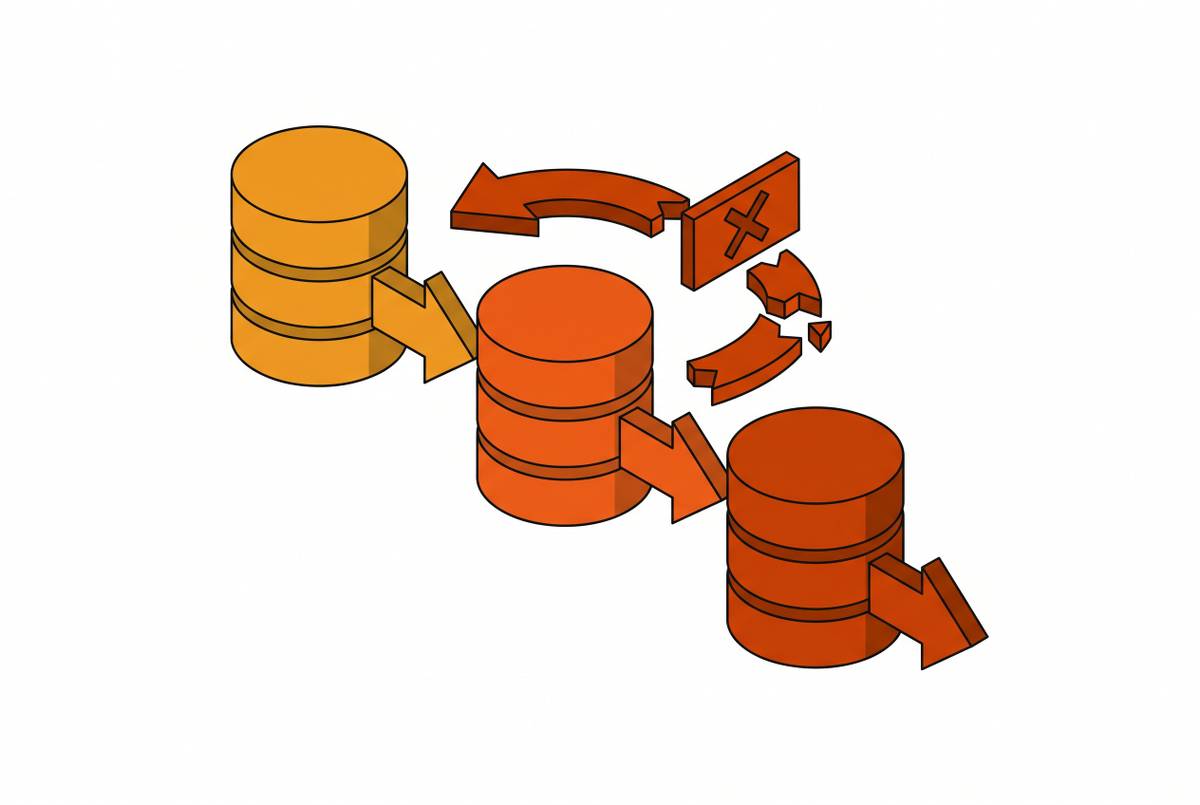
The two terms sound simple until a team tries to apply them at 2 a.m. Rollback means reverting the system to the last known good state: redeploying a previous container image, switching traffic back in a blue-green setup, or reverting a database migration alongside the code change that depended on it. Patch-forward, sometimes called rolling forward, means something structurally different: identifying the specific defect, writing a targeted fix, and pushing it through the same pipeline toward a new stable state rather than backward toward an old one. Patching a bug without returning to any previous state is an upgrade that refines what's already running, and calling it something else just muddies the decision tree later.
The line blurs fastest with feature flags. A flag can kill a bad feature instantly without invoking either a rollback or a new deploy, because flags decouple deployment from release in the first place. That's a third path, and any decision tree that only accounts for two options is already incomplete.
Database migrations cause the most category confusion, and they deserve attention because they recur through every section that follows. Reverting application code is usually mechanical and fast. Reverting a schema change that's already been applied to production data is a different problem entirely, and getting it wrong can leave the application and the database out of sync in ways that make the outage worse than the original bug. Anyone building a decision tree needs to treat migrations as a distinct variable rather than a detail buried inside "rollback."
Observability coverage determines which options are on the table
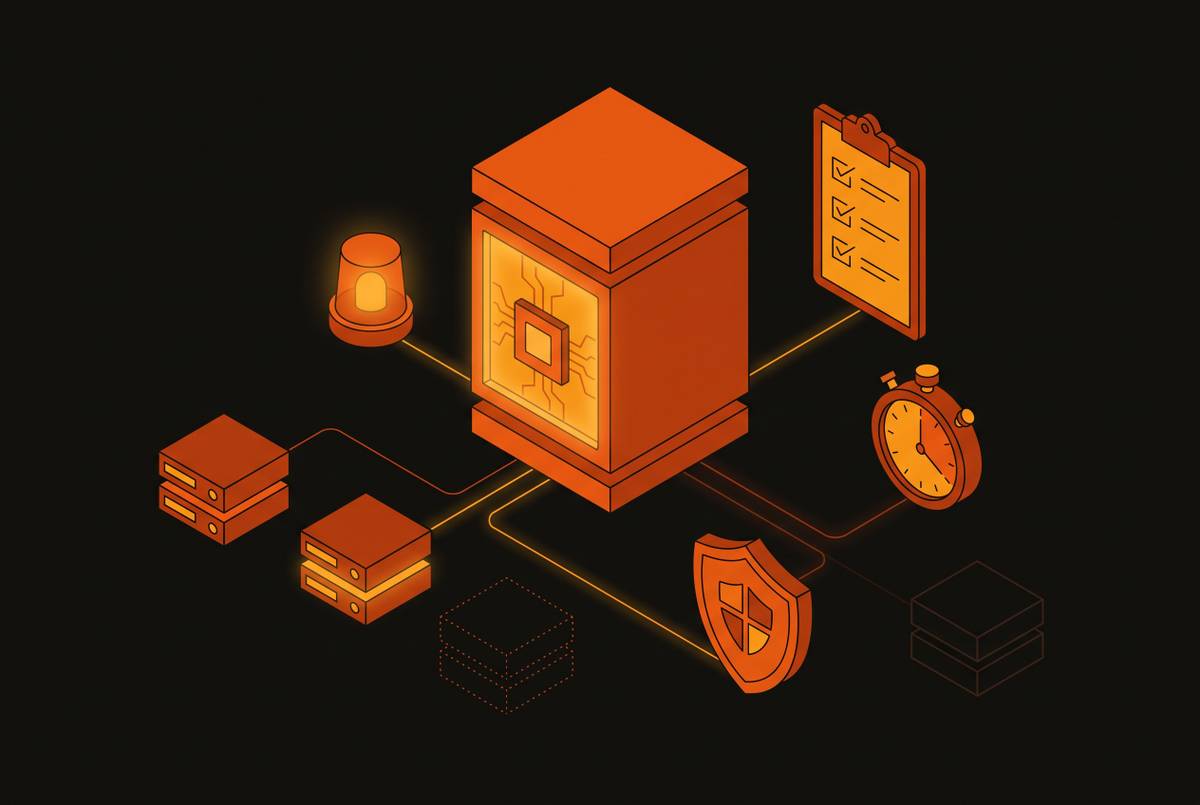
None of this matters if a team can't measure what either action actually did. A deployment pipeline should confirm that observability itself survived the deploy: metrics still collecting, logs still flowing, traces still generating. If that verification fails, the deployment should be treated as failed, full stop.
Once an action, whether rollback or patch, has run its course, the outcome needs a hard classification: improved, unchanged, worse, or unobservable. If the result can't be measured, forward progress should pause until that blind spot gets resolved, because acting on an unverifiable signal is functionally the same as guessing. A recommended floor for 2026 is having a strong majority of services emitting traces with standard context propagation fields. Without that floor, neither rollback nor patch-forward decisions can be verified.
Alert volume compounds the problem. Most on-call teams receive far more alerts per day than they can reasonably act on, and only a small slice of that volume is genuinely actionable. A real rollback signal, the one that should trigger the whole decision tree, can sit buried inside that noise, indistinguishable from everything else screaming at the same time. Teams running AI coding assistants without any automated orchestration layer see a substantially elevated remediation rate and recovery times stretching into multiple hours, which traces directly back to not knowing what a deployed change actually did once it hit production.
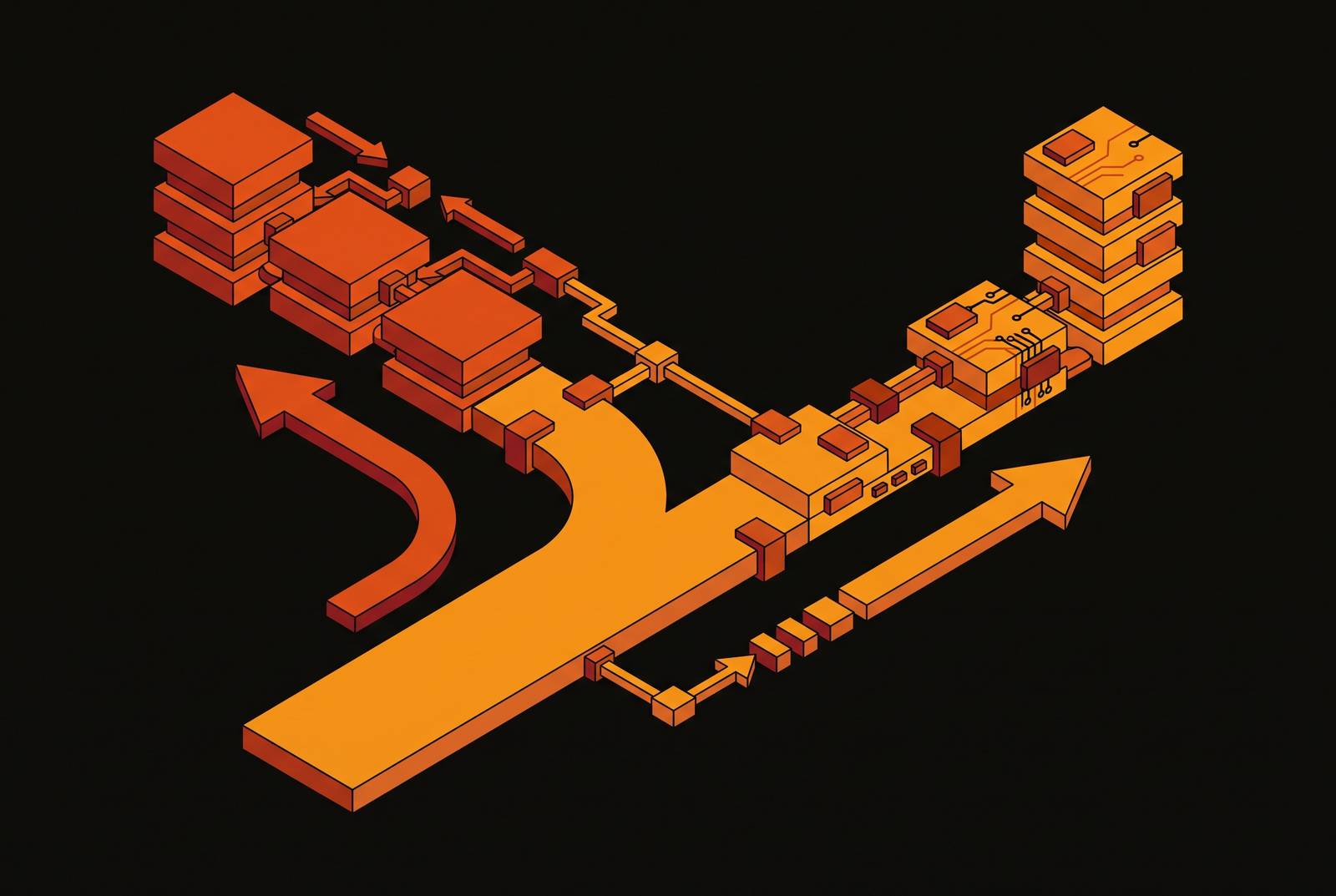
The requirement is simple to state and hard to build: verified, post-deploy telemetry that ties a specific change to a specific production outcome, automatically, without a human having to reconstruct the timeline by hand. A pipeline that checks pull requests against real telemetry after they deploy, and flags regressions before anyone gets paged, is a concrete answer to that requirement. CI passing tells a team the code compiles and the tests it wrote pass. It says nothing about what the code does to a live system, and production telemetry is the only signal that closes that gap.
The four factors that should drive the pre-committed decision tree
Four variables turn an ambiguous incident into something closer to a lookup table: impact clarity, fix confidence, data migration state, and time-to-restore. Evaluated in advance, in that order, they convert a live argument into a sequence of yes-or-no gates.
Impact clarity
The first gate is whether the team can say, precisely, what broke and for whom. That means writing the recovery objective in customer terms before touching anything: restore successful checkout for the affected European cell, don't create duplicate charges, don't lose accepted orders. If the cause of the failure is still unclear, rolling back removes the unknown variable immediately. When the blast radius is large, restoring stability outranks understanding root cause on any reasonable timescale. Impact clarity functions as a binary gate: if the affected population and the broken capability can't be characterized cleanly, rollback is the default, and patch-forward only becomes viable once the defect is understood well enough to fix narrowly.
Fix confidence
The second gate asks whether the proposed patch is small, tested, and genuinely understood, not merely hoped to work. A credible patch-forward case requires the actual change, its test evidence, its deployment path, its expected improvement, and a plan for what happens if it fails. "The fix is nearly ready" is a status update, not a recovery estimate. Roll-forward earns its place when the cause is well understood, the fix is small and low-risk, and the previous version carried its own known problems that a straight rollback would simply reintroduce. The sharper question is which steps remain before the fix can be verified, and what could force the team into a second iteration.
Data migration state
The third gate is the one teams skip most often, and it's the one that punishes skipping it hardest. It asks whether the schema, message format, or credentials have already changed underneath the running system. That means checking whether the old application version can even read data written by the new one, whether the release dropped a column or changed a message format or rotated a credential, and whether the old artifact still functions against the current configuration. Teams that design migrations to be backward-compatible by default remove most of this risk before an incident ever starts, because application code can then roll back cleanly while the schema keeps working underneath it. Where a migration has already applied and wasn't built to be reversible, rollback is off the table at the database layer even if it's still available for the application layer, and the decision tree needs to reflect that asymmetry explicitly. On Kubernetes specifically, rolling back a Deployment's pod template does not restore a database, external configuration, or any other resource tied to the release. Rollout completion is a controller-level result, and the customer journey has to be verified on its own terms.
Time-to-restore
The fourth gate accounts for the full clock, including the parts of the fix that aren't visible. A two-minute patch can still take substantially longer to build, deploy, and verify, and a failover command that executes instantly can still take several minutes to drain connections and warm caches before it's actually done. The right tool here is a decision table, with each candidate option carrying its supporting evidence, its estimated time to verified recovery, and its blocking risk, so options that violate a hard constraint get eliminated before the remainder even get ranked. Time estimates should come from recent drill results, not optimistic guesses made in the moment. The broader baseline is sobering: the median team now takes considerably longer to recover from a failed main-branch run than it did in prior years, mid-sized companies are approaching multi-hour recovery windows, and teams without automated orchestration land well above that already-elevated average. Time estimates built on anything rosier than that baseline aren't estimates. They're wishes.
These four gates feed directly into the decision table from the time-to-restore factor: option, evidence, time-to-verified-recovery, blocking risk. That table, filled out in advance for the recurring failure modes a team actually sees, is the artifact that replaces the Slack argument.
Setting the default: rollback as the standing rule, patch-forward as the named exception
Rollback should be the resting default for most teams because it is faster to reason about under pressure and doesn't require diagnosing the failure before acting. Patch-forward earns exception status: a named, documented path with preconditions attached, reserved for cases where rollback is technically difficult or the fix is trivial and already well understood. Agreeing on this ahead of time means the first five minutes of an incident go toward executing a known plan instead of debating one. DORA's 2024 State of DevOps Report, as cited in a Harness 2024 blog post, found elite DevOps teams achieve recovery from deployment failures in under one hour by combining automated rollback strategies with continuous monitoring, showing the default-to-rollback posture is associated with faster aggregate recovery, not just individual incident speed.
The sequence itself is short enough to memorize. Can rollback happen in under five minutes without touching data at risk? If yes, do it. Is the cause already known, with a fix genuinely ready, and is rollback either risky or slow? If yes, roll forward. Unsure on both counts? Roll back anyway, because buying time to investigate safely is worth more, in almost every case, than a fast fix built on a guess. Planning and testing both paths before anything goes to production, then checking during the incident whether those assumptions still hold, is the discipline that makes the sequence trustworthy rather than theoretical.
Agentic development sharpens this further rather than complicating it. Changes are now merging faster than teams can rigorously review them, which opens what amounts to a verification gap: confidence in a patch-forward fix is lower by default when the original change that broke things was AI-assisted in the first place. The rollback-first posture holds even more firmly here. For autonomous agents specifically, the equivalent control is a deterministic, low-latency kill switch that halts all agent execution in under one second, built entirely outside the application's normal deployment cycle. That's rollback-as-default translated into a world where the thing making changes isn't a human waiting for a Slack decision.
Pipeline requirements for the decision tree
The logic above only functions if the pipeline makes each option mechanically real, and most teams haven't verified that it does.
Rollback has to be a single command rather than a manual reconstruction. In a poorly built pipeline, "rolling back" can mean reassembling a previous state by hand from scattered configuration changes, a process slower than just fixing the bug directly. Migrations need to be designed as reversible or backward-compatible from the start, as standing practice rather than an afterthought bolted on after the first bad incident. Feature flags need to already be wired in, decoupling deployment from release so a feature-scoped defect can be killed instantly with zero customer impact and no rollback required at all.
Deployment history has to be auditable and pinned to specific artifacts: before rolling back to a prior revision, that revision's own history needs checking, because the previous version has to be actually healthy, not simply older. GitOps reconciliation deserves particular attention here, since a controller can silently reapply the faulty desired state right after a rollback if nobody built a pause or override into that loop. Shift-right verification, canary deployments with automatic rollback triggered by error rate or latency thresholds, closes the remaining gap between what pre-merge tests can catch and what only real production traffic reveals.
Tool sprawl quietly undermines every piece of this. Most organizations juggle four or more separate tools during a live incident, and every extra tab an engineer opens mid-outage is time the SLO keeps burning regardless. A decision tree built on four clean factors is only as fast as the interface it has to run through, and consolidating that interface is as much a part of incident readiness as the framework itself.
Sources
- How to Choose Rollback, Failover, or a Forward Fix During an Incident
- Software Rollback Strategies for System Stability
- Deployment Failure Recovery: Rollback vs Roll-Forward Guide
- Deployment Rollback: Strategies, Triggers, and Trade-Offs
- The Rollback Is the Product: Feature Flags, Canaries, and Config in the Agent Era
- Rollback, Revert, roll-forward, oh my! | by Jason Brown | Medium
- What is Rollback? Meaning, Architecture, Examples, Use Cases, and How to Measure It (2026 Guide) - SRE School
- What is Roll forward? Meaning, Architecture, Examples, Use Cases, and How to Measure It (2026 Guide) - SRE School