The 3am Page You Should Have Caught at Merge Time
Review gates and business-signal monitoring catch bad GTM deploys early.

Catching GTM regressions before they become production incidents reduces on-call alert fatigue. The strongest response to noisy on-call alerts caused by bad deploys is a workflow that combines pre-deploy review gates with post-deploy monitoring of business signals. Automated checks catch broken contracts and configuration changes, while human review catches bad judgment that can go unseen when a run succeeds on technical checks.
Why GTM systems fail the same way software does
A misconfigured lead score threshold can send an account to the wrong rep without stopping the workflow. The system still appears to be working. Like a merged PR that breaks a downstream dependency, the change can remain undetected until its consequences compound in production. The 3am page is the effect, while the missing review gate allowed the cause to ship.
GTM engineering treats data pipelines, enrichment workflows, CRM integrations, and outbound sequences as a system to be designed, built, and maintained. When there are no review gates, monitoring, or instrumentation, a bad outcome is a structural failure in how changes reach production that adding more people to operate the same system does not repair.
How the GTM stack became complex enough to regress silently
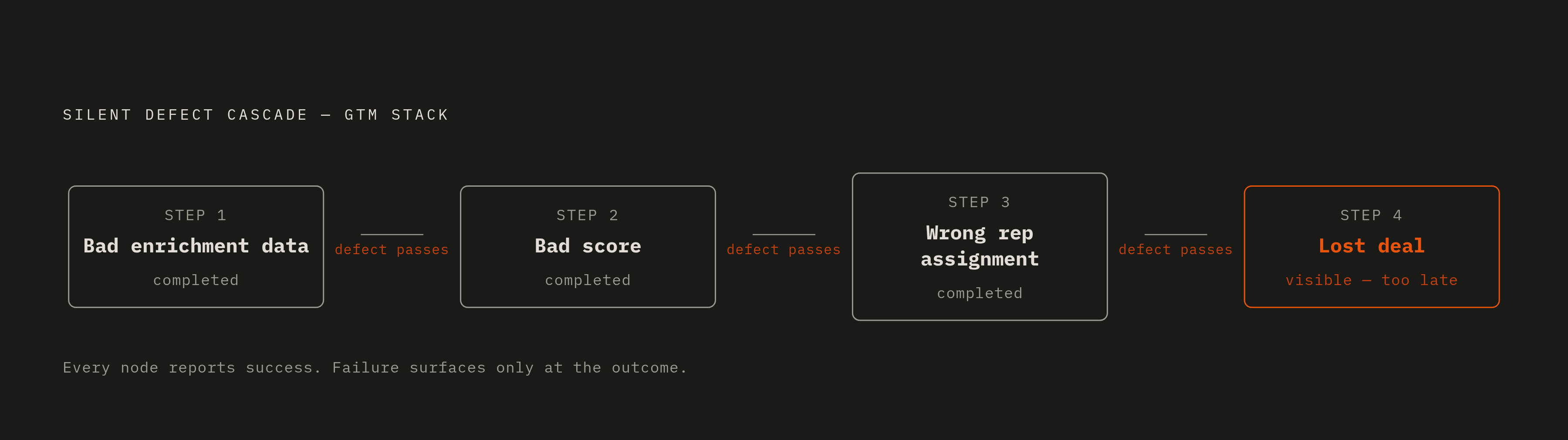
B2B revenue stacks grew faster than the teams operating them, weakening the old assumption that more headcount would produce more leads. Cursor, Lovable, and Webflow were among the early adopters of GTM engineering. GTM engineering tackles a problem that people cannot solve by coordinating the work by hand. Revenue tools overlap, many lack native integrations, and a change in one can propagate into several others without making the original defect visible.
The resulting cascade does not require a dramatic outage. Bad enrichment data can produce a bad score, which can trigger the wrong rep assignment and contribute to a lost deal. Each step may complete its assigned operation. The defect is in what passes between them, so checking that each tool is running cannot show that the system as a whole is working correctly.
Moving GTM data into Snowflake, BigQuery, or Databricks creates a shared foundation for accounts, scores, and signals. Reverse ETL then activates that modelled data in downstream tools. Each activation path remains a regression surface. A central warehouse reduces competing versions of the truth, but it does not remove the need to test how that truth reaches the systems acting on it.
Agents introduce another layer of dependency because they choose their own steps. An agent can research an account, select an angle, draft a message, enrich a record, and route the result. Its tools become part of its decision process. A regression in one tool can therefore corrupt the final output without producing an obvious execution error.
What pure-autonomy outbound taught unmonitored systems
The first wave of fully autonomous outbound executed successfully but produced work of little use. Agents were strong at reach and poor at unaided judgment. Agents produced generic messages and burned sending domains before the failure was caught. This was not merely a disappointing writing experiment, because degraded deliverability damaged the channel through which subsequent messages had to travel.
The correction was a human review gate inside the agent loop, preserving volume while restoring quality and deliverability. That intervention addressed the actual failure mode. More autonomous execution could not compensate for weak judgment, and a technically valid message was not necessarily fit to send.
The hybrid architecture that emerged wraps probabilistic model decisions in deterministic rules. Fixed logic handles routing, compliance, and validation, while models handle judgment, drafting, and prioritisation. These responsibilities require different kinds of control. Exact requirements belong in testable rules, while variable outputs require evaluation before they reach buyers. Unreviewed systems discover their limits in production.
Why agent interoperability via MCP adds new regression surfaces at every connection point
The Model Context Protocol gives agents a standard way to find and use tools across systems where connections once had to be built through bespoke integrations. This makes capabilities easier to combine. It also allows a defect in one connected tool to affect more workflows, increasing the blast radius of a regression. Interoperability reduces the work of connecting systems without removing the work of validating their dependencies.
HubSpot's official MCP server went generally available in April 2026, exposing read and write operations on contacts, companies, deals, campaigns, and email sequences to connected AI assistants. Those operations extend beyond retrieving information. When an assistant can also write into the revenue system, an integration defect can affect the records on which later actions depend. The connection is therefore part of the production change surface.
ActiveCampaign ships 34+ AI agents with MCP support that lets external tools including Claude and ChatGPT connect directly. Amazon Ads introduced an MCP server in open beta for partner AI agents to access its advertising capabilities. Adobe repositioned Marketo Engage toward agentic operations through native AI agents, MCP connectivity, and callable agents triggered by Smart Campaigns. These are different platforms with a shared engineering consequence. Work done with agents now spans tools and workflows that used to be separate.
MCP support can enable agents to share capabilities, making it a meaningful buying criterion. Compatibility alone does not establish correctness, however. Where marketing-specific connector gaps require a team to supply an integration, that connection needs the same scrutiny as any other new external dependency. The tool's expected output needs testing before a live agent depends on it.
The AI visibility channel that breaks silently when your site regresses
A GTM regression can also cost a chance to win an account before it enters the pipeline. AI answer engines weigh what is on a site and decide whether to cite it. That broadens the failure surface beyond a single page. A structural defect can affect how the site is interpreted, while a loss of crawlability can prevent content from reaching the answer engine at all.
SEO, Answer Engine Optimisation, and Generative Engine Optimisation address distinct parts of that process. SEO gets content into the pool of pages an AI reads, AEO makes answers easier to extract, and GEO helps the AI choose a source when synthesising its response. None can compensate for inaccessible source material. Schema markup, fast rendering, crawlable content, and structured answer blocks are therefore technical requirements of the acquisition channel.
A robots.txt update illustrates how a routine configuration change can become an acquisition regression. A rule that blocks a growth-engineering crawl can also block Claude-SearchBot. Anthropic warns that blocking that bot may make a site less visible in Claude's search answers. The configuration can be syntactically valid and still defeat the site's commercial purpose. A successful deploy is insufficient evidence of a healthy acquisition path.
Replacing specific, sourced claims with generic AI copy removes the verifiable detail that distinguishes a source from material an answer engine can synthesise away. More copy cannot bring back that lost evidence. Technical checks keep the site accessible and its structure intact, while content review keeps the facts that give an answer engine a reason to cite it.
How do you catch regressions at merge time and right after deploy instead of waiting for alerts?
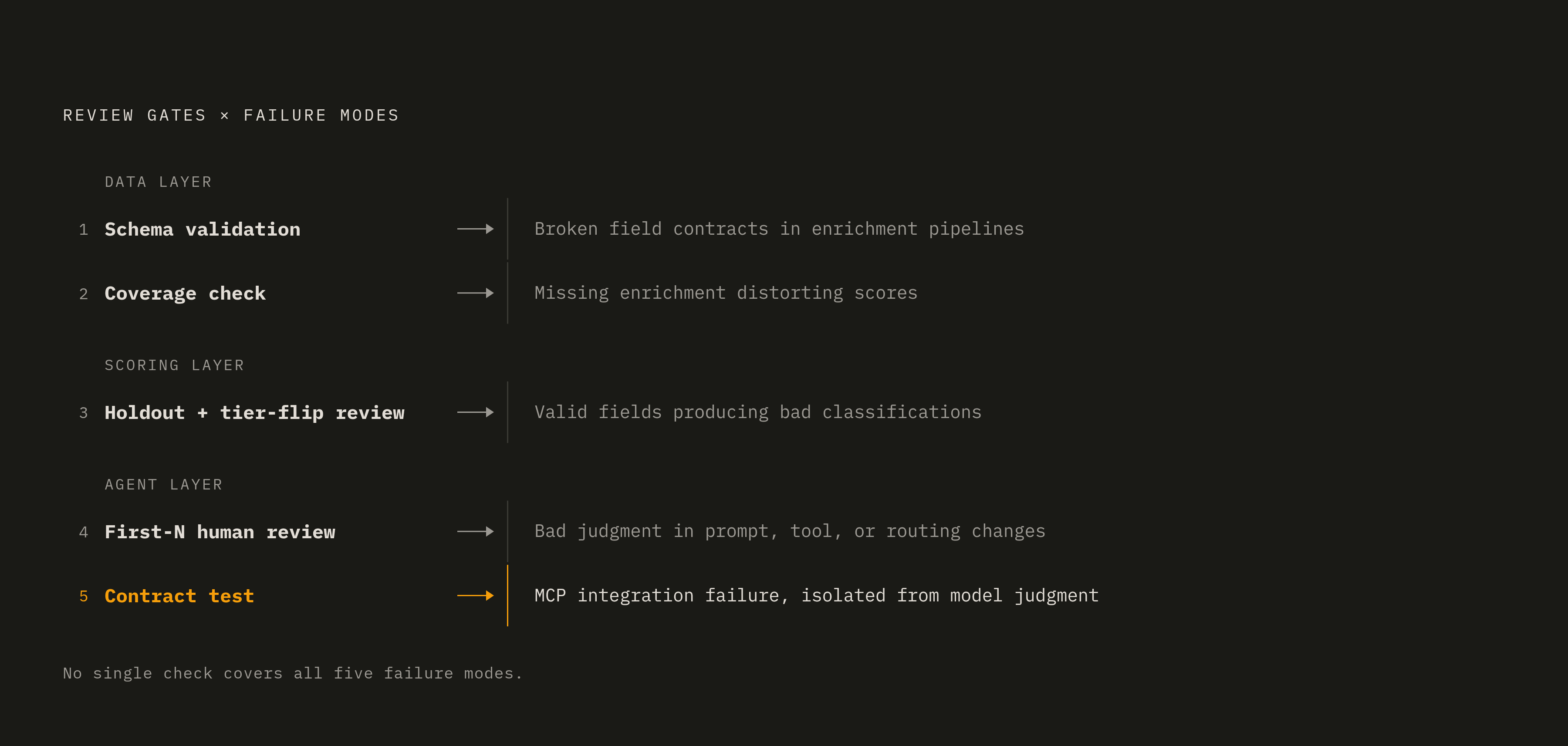
The practical response is to organise checks around the failures they must catch, starting with a shared data model. Accounts, scores, and signals should be modelled once in the warehouse and activated downstream through reverse ETL. This gives review a stable reference point. Without it, each tool can operate on its own stale copy, making a local change difficult to evaluate against the rest of the revenue system.
Before promoting an enrichment pipeline change, validate its output schema and coverage rate. A workflow that completes but returns less useful data has still regressed. Schema validation catches broken field contracts, while coverage checks address missing enrichment that can distort later scoring.
Scoring updates require a different gate because valid fields can still produce bad classifications. Run the new model against a holdout set of historical deals before activating it. Flag accounts that flip tier for review before rerouting them. Tier changes deserve an explicit decision before activation. This gate targets the cascade from changed score to changed ownership before that cascade reaches a rep's queue.
Agent workflow changes need human review of the first N outputs after any prompt, tool, or routing change. The autonomous outbound failure explains why this review belongs in the release workflow. Deterministic checks should enforce routing, compliance, and field requirements, leaving reviewers to evaluate the judgment expressed in research, prioritisation, and messages.
For an MCP integration, write a contract test against the tool's expected output before connecting it to a live agent. This tests a dependency at its boundary. It separates an integration failure from a failure of model judgment. That separation makes the regression surface smaller and easier to test in isolation.
Site changes need structured crawlability and schema checks in the deploy pipeline so that a robots.txt change or schema deletion produces a failed check that flags the risk of visibility loss. The site must remain readable and interpretable by the systems through which buyers discover it.
After deployment, monitoring must track how the system affects the business in ways that can be measured, as well as whether it runs successfully. Define the signals that reliably precede a deal and alert on deviations from their normal firing rate. A sudden drop requires diagnosis. It may reflect a market shift or a system regression, and instrumentation must make that distinction possible.
Review gates reject known failure modes before broad exposure, while monitoring detects changes that become visible only under production conditions. Neither replaces the other in a release workflow. Reducing alert fatigue means catching defects earlier and alerting on meaningful deviations.
What the agent-era buyer means for the cost of a missed regression
An AI agent can handle discovery, evaluation, purchase, and post-purchase logistics on a buyer's behalf. The human may never see the excluded offer. A site regression can therefore affect a purchasing decision before there is a visitor whose behavior the revenue team can observe.
OpenAI, Stripe, and Meta co-published ACP in September 2025, with major extensions in 2026. Google announced Agent Payments Protocol in September 2025 and launched Universal Commerce Protocol in January 2026. UCP is compatible with AP2. These protocols make agent-driven transactions an infrastructure question now, rather than a distant scenario that can be deferred until buyer behavior changes completely.
An agent evaluating an offer needs structured data, verifiable claims, clear pricing, and machine-readable proof. A poorly structured or crawl-blocked site fails before persuasion begins. If the offer is not executable by the agent, demand can move elsewhere without an alert, a bounce, or a retry visible to the seller. Brand strength among human visitors does not repair an inaccessible machine-facing path.
The cost grows with the share of buyers delegating decisions to agents because the same defect can exclude an offer across that buyer segment until it is corrected. Review gates and instrumentation therefore protect access to demand and operational stability. The asymmetry is decisive for the release process. A human buyer who encounters a broken page might retry, while an agent moves on.