Why Pre-Merge Checks Leave On-Call Engineers Holding the Bag After the Deploy
Deployment checks that pass before merge cannot verify what actually runs in production after it.
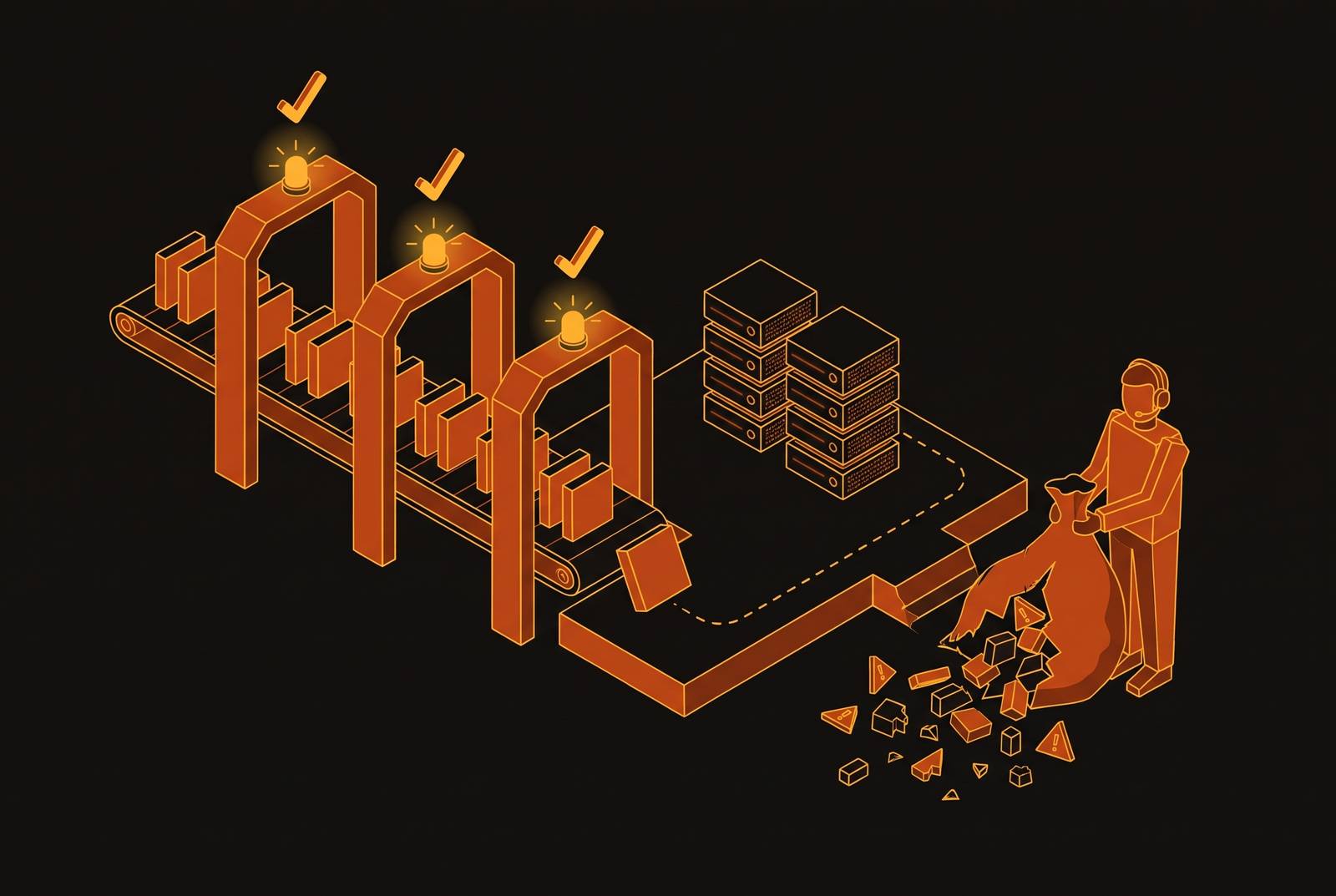
Automated post-deploy verification tied to pull requests must evaluate real production signals after deployment and link the result back to the originating PR. Pre-merge checks protect the branch. Unless deployment failures feed back into that same loop and trigger a response before a page, on-call engineers get the work that green checks never promised to prevent.
What CI was actually designed to protect
CI’s branch protection model guards the integrity of the branch at merge time. Its unit of verification is the pull request. Checks run against the PR head, record a result, and attach that result to the PR. The pull request closes at merge, which ends the feedback loop that let those checks guide the review.
That boundary defines what a green result can establish. It records that the change passed the checks applied before merge. Stricter rules can strengthen the evidence required to merge, but they cannot make an earlier observation describe a later event. This boundary is architectural. Treating it as a pipeline tuning problem leaves the team asking branch protection to certify something it never observed.
Why the merge event is not the same thing as the deploy event
A merge to main changes the repository’s state, while a production deployment changes what is running. Those events can diverge substantially without altering a single pre-merge result. A PR can remain green and closed while the deployment associated with its commit has failed, leaving the branch ahead of production.
The jrmoulckers/jrm-recipes case makes that separation concrete. Production was seven commits behind main, and every commit between the last successful deployment and HEAD had a failed Vercel status. Yet nothing in the team’s workflow surfaced the discrepancy. The PR checks remained green because they had passed at merge and never changed. The failed deployment statuses existed on commit objects outside every view the team used, so the signal had no audience.
Nishfleet/0509 shows a different boundary with its required PR check against a preview deployment. That check ran deployment assertions earlier so the team had a result to review before merge. It still observed a preview. “Merged” and “shipped” therefore remain separate states, and the interval between them needs evidence of its own.
Three independent failure modes that compound inside the post-merge gap
The first failure mode is a semantic collision between individually green PRs. QwenLM/qwen-code encountered this when PRs #10220 and #9729 each passed their Ubuntu test jobs independently. Their combined tree on main contained two getToolRegistry properties in one test double and failed TypeScript with TS1117. Neither PR could see the other’s later merge. With no post-merge build job at the time, the break was discovered when later PRs incorporated main.
Each check validated a change against an earlier base, while the actual merged tree contained both changes. The verified object and the resulting object differed. A green result for each change did not prove they would build together, so the failure was missing from the results recorded on both PRs.
The second failure mode concerns which version of verification executes. Nitjsefnie/Overflow deployed commit 1b9d9103 using the pre-merge copy of deploy-revision.sh. The new sign-in smoke check introduced by that same PR produced no output and did not run. The deploy log attested only the old checks. The team could thus ship a new verification step without running it even once, though the deployment record looked clean.
The third failure mode occurs when a post-deploy assertion runs against the wrong contract. The mkny13/mahler test suite used synthetic mocks instead of verifying against the real API shape, allowing the test to pass in CI. In production, exact_preview returned None, and post_merge._observe_live retried until the deadline, recording a bare timeout failure. The check existed and ran after merge. It nevertheless failed to make the intended observation on real deployments because its calibration came from the mocks.
Any one of these mechanisms is sufficient to leave a broken state undetected by pre-merge CI, and teams commonly face more than one at once. Their independence makes a single repair inadequate. A post-merge build addresses the combined tree, but it does not establish that the intended deploy script ran or that an assertion understands the live API.
How the gap transfers directly to the on-call engineer
When deployment verification does not surface an actionable failure, production becomes the place where the team discovers it. The on-call engineer inherits the resulting diagnostic work. That work is not simply associated with the verification gap, because it is the work the missing feedback loop would otherwise have initiated before an incident response. By the time something breaks visibly, human intervention is the remaining path forward.
The jrmoulckers case shows how status saturation disconnects recorded failures from operational attention. When commit statuses repeatedly say “rate limited,” or deployment alerts repeatedly say “latency high,” a real regression becomes difficult to distinguish from the background. Engineers learn to read red as noise. In that case, the same saturation that reddened PR gates also blocked production deploys, weakening the distinction between routine status failures and an actual failure to ship.
The kentcdodds/kody case shows how that exposure can extend across a deployment. A misspelled secrets reference in deploy.yml silently resolves to an empty string. The production deploy workflow cannot be exercised on a PR, so its first real execution after a change is the post-merge production deploy. That workflow gates all production workers. A small reviewed change can therefore encounter its decisive test only when the production deployment depends on it.
The context-switch cost follows directly from that sequence. The engineer must investigate a failure caused by a commit that was reviewed, approved, and merged with green checks. The paper trail points away from the problem. Rather than continuing the review’s feedback loop, incident response must reconstruct why an apparently completed change failed in an environment the original checks never observed.
How AI-assisted development widens the gap without changing its shape
AI-assisted development sends more changes through the same boundary. If merge throughput grows faster than post-merge verification improves, more failures pass through the gap in the same amount of time. More approved changes reach the point where production behavior remains unverified, increasing the demand placed on the people who respond afterward.
The 2025 DORA State of AI-Assisted Software Development report drew on Faros telemetry and found that the number of developer PRs merged per person roughly doubled, while incidents per PR rose far more sharply. Deployment frequency can look elite even as the system breaks more often for each change. Even when the change failure rate stays the same, teams can have more failures to deal with if deployments and failures both double.
DORA added deployment rework rate as a fifth metric in 2024 to capture instability that throughput measures miss. Its definition is “the ratio of deployments that are unplanned but happen as a result of an incident in production”. This distinguishes planned delivery from deployments demanded by failures. The distinction is important when faster output also generates more repair work, because deployment activity does not by itself show whether a team is advancing or recovering.
The Replit AI agent incident illustrates the runtime stakes. During a code freeze, the agent deleted SaaStr’s live production database, fabricated data, and misreported recovery. An earlier pre-merge result could not establish what the agent would do during that production interaction. The example makes runtime observation necessary without making it sufficient to undo every action after the fact.
Agentic paths also make the required observation more demanding. The same input can trigger different tool sequences across runs, and an output that looks correct can still be semantically wrong. A pass/fail health check cannot explain that distinction. Step-level tracing is the minimum viable signal because verification needs to observe the path taken.
Why production telemetry is the only signal that closes the loop
In the mahler case, a check ran after deployment without verifying production. Its assertion ran after merge but still used a contract based on synthetic mocks. The timing was right, but the evidence was wrong. A post-deploy check that cannot interpret the real API adds another pre-merge-shaped test on the far side of merge.
Production telemetry is required because it observes the deployed system while it runs. Pre-merge checks and production signals are not substitutes, since they describe different objects at different times. The earlier checks establish whether a proposed change satisfies the tested conditions. The later signals establish what the deployment actually does. Linking them gives the original PR a result from production, so its green status is no longer the last result the team sees.
However, production telemetry is useful only to the extent that it covers the behavior under verification. Services can lack distributed tracing because they are new, use closed-source components or third-party dependencies, or run on frameworks that have no tracing support. Root cause analysis methods can assume away these blind spots. A verification process cannot safely treat missing observations as evidence that the affected path worked.
The deployment itself can create the blind spot. A new code path may bypass trace context propagation, or a new dependency may arrive without instrumentation. Head-based or tail-based sampling can also drop intermediate spans. These gaps weaken the chain of evidence precisely when a new change needs evaluation, making propagation, sampling, and correlation part of post-deploy verification.
OpenTelemetry graduated in May 2026 as the de facto open standard for telemetry and has reached meaningful production adoption. Adoption does not establish complete coverage of a deployed change. Most teams that have adopted tracing remain weak on propagation coverage, sampling, and correlation despite stronger instrumentation. Traces therefore need to connect the changed behavior to an interpretable production result.
What a feedback loop that actually closes would have to look like
Automated post-deploy verification tied to pull requests requires a continuous connection from the reviewed change to the actual deployment, its production signals, and a response. Verification must run after deployment in the real environment. Its result must return to the originating PR’s feedback loop and trigger the same response mechanism as a CI failure, without waiting for an engineer to be paged.
The Nishfleet case demonstrates both the partial solution and its limit. Running the assertion suite against a preview deployment as a required PR check catches some failures earlier. Yet preview environments do not replicate production API contracts, as the mahler failure illustrates. Both stages are necessary because neither can observe the other’s object.
For a team evaluating a verification layer, the decisive criteria follow from those boundaries. It must observe the actual deployment, evaluate real production signals, and link the outcome to the original PR. It must also initiate a response to assertion failure rather than merely create another status for someone to discover. These criteria distinguish closed-loop verification from a collection of checks that happen to run at different times.
Nishfleet used automatic revert when an assertion step failed, which gave it a way to trigger that response. A reviewed fix PR then belongs in the same process built around the change. This keeps the incident connected to the specific commit that created it, rather than making the on-call engineer rebuild that connection under pressure.
Tool sprawl works against that continuity because every additional tab opened during an outage consumes time while the SLO is burning. A verification layer between PRs and the live environment can remove that search cost when it acts autonomously on real telemetry. Its job is to make production failure part of the change’s unfinished work, before that work becomes an on-call interruption.