Why the Incident Loop Isn't Closed Until a Fix PR Lands in Review
Verified fix PRs in review are the only durable closure gate for incidents.
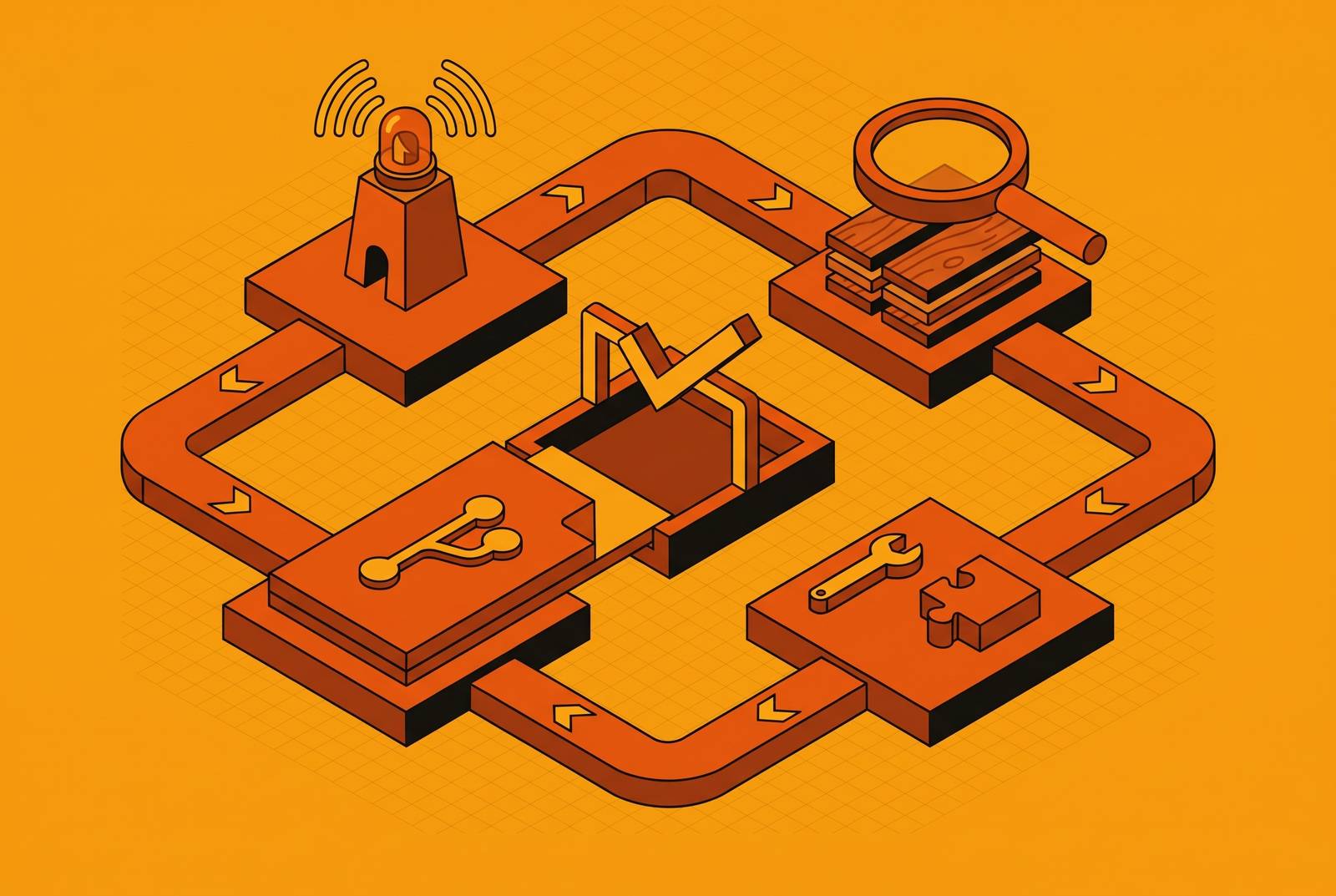
Automated fix PR generation on production regression must connect production evidence, a scoped patch, and runtime verification in one reviewable artifact. An executed action or cleared alert is not enough. The incident loop closes only when recovery is verified, a fix PR reaches human review, and the findings feed the next response.
Why "incident resolved" almost never means the system is actually fixed
An on-call engineer marks an incident resolved in Slack while the system is still unhealthy. The runbook completed, a pod restarted, and the alert stopped firing. Those events establish only that actions occurred. The distinction is easy to lose during recovery. An action gives a clear signal when it ends, while system health needs another check.
Open-loop remediation turns that distinction into a structural defect. An alert fires, a runbook runs, and the incident closes without a feedback path from the system being repaired. The automation treats a script exiting zero as a substitute for evidence that the service recovered. It can therefore report success even when the original failure is still there.
Flapping remediation makes the defect visible. The fix runs, the alert clears briefly, the root cause reasserts itself, and the alert fires again. Without verification, automation can do this for hours while each run reports success.
A cleared alert establishes that the alert is no longer firing. Establishing that the condition stayed closed requires a check against the system itself and evidence that the recovery held.
Why agentic development velocity makes this gap dangerous rather than merely untidy
AI-assisted development increases the rate at which changes reach production, putting more pressure on an already incomplete verification process. Cortex’s 2026 AI benchmark found that pull requests per author and deployment frequency went up, and so did incidents per pull request. Throughput and failure moved together.
The relevant failure pattern is not always hallucination. An agent can produce plausible code while lacking environmental context, missing an edge case, overlooking an integration dependency, or working from a snapshot that is stale by merge time. CI can pass despite those omissions. Production then exposes the assumptions that the development environment did not test.
The Harness State of DevOps Modernization 2026 found that teams at peak AI-assisted velocity also faced high remediation rates and lengthy recovery times, with many describing their working methods as unsustainable. If agents ship changes faster than teams can validate recovery, each unverified remediation adds risk to the unverified deployment before it.
The danger is therefore more specific than a growing backlog of untidy incident records. A new change can arrive before the previous repair has demonstrated that it worked. Under those conditions, additional automation accelerates uncertainty unless it also supplies a dependable way to detect its own failures.
What closed-loop remediation actually requires, and why most automation stops short of it
Closed-loop remediation measures success against the state of the system. Its stages connect the triggering observation, the attempted repair, a fresh measurement, and a decision to resolve or roll back. The feedback path is essential. Without it, automation can execute a response but cannot establish that the response succeeded.
Strong verification returns to the signal that triggered the incident. It compares the post-action state with a defined healthy baseline and observes the result for a defined window. Raising a connection pool limit is an action. Verification instead establishes that error rate and latency returned to baseline and held there, rather than briefly improving before the same condition returned.
Failure also needs a defined branch. When verification fails, the system rolls back and escalates. That branch separates a controlled attempt from an unconditional instruction to keep acting. It also prevents the next page from becoming the first acknowledgment that the previous repair failed.
Automation still has limits within this structure. Failure signatures that are new, repairs that need teams to work across multiple services, and verification signals that are unclear need human judgment. These are escalation gates. Closed-loop behavior is a design property.
The resulting audit trail links the triggering signal, action, post-action measurement, and resolve-or-rollback decision. That causal sequence gives a reviewer more than a chronology. It shows why the system acted and what evidence justified its conclusion, providing a basis for granting the automation more autonomy over time.
Why "compiled and committed" is not the same as "fixed" — and why only runtime attestation settles the question
Code review evaluates intent and implementation, while compilation establishes that a patch is well-formed. Neither proves that the original exploit or regression can no longer execute. Fixer confidence is not a substitute either. A change can look correct, pass its development checks, and leave the running system exposed to the same failure.
Ridge Security and Google CodeMender validations provide a concrete example. Two independently built AI applications applied a textbook JWT algorithm-pinning fix. The changes read as correct, compiled, and deployed. Yet a forged administrator token still returned the full user table at runtime because the applications used a 2014-era JWT library that ignored the algorithm option and because the signing key was public.
The decisive evidence came from the running applications. Inspecting the intended restriction could not establish that the library enforced it, and a successful build could not establish that the signing key was safe. Runtime re-attack tested the claim the patch was supposed to make true.
Ridge’s workflow connects a validated finding to a reviewable patch, with runtime re-attack before promotion and a human gate retained for merge. The same principle applies to production regressions. Closure depends on the running system passing the check that exposed the failure.
That check also depends on adequate instrumentation. Broken trace context propagation can leave traces that appear complete but stop before the root cause. When verification uses those traces, gaps in what they cover can lead to closing an incident too soon. Runtime evidence is stronger than build evidence only when it actually observes the affected path.
Why a reviewed fix PR is the first moment any of this can be certified as permanent
A verified fix PR in review is the closure gate because it brings intent, implementation, and runtime evidence into one artifact that a human can assess. It provides the basis for an auditable, reversible, permanent repair. Review is the first point where the proposed durable correction and the proof of recovery can be evaluated together, with deployment remaining a separate step.
Auditability begins with the link between the incident and the change. The PR records what changed, why it changed, and what verification showed about the result. A Slack thread may say what was done, while a runbook log may show that commands finished. On its own, neither links the failure, the code correction, and the evidence for closure in the same way.
A PR provides a defined change that can be reverted, rather than a collection of runtime interventions whose effects must be reconstructed. Restarting a pod or flushing a cache cannot be undone in the same way. An SSH-applied configuration change likewise lacks the same confidence of reversal unless its correction is captured in the codebase.
Permanence requires that distinction between runtime state and source. A repair that exists only in the running system can disappear with the next deployment, rollback, or scaling event. A merged correction becomes part of the codebase. At review, the team can certify whether the proposed change captures that correction rather than leaving recovery dependent on a temporary intervention.
The closure gate therefore needs more than an opened PR. It needs a reviewed artifact with verification evidence. Recovery then flows back through the CI/CD pipeline that introduced the issue, instead of remaining a manual adjustment that the pipeline can overwrite.
How does an incident response pipeline generate a fix PR instead of just an action log?
The bottleneck is often the on-call engineer’s cognition at 3 AM. The engineer reads the alert, correlates logs and traces, forms a hypothesis, writes or approves a fix, and opens a PR. Each handoff demands that context survive another tool or dashboard. Meanwhile, the SLO continues to burn. Automating isolated actions leaves much of that work untouched.
For a growing class of stack-trace-anchored errors, the sequence through PR creation is automatable. Tooling can read the error, retrieve the relevant files, form a hypothesis, write a scoped fix, run CI, and open a pull request. This lets people use their judgment at review without having to step in at each earlier stage. It does not establish that every production regression can be repaired without escalation.
Trustworthy generation starts with real production telemetry. It also requires correlation between the deployment and regression, a patch scoped to the failure evidence, and verification against live observability data before the PR is opened. Producing a diff is only one stage of producing evidence that a regression is fixed.
Graduated autonomy provides the safety model for that pipeline. The system earns permission to do more only after its verification step shows that it can reliably spot repairs that failed. Nothing silently merges to production. Human review and merge are still required gates, and new failures and unclear evidence still trigger escalation.
The agent also needs feedback from its mistakes. The root cause, correction, and missing test belong in its future context. An agent runbook keeps that feedback up to date for the agent to read before it touches the relevant code paths.
How to know when the incident loop is genuinely closed — and what to measure to get there
Engineering leads need three conditions for closure. The system signal must return to baseline, the correction must exist as a reviewed PR, and the postmortem must feed the next cycle. These conditions test different parts of the response.
The first measurement is the signal that exposed the incident. Latency and error rate must return to the pre-incident baseline and hold for a defined observation window. The evidence comes from observability data.
The second check is traceability at the codebase gate. The PR must link the incident, the change that produced recovery, the telemetry evidence, and the verification result. Reviewers need that chain to judge the repair. Without it, a team may have achieved a real recovery without establishing that its proposed code change preserves it.
The third check is whether the postmortem changes preparation. A traceable timeline must feed improvements to playbooks, runbooks, threat models, or the agent’s context. A document that changes none of those is a record.
The practical test is deliberately demanding. Would the resolution withstand an explanation to a regulator, a customer, or the on-call engineer inheriting the system next quarter? Could the team point that person to the reviewed PR and the runtime evidence supporting it? If not, the loop is not closed.