Closing the Incident Loop With a Reviewed Fix PR Instead of a Page
Automated fix PRs turn incident hypotheses into reviewable code backed by production evidence.
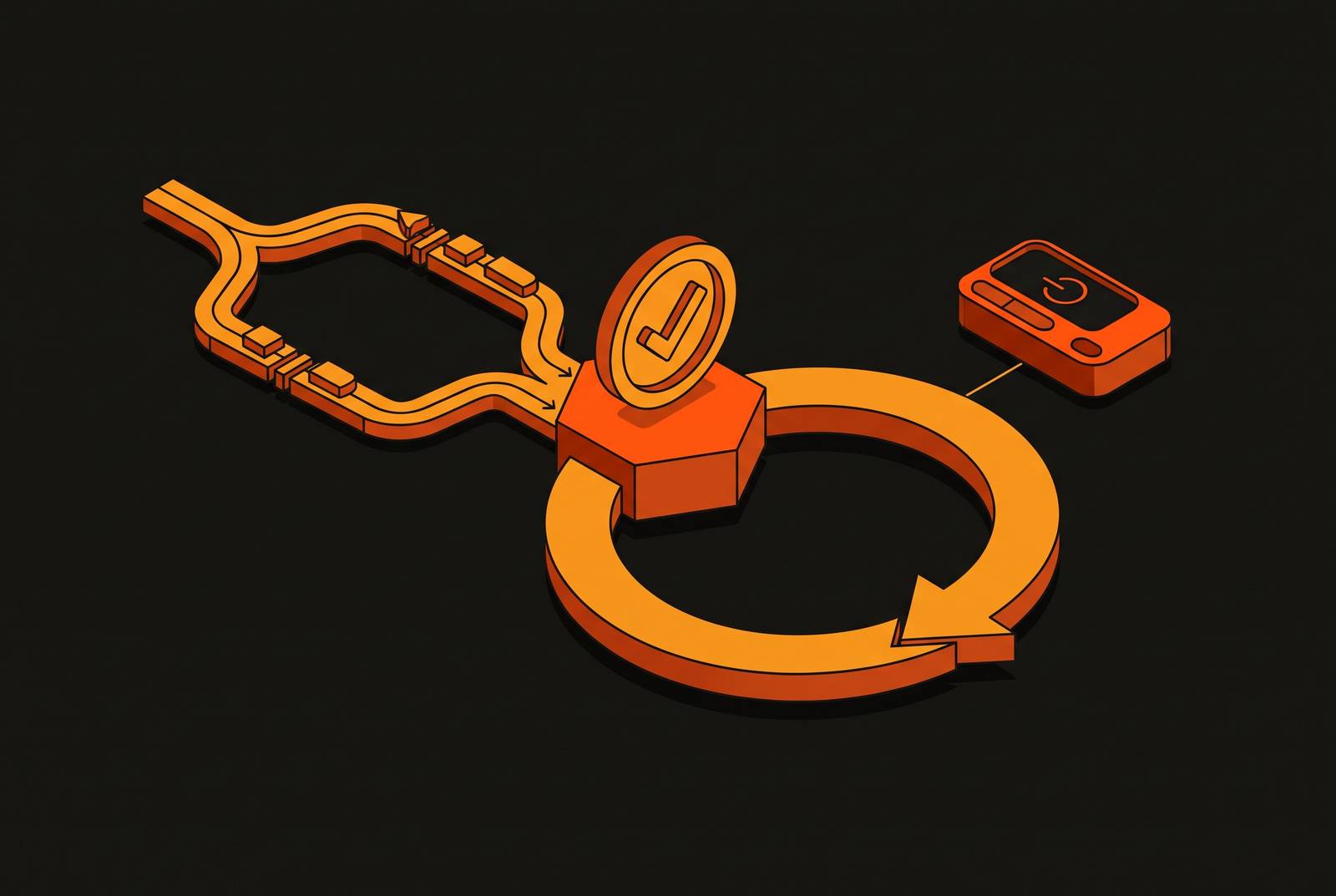
Automated fix PR generation on production regression turns a hypothesis about an incident into code that engineers can review, deploy, and check against live telemetry. OnePatch helps run this loop by opening fix PRs and checking changes against production signals after they deploy. The correct unit of incident closure is a reviewed fix PR backed by evidence that the repair worked.
Why the incident loop fails at resolution, not detection
At 3 AM, the phone lights up, alerts flood in, and the Slack channel is already filling. Engineers start sorting through the symptoms, which include 500s, latency spikes, and failures across services that depend on one another. They need to get the service back up, so they face the same pressure as they investigate and repair it. When the service recovers, the channel quiets down. Yet recovery alone does not establish what failed or whether the conditions behind it have changed.
The structural defect is the collapse of three distinct activities into one rushed response. Troubleshooting stops the bleeding, root cause analysis explains the failure, and the postmortem records what happened. The symptom may come from a configuration change three deploys ago or a memory leak that crosses a threshold when traffic peaks. If the response ends with verbal agreement about that cause, the proposed repair never becomes an artifact whose reasoning can be reviewed. Google's SRE postmortem model makes preventing recurrence the goal.
Richard Cook describes failures in complex systems as requiring “multiple contributing causes, each necessary but only jointly sufficient”. A repair aimed only at the trigger can leave those other conditions intact. Responders therefore need a faster answer and must preserve the causal argument, turn it into a change, and establish whether that change addressed the failure.
What the toil actually costs the engineers running this loop
The effort required to construct that argument falls on the on-call engineer. During a live incident, engineers spend over 30 minutes stitching context across fragmented tools. Logs, metrics, dashboards, and recent changes must be reconciled while the service remains impaired. Finding the right responder by hand, setting up a channel, and bringing others up to speed takes more time while the SLO burns. This is structural toil.
Faster detection helps, but it does not remove the work between an alert and a repair. Intelligent correlation can reduce detection time, and automated workflows can shorten acknowledgment time. Neither improvement establishes that the proposed fix addresses the cause. If engineers still have to reconstruct the evidence and carry it manually into a code change, the most demanding part of the response remains fragmented. Resolution time reflects that unfinished handoff.
Buying more AI monitoring without changing the closure artifact can add another tool to the same cycle. In a production verification platform such as OnePatch, detection leads into automated investigation and fix PR generation as parts of the same loop. That connection targets the context switches during the most time-sensitive phase. Its value depends, however, on the evidence being strong enough to support the proposed change.
What it takes to convert an alert into a trustworthy fix hypothesis
A hypothesis that engineers can trust must explain how the suspected cause led to the symptom they saw. Naming an anomalous service is not enough, because the service may be suffering from a failure elsewhere. The OpenRCA 2.0 preprint found that frontier LLMs identified at least one correct root-cause service in roughly three-quarters of cases, but grounded it in a verified causal path far less often. They rarely found the exact root-cause set. Automated investigation must therefore preserve the distinction between a ranked suspect and an explanation supported by evidence.
This work rests on a dependency graph built from real production traffic using parent-child span relationships. Static architecture documents cannot reliably represent a system after services have been refactored. OpenTelemetry, the CNCF graduated project, provides a vendor-neutral framework for generating, collecting, and exporting the necessary telemetry. An OTel-native pipeline can route that data to another backend without re-instrumentation. The investment supports investigation and verification rather than tying the evidence to one stage of incident response.
Two gaps can undermine that foundation, namely missing instrumentation and broken context propagation. The first creates blind spots, while the second fragments a single request into disconnected traces. Async boundaries deserve particular attention because message queues, event buses, and async job processors require explicit context injection and extraction. Synchronous HTTP and gRPC auto-instrumentation does not remove that requirement. Without the connection across an async boundary, an investigation cannot trace the affected request end to end.
With that evidence available, change analysis narrows attention to recent changes, timeline reconstruction orders deploys and symptoms, and the 5 Whys tests a clear causal chain. AI compresses the evidence into ranked explanations, while review tests whether the reasoning holds. How deep the investigation goes should depend on the incident, so a Tier 1 quick investigation may lead to a one-line fix PR. A Tier 3 incident may need changes across services with a full postmortem attached.
How does an incident response pipeline generate a reviewed fix PR end to end
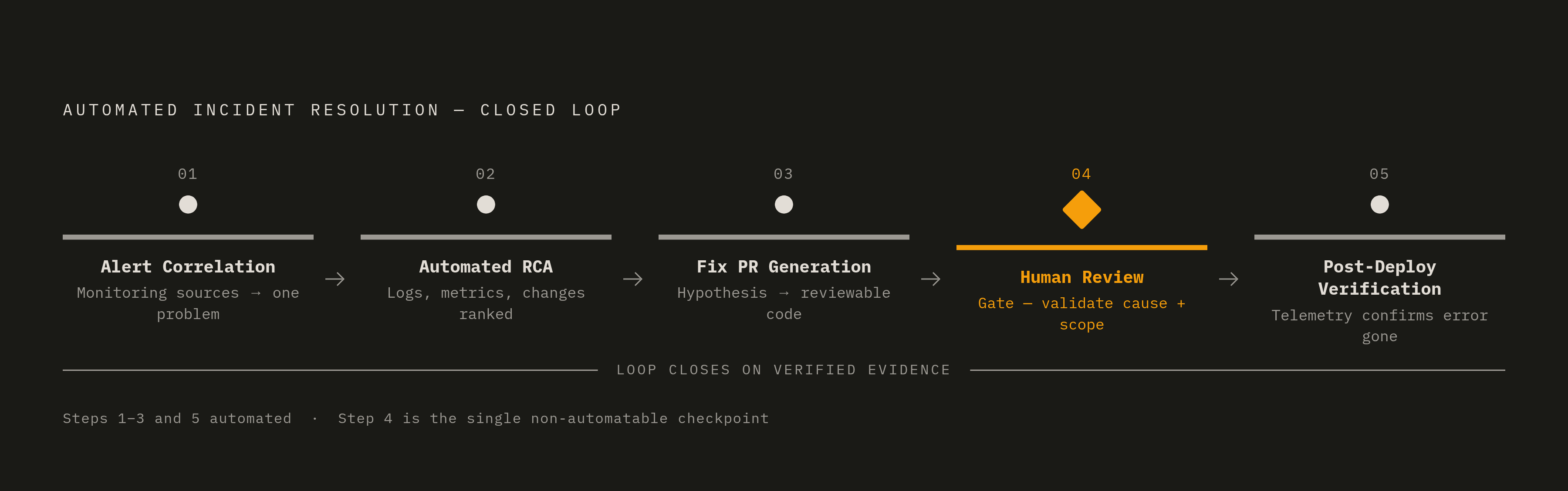
The sequence starts by correlating alerts from monitoring sources into the problem that needs investigation. A cascade of symptoms should not become a separate investigation for every firing alert. Automated RCA then examines logs, metrics, and recent code changes to identify anomalous patterns and rank probable causes. At this stage, the output is still a set of explanations to test. The telemetry foundation determines how much of the causal path those explanations can account for.
For an identified cause, fix PR generation converts the proposed remediation into code. This is the decisive change in the workflow because the hypothesis now has a concrete implementation that another engineer can inspect. A reviewer can assess both the explanation and whether the diff follows from it. The PR becomes the gate before merge. Once the accepted change deploys, production telemetry must show whether the error pattern linked to it has disappeared.
OnePatch supports the latter part of this sequence by opening fix PRs autonomously when production breaks and automatically verifying deployed PRs against real production telemetry. Its relevant capability is the connection between detecting a regression, proposing a repair, and checking the result. An alerting workflow delivers a signal that demands attention. A fix-PR workflow carries that signal into a proposed change and then into evidence of resolution. Creating the proposal automatically can save manual work before review without giving permission to merge it unattended.
The artifact matters because different records preserve different parts of the response. A Slack discussion can capture useful reasoning, but conversation alone does not enforce review or verification of a change. A postmortem can record what happened in the incident, but people still need to carry out its action items and follow through on them. A reviewed fix PR connects the reasoning to versioned code, preserves it in git history, and allows the change to be reverted. When production evidence is attached to that outcome, the record covers both the decision and its result.
Why human review inside the PR is not optional, even for AI-generated fixes
Generating a fix quickly does not remove the need to decide whether it is safe to deploy. Automation multiplies the amount of evidence an engineer can consider and the speed at which a proposed repair becomes available. Review supplies the judgment that makes that speed useful in production. IBM Research's ITBench benchmark found that state-of-the-art AI agents autonomously resolved only a small fraction of real-world SRE scenarios. That result supports a division of labor in which automation compresses investigation while a human accepts or rejects the repair.
The reviewer is assessing more than whether the patch looks plausible. The causal explanation must hold up when checked closely, especially when several conditions could have helped cause the same symptom. The change must also fit the incident's scope rather than address only the first convincing suspect. Customer impact, data correctness, and unclear blast radius require an assessment of consequences that telemetry alone cannot fully capture. The PR makes that assessment part of the production change.
DORA research found that greater AI adoption went with less stable software delivery and that strong automated testing, mature version control practices, and fast feedback loops were needed to keep it in check. A reviewed fix PR places the proposed change within those controls. Review establishes that the evidence and proposed implementation justify deployment. An agent that merges its own fix without review removes that gate, creating a different loop.
How post-deploy verification closes the loop that code review opens
Review authorizes a production test of the hypothesis, but deployment supplies the conditions under which its outcome can be observed. Passing CI confirms that the code compiled and the tests passed. It does not establish that the error pattern in live traffic has disappeared. A service returning to normal operation is also insufficient if the contributing conditions remain.
Versioned telemetry makes that distinction operational. Span resource attributes including service.name, service.version, and deployment.environment.name allow the system to connect production behavior with a particular deployed version. Without that connection, an improvement in the error pattern cannot be reliably associated with the fix PR. The post-deploy check must examine the signal that motivated the repair. Through production-verification, OnePatch automatically checks deployed PRs against live telemetry to see whether the proposed fix resolved the incident.
That check can also reveal a repair that was justified but incomplete. A change may remove one contributing cause while leaving another latent condition in place. Production signals may then show improvement without showing that the incident is resolved. For a Tier 3 incident, each of several fix PRs across services may need its own verification before the whole repair is complete. The formal closure condition is therefore a reviewed change, or set of changes, supported by post-deploy evidence that the associated failure has been addressed.
What engineering teams need to have in place before this loop works
To be ready, teams first need telemetry that covers the services in the affected user journeys. Teams need to account for async boundaries as well as synchronous calls, with explicit context injection and extraction where required. Without that coverage, the dependency graph leaves out part of the path the investigation must explain. Versioned spans are the next prerequisite, with service.version and deployment.environment.name configured so production behavior can be associated with the deployed repair. Fix generation cannot compensate for evidence that is missing or disconnected.
Tier 1 can receive a two-sentence close, Tier 2 a lightweight structured investigation, and Tier 3 the full loop with formal RCA where warranted. The principle is not to manufacture a code change for every alert, but to carry an incident requiring repair through review and verification. A small fix can have a proportionate explanation. When a failure spans services, the investigation needs to go far enough to back all the changes.
Lifecycle tooling must carry evidence between detection, investigation, the PR, and production verification without requiring engineers to reconstruct it across separate views. Consolidation is a reliability decision when every manual handoff prolongs the outage. A blameless postmortem culture is equally important because the hypothesis must describe what happened. Where finger-pointing discourages disclosure, the proposed fix can rest on a defensive account of the incident. Neither automated analysis nor a review gate can, on its own, make that account one people can trust.
These prerequisites make the loop useful beyond the incident that prompted it. Better telemetry coverage produces a more accurate dependency graph and more complete evidence for the next investigation. The reviewed PR also preserves institutional knowledge through the reasoning, the change, and the production result. Future engineers can understand why the repair was designed that way rather than reconstructing its intent from scattered messages. Closing with a verified fix therefore reduces more than the current outage's uncertainty, because it gives the next response a stronger starting point.