Runbook Automation for Post-Deploy Incident Response
Automated runbooks cut incident response time by removing the human delay between alert and action.
The minutes after a deploy are when a runbook has to prove its worth, and they are the minutes when most runbooks fail. A deploy is a known, timestamped event with a clear cause attached to it, yet most incident response still treats the failure that follows as a mystery to be solved from scratch, reassembling context the deploy pipeline already had on hand. In practice, the sequence runs like this: an alert fires, an on-call engineer gets paged, that engineer opens a document, reads it under pressure, and only then starts doing what it says, well after the deploy itself signaled that something had gone wrong. Cutover's MIM Survey 2025 found that 85% of enterprises say automation has improved incident management, yet manual runbook execution remains the norm because their runbooks were never wired to anything capable of executing them.
What runbooks are, and the distinction between a guide and an executor
A runbook stops serving its purpose the moment it stays only a document that someone has to find, read, and interpret while an incident is actively getting worse. Cutover draws a clean line between a runbook and a playbook: a runbook is narrow and tactical, a step-by-step technical procedure for a specific failure, while a playbook is broad and strategic, coordinating who does what, when, and why across teams.
The more consequential distinction runs along a different axis entirely: how much of the runbook a machine can carry out without a human in the loop. At one end sits the static document in a wiki, a checklist a person reads and follows by hand. One step up is the scripted runbook, where commands have been collected into a script that still waits for a human to invoke it. At the far end is what Cutover describes as the intelligent or automated runbook: a dynamic, executable task list triggered by a specific alert or human action, capable of running scripts, integrating with other tools, and orchestrating complex tasks on its own. Harness's AI SRE model makes the executor concept concrete at the level of a single step: each step in an automated runbook runs an action against a connected system, sets a field on the incident, branches on a condition, or loops over a list, and posts its result to the incident timeline.
Whether a runbook is a static document or a full executor, it has to meet the same five-part bar to be worth trusting with anything automatic: actionable, accessible, accurate, authoritative, and adaptable. Rootly and Harness independently converge on this same five-attribute framework for what makes a runbook trustworthy. Automating a runbook does not fix a weak runbook; it amplifies whatever quality was already there, for better when the content is sound and for considerably worse when it isn't.
Why stale runbooks are worse than no runbook at deploy time
A runbook that is wrong does more damage than no runbook at all, because a responder with nothing in hand improvises carefully, while a responder holding a document that looks authoritative follows it straight into the wrong action. Runbooks describe a system as it existed at the time they were written, and every deploy that ships without a corresponding runbook review widens the distance between what the document says and what the system now actually does. Deploy velocity makes this mechanism worse rather than better: the faster a team ships, the faster its documentation falls out of sync with the thing it claims to describe.
The fix is to treat the deploy itself as the trigger that forces a review, rather than leaving runbook maintenance to whenever someone remembers. One concrete version of this pattern: if a deploy modifies infrastructure or a database schema, the CI/CD pipeline flags the associated runbooks for re-validation before that deploy ships, making the runbook review part of the deploy pipeline itself rather than a task that happens afterward. Agentic development sharpens the urgency further, since code can ship faster than humans can author or review the runbooks meant to cover it: the distance between what's running in production and what the runbook documents can widen at the pace of an agent rather than the pace of a release cycle. Closing that gap means wiring runbook validity to the deploy event itself, which is the structural shift the next section walks through.
Automated Runbook Execution in the Minutes After a Deploy
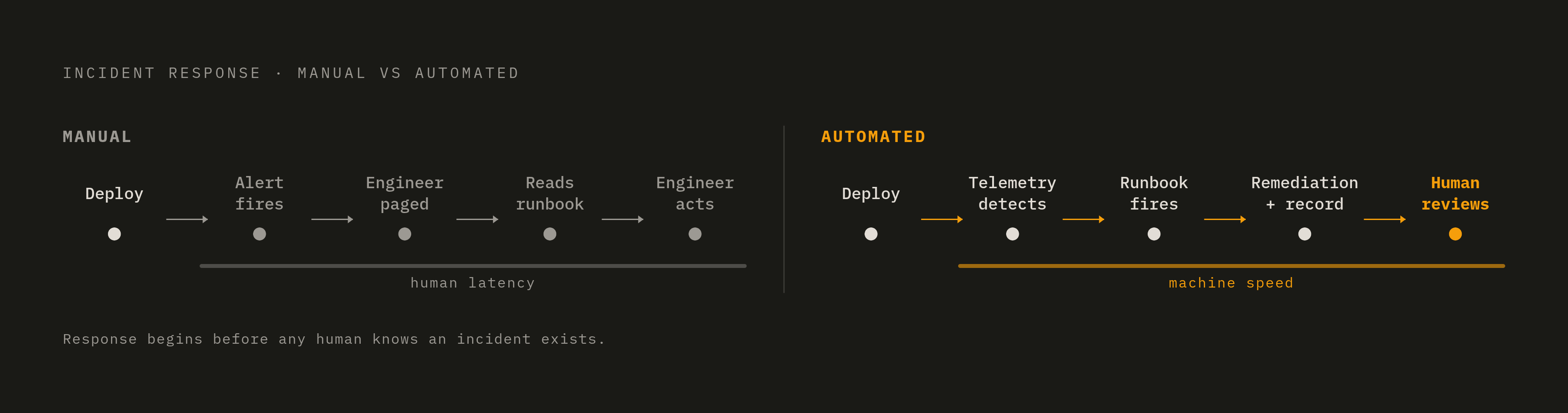
Wiring a runbook to the deploy event rather than to a paged engineer changes the order of operations entirely: the response can begin before any human knows an incident exists. The manual sequence runs alert, then page, then an engineer opens the runbook, reads it, and acts. The automated sequence runs differently: deploy, then telemetry detects a regression, then the runbook fires on its own, remediation steps execute, and the incident record populates itself, with a human reviewing what happened rather than orchestrating each step of it. Cutover frames this as removing human latency from the step where the most time is typically lost, which is alert recognition and initial triage. Harness's AI SRE model shows how far that execution can extend: the same runbook that pages the on-call engineer can also file the ticket and run the pipeline that ships the fix, where a static, human-read runbook can only tell a responder to roll back without ever running that rollback itself.
Three concrete things follow from execution happening this way that simply can't happen when a human carries out each step by hand. The process generates an audit trail automatically: timestamped records of every action taken, produced as a byproduct of execution rather than reconstructed afterward from a Slack thread. The response stays consistent no matter who is on call, firing the same way at three in the morning on a holiday as it does in the middle of a business day. And the sequencing holds: predefined scripts and API calls run in the correct dependency order without anyone having to decide, under pressure, what step comes next.
The numbers behind this pattern come from live deployments, not pilots. Cutover's Respond platform, running at a global bank, produced a 50% reduction in planning and execution time for customers using automated runbook templates, with more than a hundred live incidents run through the platform in its first year and a meaningful cut to mean time to resolution; the gain came from the consistency of execution rather than any change to the content of the runbooks themselves. Harness's AI SRE model shows the same shift in a different form: runbooks that execute on their own, file tickets, trigger rollbacks, and post updates to the incident timeline without anyone manually working through a checklist, making the runbook an active participant in resolving the incident rather than a reference someone consults.
The same executor logic can run a layer earlier than the runbook itself. Automated production verification that checks every pull request against real production telemetry, and opens a fix PR the moment something breaks, applies that same logic before the runbook ever fires: by the time the runbook executes, the system has already confirmed that the deploy caused the regression and identified which change is responsible, so the runbook acts on a context that's already understood rather than one that still has to be pieced together.
The telemetry gap that breaks automated runbooks before they can fire
An automated runbook is only as trustworthy as the telemetry that triggers it, and most production environments carry instrumentation gaps that make that trigger unreliable. Most root-cause analysis methods lean on distributed traces and assume full coverage across services, an assumption that fails routinely in practice; any service that lacks tracing instrumentation becomes a blind spot where an automated runbook has nothing to see and nothing to act on.
These gaps cluster around deploy time for a structural reason. Microservice systems introduce new services and new versions constantly, and engineers often don't have time to add distributed tracing to a newly introduced service before it ships, under release schedules that leave little room for instrumentation work. Traditional distributed tracing typically requires changes to source code, work that takes real time and real engineering effort, so new services tend to ship without it and the runbook ends up with no signal to trigger on. Even where instrumentation exists, context propagation can fail during inter-service calls, meaning trace context gets dropped or transformed in transit, so even a properly instrumented service can go dark during exactly the calls that matter most for diagnosing a regression.
The consequence is direct: a runbook wired to a trace-based alert cannot fire if the relevant service is in a blind spot, and the incident that follows reads as a mystery rather than a regression anyone could have caught. OpenTelemetry has emerged as the baseline instrumentation layer that closes this gap, since tools that ingest OTLP and read the OpenTelemetry span model work with any properly instrumented service, and the cloud-native developer survey places OpenTelemetry in its "Adopt" tier, marking it as a baseline expectation rather than an optional investment. Closing instrumentation gaps is a precondition for runbook automation to work at the moment it matters, because a team that automates runbooks without closing its telemetry gaps has only automated the response to incidents it could already see, leaving the worst ones exactly as dark as before.
Guardrails that keep automated remediation from making an incident worse
The risk in automated remediation is that it can act beyond the scope the incident actually requires, turning a contained regression into a wider outage. The strongest version of the objection to automation deserves a fair hearing: AI and automation tools don't reliably eliminate toil so much as redistribute it. Roughly half of SREs report a net reduction in toil from AI tools, and the rest report either no change or new work supervising models, operating them, and reviewing their output. A team that skips alert hygiene and buys automation anyway doesn't eliminate the noise in its incident stream; it just supervises that same noise faster.
Limiting blast radius is the first and most concrete guardrail against that risk, and it's now showing up as a named principle in production guidance rather than staying an implicit good habit. An automated rollback scoped only to the service that regressed behaves nothing like one with write access to shared infrastructure that other services depend on. The 2026 Singapore Consensus on Global AI Safety Research Priorities names ten principles for agentic systems that apply directly to automation running adjacent to a deploy: least privilege, traceable identity, auditability, validated deployment, adversarial resilience, multi-agent stability, runtime assurance, interruptibility, legibility, and human oversight.
A real limitation in current agentic runbooks complicates the picture further, and it's one that advocates for automation tend to understate: most AI tooling carries no runtime context from one session to the next, so every invocation starts cold. Static context files drift the moment infrastructure changes, and they can't capture live system state, the pattern of past incidents, or how the topology evolved to get here. This limitation is most damaging during cascading failures, precisely the moments when selecting the right runbook depends on understanding what actually changed before the problem surfaced.
Human approval sits alongside alert quality and blast-radius limits as one of three guardrails that both Cutover and the underlying research identify as essential: automation handles the steps that are high-confidence and low-risk, while anything novel or potentially destructive escalates to a person before it runs. A model that hands off a fix as a pull request, a runnable script, or a prompt for a coding agent, rather than applying that fix on its own, keeps a human positioned at the single highest-consequence decision point in the whole process. The remediation itself can run automatically. The approval to carry it out should not.