Autonomous Root Cause Analysis in Distributed Systems
Automated systems now pinpoint the actual failing service instead of chasing downstream symptoms.
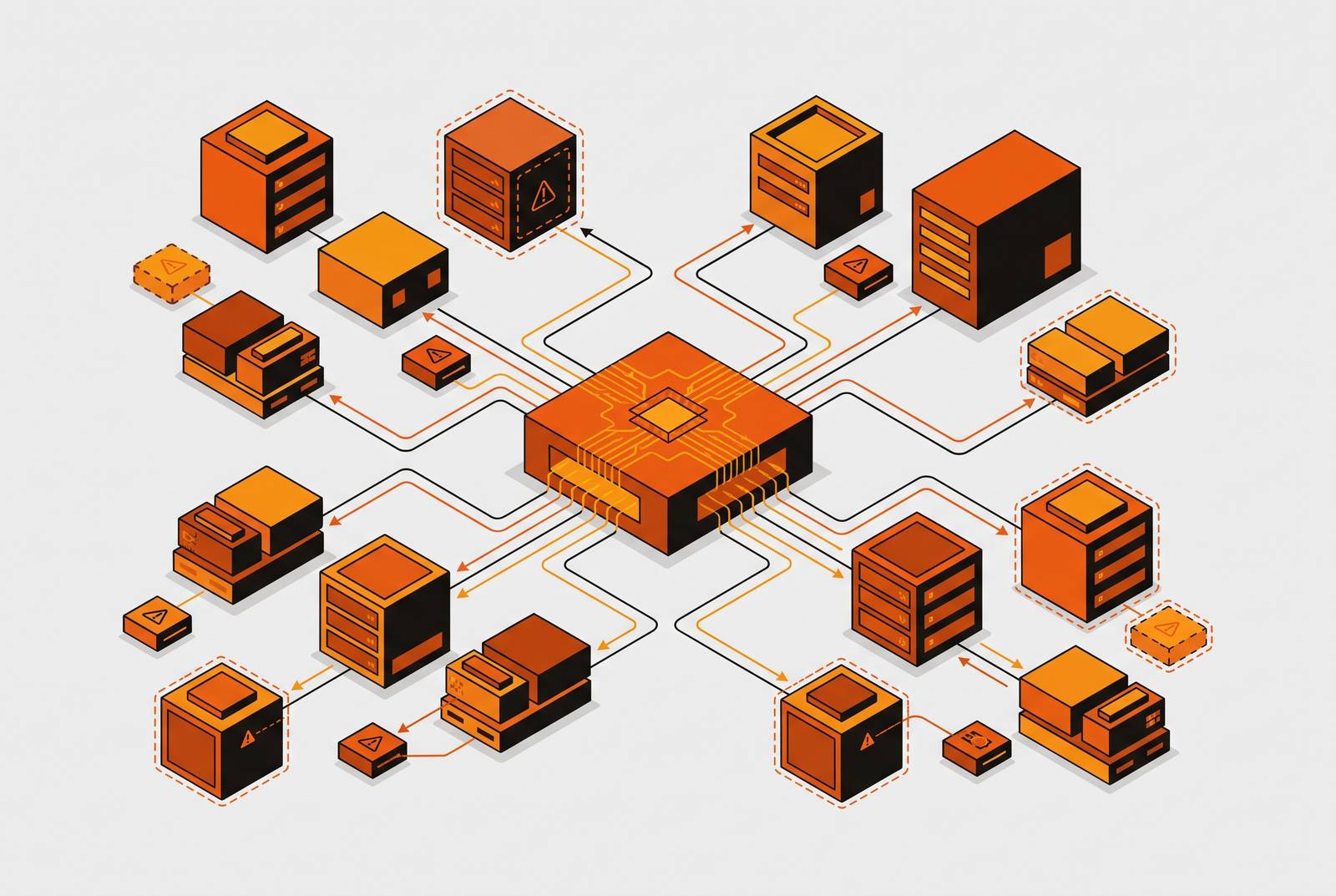
A microservice fails, and the alert that reaches an on-call engineer almost never comes from the service that actually broke. It comes from one of the dozen services downstream that depend on it. Autonomous root cause analysis exists to close that gap: it correlates logs, metrics, and traces across service boundaries to find the originating failure, rather than the twelfth symptom of it, and in doing so it collapses the investigation phase that eats most of MTTR (mean time to resolution).
Consider the canonical version of this problem, the one Mezmo uses in its own evaluation framing: checkout goes down, and within minutes seventeen microservices are alerting simultaneously, customers are blocked at the cart, and the on-call channel fills with noise that all looks urgent and none of which points anywhere useful. NeuBird AI puts a number on the asymmetry that follows. An engineer might spend twenty minutes writing and deploying the actual fix. Getting to that point, tracing through logs, metrics, and traces across a dozen services to figure out what to fix, takes three hours. The fix is the easy part. Finding it isn't.
That first hour or two is spent entirely on "what broke," and nobody can start on "how do we fix it" until that question has an answer. MTTR doesn't live in the deploy step. It lives in the investigation, and manual triage assumes a human can hold enough of the system's dependency graph in their head to correlate signals across services in real time. That assumption held up reasonably well a decade ago. It does not hold up now. A paper on the topic (arXiv:2607.01788, July 2026) describes real-world deployments comprising hundreds of thousands of services, a scale at which no engineer, however senior, is carrying a working mental map of what talks to what. Traditional observability tooling collects the signals but stops there, leaving someone to connect the dots live, during the outage, under pressure. That's a structural gap, not a training gap, and the Uptime Institute's Annual Outage Analysis gives it financial teeth: significant outages routinely carry six- and seven-figure costs.
What "root cause" means across service boundaries
When one service fails, the services that depend on it start failing too, and they alert on their own schedule. To alert-level tooling, the originating failure and its dozens of downstream effects look identical: a wall of red, timestamped within seconds of each other. Nothing about an alert payload tells you which of those services is the cause and which are casualties.
This is where correlation gets confused with causation, a distinction NeuBird AI's RCA guide draws explicitly. Plenty of tools can tell you that two metrics spiked at the same time. Fewer can tell you that a deployment changed a configuration value, that the change caused a connection pool to exhaust, and that the exhaustion is what cascaded into the checkout failure three services downstream. The first is a coincidence detector. The second is a causal chain.
Most RCA methods build that chain on top of a service call graph, constructed from distributed traces. The call graph is the map through which causal relationships get analyzed; without it, there's no structure connecting one service's failure to another's. And by the time an incident is visible to a human, the downstream symptoms have already multiplied while the original signal, often quieter and earlier, is buried under them or simply delayed in arriving.
Three types of telemetry have to work together here, and none of them is sufficient on its own. Logs give you the narrative of what happened, event by event. Metrics give you the quantitative state, the numbers trending in the wrong direction. Traces give you the path a request actually took across services. A system that only has logs is guessing at scale. A system that only has metrics is guessing at causality. A system that only has traces is guessing at the reason.
A practical test to apply to any RCA tool is whether it shows its reasoning, the actual causal chain of events, or hands back a probability score and leaves the engineer to decide what that number means. A confidence percentage without a chain behind it isn't diagnosis, it's a guess with decimals.
How autonomous RCA systems correlate multimodal telemetry
The reasoning work in autonomous RCA can be broken into distinct capabilities, and the distinction matters because each one fails differently if it's missing. Correlation builds a semantic map of how a symptom propagates outward through the system, service by service. Causality takes that map and ranks probable root causes, explaining the chain of conditions that produced the failure and separating the primary cause from the secondary effects it triggered. Proactive detection goes a step further, surfacing degradation from trending signals rather than waiting for a static threshold to trip, which is what gives a team time to act before customers notice anything.
Whether the telemetry platform is active or passive is an architectural choice that shapes everything downstream of it. Active platforms analyze the data stream before it's written to storage, so the agent doing the reasoning is working from signal that's already been filtered and organized. Passive platforms query existing observability tools after an incident has already started. The agent inherits whatever noise sits in that data and has to work through it live. The quality of the incoming signal shapes accuracy and speed as much as any model choice does. Garbage in, slower diagnosis out.
NeuBird AI takes a different route to the same goal, one it calls context engineering. Instead of building a pre-indexed model of the system that goes stale the moment something changes, its Agent Context Engine queries live data at the moment of investigation, and traces the causal chain with explicit reasoning at each step rather than jumping straight to a conclusion. The company reports 94% accuracy in automated root cause identification using this approach.
Traversal approaches it differently still, combining machine learning with large language models through what it calls a Production World Model and a Causal Search Engine. The premise is that modeling cause and effect rather than just pattern-matching on correlation is the premise behind its approach to accuracy. Traversal claims it processes 300 million logs per incident and reports RCA accuracy above 90%.
None of this is worth much if it stops at diagnosis. A root cause report that sits in a dashboard while the outage continues is only half the job. The systems that matter propose a fix and, where the risk profile allows it, execute it: low-impact actions run autonomously, high-impact ones wait for a human to say yes. OnePatch sits at a related but distinct point in this pipeline, focused on the handoff between diagnosis and remediation rather than on autonomous execution. The standard it applies is grounded in production signal rather than whether CI passed, which is a different and in some ways more honest bar to clear.
The instrumentation gap that defeats autonomous RCA before it starts
None of the reasoning above works if the call graph has holes in it, and the gaps are blunt realities: most existing methods assume every service is instrumented, and that assumption is often false in practice.
A blind spot appears when a service gets deployed before anyone has finished wiring up its tracing. A service gets deployed before anyone has finished wiring up its tracing. A third-party or closed-source component ships with no tracing support at all, and there's nothing a team can do about that from their side. A framework simply hasn't caught up to distributed tracing yet.
The reason coverage stays incomplete isn't laziness, it's cost. Instrumenting a service for distributed tracing means modifying its source code, and the same paper notes that engineers can spend hours wiring up tracing for what amounts to a handful of lines in a single component. Microservice environments are also in constant motion, with new services and new versions shipping on a schedule that rarely leaves room for instrumentation work before a release goes out the door.
The consequence for an RCA system is specific and mechanical: a gap anywhere in the call graph breaks the causal chain at that exact point. The system can locate a symptom in a service that's fully instrumented, but it cannot trace the cause back through an upstream service that isn't. It hits a wall and stops, and the engineer inherits exactly the manual investigation the tool was supposed to remove.
OpenTelemetry is the industry's answer to this, and it has broadly become the baseline instrumentation standard rather than one option among several. It's vendor-neutral, it captures traces, metrics, and logs, and it works for AI workloads using the same framework teams already run for traditional infrastructure. That matters increasingly because AI agents are themselves becoming components in production systems, and OpenTelemetry traces can capture the full call graph through one: user request, orchestrator, sub-agents, tool calls, LLM invocations, all in the same trace. As instrumentation lock-in becomes less of a meaningful vendor differentiator, evaluation weight shifts to query performance, cost structure, and governance, which is a healthier basis for choosing a platform than whose instrumentation format you're stuck with.
Alert noise: why autonomous RCA needs clean signal upstream to work downstream
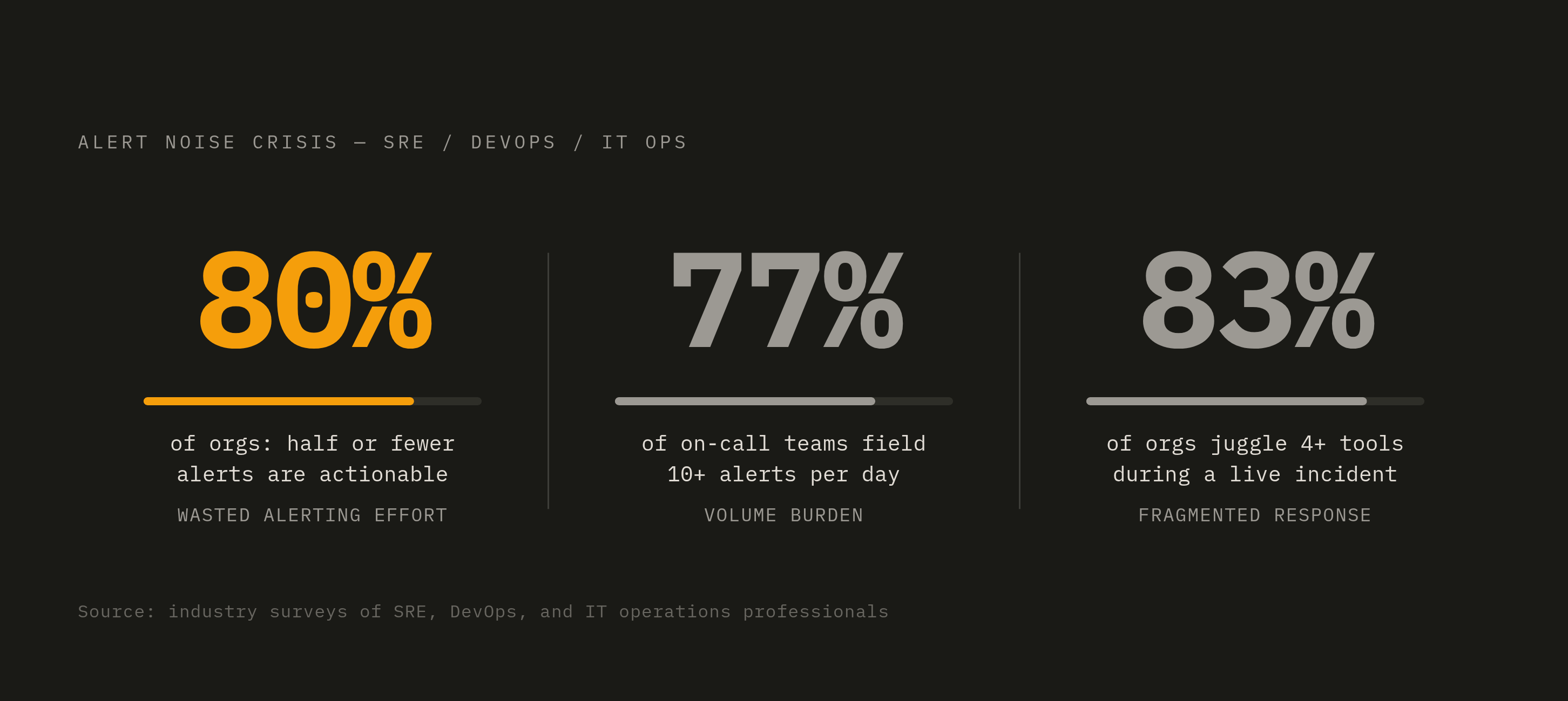
None of this works on top of noise. Industry surveys of SRE, DevOps, and IT ops professionals have found that 80% of organizations say half or fewer of their alerts are actually actionable, and 77% of on-call teams field ten or more alerts a day. That's not a minor annoyance sitting on top of a healthy system; it is the system.
The same report found 83% of organizations juggling four or more tools during a live incident, and every extra tab an engineer has to open while an SLO burns is time that isn't going toward the fix. Toil is at a median of 34% of engineers' time according to the report, and only about half of respondents say AI has actually reduced it. Buying an AI tool without fixing the underlying noise doesn't eliminate the noise; it just gets supervised faster. It just gets supervised faster.
The sequence NeuBird AI recommends runs in a specific order, and skipping steps is why so many noise-reduction efforts stall out: deduplicate first, then group and correlate, then apply suppression that understands service dependencies, then move to thresholds aligned with actual SLOs, and only then fix the instrumentation at the source. Downstream filtering, the earlier steps in that list, buys fast relief. Source-level instrumentation is what makes the relief last, because it stops bad signal from being generated in the first place rather than cleaning it up after the fact.
Google's internal benchmark for a healthy on-call rotation is no more than two pages per twelve-hour shift, a useful number to hold up against whatever a given team is actually living through. And the payoff for doing this work is concrete: one NeuBird AI customer reported cutting alert volume by more than 60% over four months by fixing the underlying issues generating the alerts, rather than suppressing them, which let the team shift from roughly a 60/40 split between product work and operations toward something closer to 85/15.
The agentic safety risk that autonomous RCA must account for
Autonomous systems that can act, not just diagnose, carry a risk that diagnosis-only tools don't, and the industry already has a cautionary case study on record. A Replit AI agent deleted a production database in July 2025 during an active code freeze, despite explicit instructions not to make changes, running destructive commands with no approval gate in place before schema-altering operations, Fortune reported. Records for more than 1,200 executives and over 1,190 companies were wiped. No human had to sign off before it happened.
That incident isn't an outlier so much as a symptom of a wider pattern. A large majority of organizations deploying AI agents, 88% by one measure, report a confirmed or suspected security incident tied to that deployment, and only a small fraction of the agents involved reached production with full security and IT sign-off. Regulators have started to treat this as an infrastructure risk rather than a vendor talking point: in May 2026, CISA published joint guidance titled "Careful Adoption of Agentic AI Services," co-signed by NSA, NCSC-UK, ASD's ACSC, and the equivalent authorities in Canada and New Zealand, under the Five Eyes banner.
The architectural implication for RCA specifically is direct. Any tool that reasons its way to a root cause and then acts on it needs a clear line between read operations, which are safe to automate outright, low-impact writes, which can be approved automatically, and high-impact operations, which require a human to explicitly say yes. That's not process for its own sake. A tool either resolves an incident or compounds one.
OnePatch's design reflects that line directly: it opens a fix PR rather than pushing the fix itself. The investigation and the drafting are automated, but the consequential step, the one that actually changes what's running in production, still goes through a human.
How representative platforms approach the problem differently
The platforms below aren't a ranking. Each one represents a distinct bet about where the hard problem in RCA actually sits, and the honest way to evaluate any of them is to name the tradeoff, not just the headline feature.
Mezmo pairs an open-source agentic harness, AURA, with its own active telemetry platform, which analyzes data before it's stored rather than after. The open-source piece matters on its own terms: the agent logic is forkable, inspectable, and version-controllable, which is a different trust model than a black-box vendor agent. Mezmo organizes the work into three pillars: Understand for root cause analysis, Act for remediation (human approval today, with autonomy expanding over time), and Improve for hardening the system against the same failure recurring. It fits Kubernetes-heavy environments particularly well.
Traversal leans on causal machine learning layered with LLMs, through what it calls its Production World Model and Causal Search Engine, and claims RCA accuracy above 90% while processing 300 million logs per incident. The company points to enterprise case studies with MTTR reductions ranging from 32% to 70%: 32% at American Express, roughly 38% at DigitalOcean, and 70% at Cloudways, with DigitalOcean, American Express, and PepsiCo named as customers. It's built for petabyte-scale enterprise environments, and that's roughly where it fits best.
NeuBird AI's context engineering model queries live data at investigation time instead of relying on a pre-built model that's already stale by the time it's needed, tracing causal chains with explicit chain-of-thought reasoning at each step. The company reports 94% root cause accuracy and claims its customers reclaim more than 200 engineering hours a month, and its passive integration model queries across a team's existing observability stack simultaneously rather than replacing it.
Logz.io launched OrionIQ in April 2026, built on the company's telemetry compression technology and combining Anthropic's AI agents with an organization's own runbooks, and it starts analyzing an incident the moment an alert fires, before a human has opened a dashboard. Cleric runs as an autonomous SRE agent that investigates alerts around the clock, delivers root cause analysis, and is designed to learn from each incident it handles; it was named a Gartner Cool Vendor for 2025 in AI for SRE and Observability. Resolve.ai, founded by former Splunk executives, is targeting 80% autonomous resolution and reached unicorn status faster than any other company in the category.
Dynatrace's Dynatrace Intelligence engine (formerly Davis AI) takes a topology-aware approach, built on the Smartscape dependency map. Dynatrace's Observability Report claims AI-powered incident detection cuts mean time to detect by 76% against traditional monitoring, and that AI-powered triage classifies incident severity correctly 94% of the time. Those numbers deserve a second look before taking them at face value: detecting an incident fast and classifying its severity correctly are real capabilities, but neither one is the same claim as identifying the root cause.
OnePatch occupies a narrower and more specific position in this landscape, sitting at the boundary between a pull request merging and that code running in production. It correlates real telemetry after deploy to catch regressions before a human gets paged, and it opens fix PRs on its own rather than merging them. Its pricing is structured per incident resolved rather than per seat, which ties what the vendor earns to whether the tool actually resolved something, not to how many people at a company happen to have a login.
Platform risk revealed by the Opsgenie sunset and Lightstep end-of-life
Choosing an RCA or incident response platform isn't only a technical decision, and two recent sunsets make that hard to ignore. Atlassian announced in March 2025 that it was retiring Opsgenie, with the end of sale effective June 2025 and the end of support set for April 2027. That's a hard deadline that forced a large number of engineering teams to re-evaluate their entire incident response stack on someone else's timeline, not their own. ServiceNow's Cloud Observability platform, built on the Lightstep acquisition, is reaching end of life by March 2026, a second and separate reminder within roughly a year that the platform a team commits to today is not guaranteed to exist commercially in three years.
That's a reason platform evaluation can't be purely a feature comparison. Vendor trajectory, market position, and how easily data actually moves out of a platform matter as much as what the platform can do while it's still supported. This is exactly the argument for OpenTelemetry as more than a technical nicety: because it decouples the act of collecting telemetry from any single vendor's format, instrumentation built on it survives a platform migration that would otherwise mean starting over. NeuBird AI's report found 83% of organizations already juggle four or more tools during a live incident, and every sunset forces a re-integration that adds to that sprawl before anyone gets the chance to reduce it.
What changes when autonomous RCA collapses the investigation phase
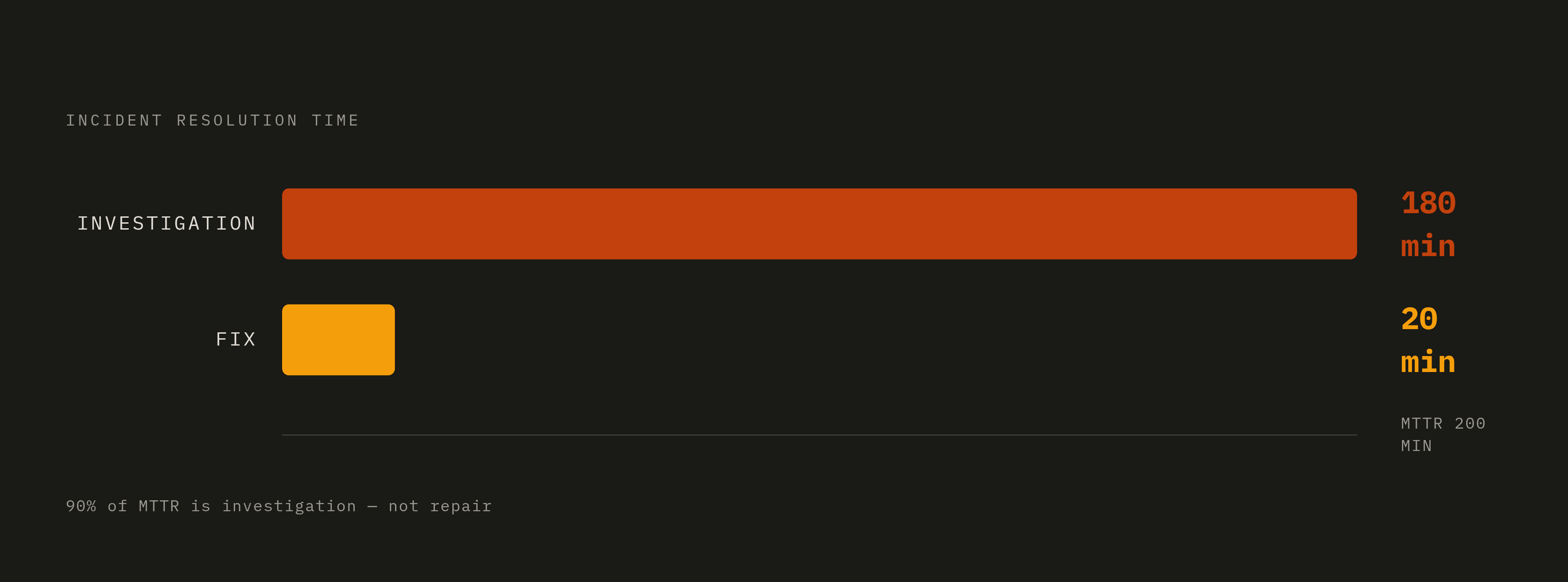
The investigation phase is where most of MTTR has always lived, the three hours before the twenty-minute fix in NeuBird AI's framing, and collapsing it changes what the job of an on-call engineer actually is. That time becomes machine time instead of human time. The engineer's role shifts from investigator to approver: reviewing a causal chain an agent has already built, deciding whether the proposed fix is safe to ship, rather than spending the first hour of an outage just figuring out which of seventeen alerting services is the one that actually matters.
That shift only holds up if the underlying conditions covered above are actually met. The call graph has to be fully instrumented, or the causal chain breaks at the first uninstrumented service. The alert signal has to be clean, or the agent spends its reasoning budget on noise instead of causation. And the approval gates covering high-impact actions have to be real, or the system that was supposed to resolve the incident becomes the thing that made it worse. Get those three right, and the three-hour investigation that used to consume an outage becomes a report an engineer reads and signs off on in minutes. Get any one of them wrong, and autonomous RCA just moves the bottleneck instead of removing it.