Tools That Open a Fix PR When a Production Regression Is Detected
Automated systems catch production regressions and open fix PRs before humans need to intervene.
You get almost nothing from a passing CI pipeline about how code behaves once it reaches production, yet most teams still treat a green checkmark as the end of the verification story. Lint passes, type checks pass, unit tests pass. None of that proves the change won't break a contract between two services, return a wrong default silently, or cascade into a second failure once the first one is patched. Regression detection has to operate in the space CI never reaches: the live traffic, the real dependency graph, the production configuration that doesn't match what's in the repo. Silent failures are the hardest class of bug precisely because they don't crash anything loudly enough to page a human; a service returns success with the wrong payload, a config drifts out of sync with code, a fix for one bug exposes a second one nobody tested for. AI-generated code ships at agent speed, and that makes this worse on a structural level: the volume of merged pull requests now moves faster than any team's review cadence can absorb, so post-deploy blind spots stop being an occasional risk and become a mathematical certainty. If CI cannot verify production behavior, something else has to.
What a closed-loop fix-PR pipeline does, step by step
A defensible automated fix-PR pipeline can't just be one tool doing one job. It's four interlocked stages, each capable of failing on its own, each one a tool has to get right for the loop to actually close.
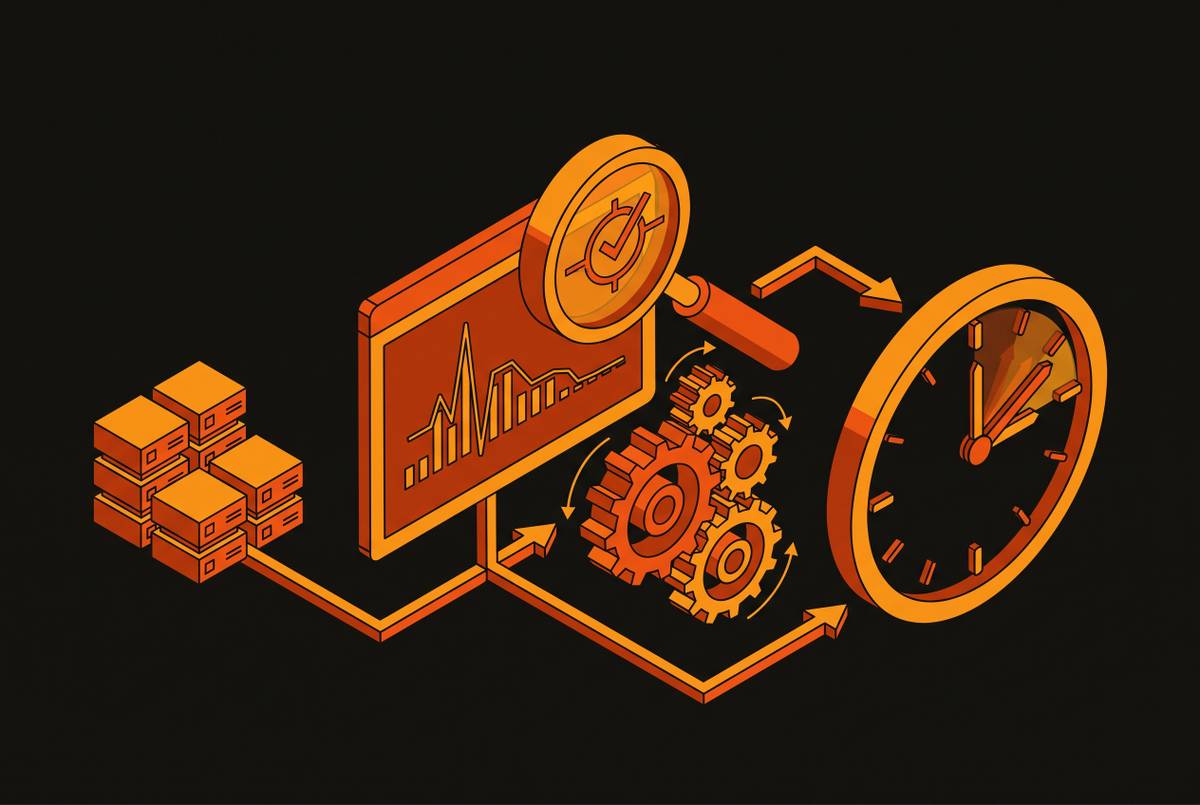
Stage one is regression detection. A credible system establishes a baseline of production error behavior over a meaningful window, then normalizes error signatures to strip out noise like UUIDs, timestamps, and transient counts that would otherwise make every error look unique. It polls post-deploy traffic over a defined window, and it flags only the errors whose rate is significantly higher than the baseline predicts. If you skip the normalization step, the system drowns in noise before it ever finds a real signal.
Stage two is causality triage. A failure that shows up after a deploy was not necessarily caused by that deploy. A properly built triage step compares the failure against pre-deploy baselines: if the problem existed before the change shipped, it gets logged as pre-existing and set aside; only regressions that appear after the deploy get attributed to it. This is the stage that keeps the pipeline from opening fix PRs against bugs that were already there, a mistake that erodes trust in the system faster than almost anything else it could do wrong.
Stage three is fix agent dispatch. The fix agent works from three inputs: the failing test or error signature, the causal diff, and a fix instruction. It writes the minimal change needed to make the test pass without expanding scope, and then it opens a pull request against the main branch. The broken deployment stays live while this happens, and main stays untouched until a human reviews and merges, which keeps rollback as the first line of defense rather than something the agent has to reason about on its own.
Stage four is the circuit breaker. When an agent attempts the same fix repeatedly without success, that's a signal the regression can't be self-resolved, whether because it's a flaky test, an environment issue, or a dependency the agent has no visibility into. A properly designed circuit breaker halts dispatch after a defined number of consecutive failed attempts, and it escalates to a human ticket instead of continuing to burn tokens against an unfixable problem.
LangChain's GTM Agent pipeline is the most fully documented public example of this sequence running end to end. A self-healing GitHub Action triggers right after a production deployment, capturing build and server logs along two paths: one that catches build failures immediately, and one that watches for server-side regressions over a 60-minute observation window. When either path turns up a real issue, Open SWE gets dispatched to fix it and open a PR, with no manual intervention required until a human reviews the change. LangChain has described this publicly as a real, internally-deployed production system built on its Deep Agents framework, running live workflows. It shows all four stages operating together rather than as isolated capabilities, which makes it a useful reference case.
Some pipelines invert the order and lead with monitoring instead of detection, generating targeted monitors at merge time, each one scoped to the changed code with explicit thresholds for error-rate spikes and latency regressions, so that when a monitor fires, the alert already carries the context an agent needs for triage. The entry point differs, but the downstream loop, triage, fix dispatch, circuit breaker, stays the same. In either design, production telemetry is the only signal that counts as ground truth. CI passing is necessary, but a pipeline only works if it reads real post-deploy behavior.
Failure modes that disqualify naive implementations
Describing a closed loop is far easier than building one that holds up under real production conditions, and each of the four stages carries a specific way of failing that turns the automation from a safeguard into a liability.
Detection that skips baseline normalization produces constant false positives in any environment with naturally noisy error rates, so the system opens fix PRs against ordinary statistical variation. An engineer who gets paged by three false alarms in a week stops trusting the fourth alert, real or not.
If triage skips pre-deploy comparison, it attributes failures that already existed to whatever deploy happens to be most recent. This is the failure mode most likely to destroy trust in an automated system, because engineers watch the agent "blame" a deploy for a bug that was sitting in production long before the change shipped.
Fix dispatch without scope constraint generates pull requests that overcorrect: broadened test coverage nobody asked for, unrelated logic changes, new surface area introduced to solve a narrow problem. The value of a fix-PR pipeline rests on the fix being minimal and targeted; a PR that rewrites half a file to patch one bug defeats the purpose of automating the fix.
A missing circuit breaker means an unfixable regression, a flaky test, an environment quirk, a dependency that lives outside the repo, generates an unbounded stream of pull requests, burning tokens and cluttering the review queue until someone manually kills the process by hand.
Tool sprawl compounds every one of these failures. When an engineer has to jump across multiple dashboards and alerting systems just to confirm whether a fix PR actually addresses the real problem, the speed advantage the automation was supposed to deliver disappears into the time spent correlating signals across tools. A pipeline that handles all four stages, and accounts for all four failure modes, is genuinely rare, which is what makes the comparison below worth taking seriously.
Tools that deliver the full loop (and what each one does)
A small set of tools now automate the detect-triage-fix-PR sequence without a human having to kick it off, but they differ substantially in which stages they actually own and what telemetry feeds them.
One Patch sits between pull requests and the live production environment, and it automatically verifies every PR against real telemetry after it deploys. It is purpose-built to operate in exactly this gap: CI never sees real traffic, so One Patch treats production verification as an autonomous stage that runs after merge, catching regressions that no test suite could have caught beforehand. It implements all four stages of the pipeline as a single workflow. It detects regressions against production baselines, triages causality by comparing pre- and post-deploy telemetry so pre-existing failures don't get misattributed, dispatches a fix PR for human review, and includes circuit-breaker logic so unbounded retries against an unfixable regression don't consume tokens indefinitely. The human stays in the loop only at review and merge; detection, triage, and fix dispatch run without anyone having to initiate them. The platform is built for backend-leaning teams, platform engineers, on-call engineers, developer tooling leads, who need detection, triage, and fix dispatch consolidated in one surface rather than split across several dashboards during an active incident. Teams shipping AI-generated code at agent speed need that consolidation most, because the volume of merged PRs has outpaced what any human review cadence can keep up with, so automated production verification has to be a first-class requirement, not something bolted onto CI as an afterthought.
LangSmith Engine, from LangChain, is an autonomous agent that watches production traces, clusters failures into named issues, diagnoses root causes against code, and proposes both fixes and eval coverage so the same regression doesn't resurface. It can open a PR with a targeted code or prompt change, create a custom online evaluator scoped to the specific problem, and add failing traces into the offline eval suite as ground truth. Version 2 of the product extends this further: it red-teams agents proactively to surface issues before they reach production, detects inefficient trajectories and trends in error rate and latency, tests proposed fixes automatically before a human reviews them, and reproduces failures end to end before surfacing validated changes. Cogent, Harmonic, and Campfire have used it to resolve issues touching thousands of traces. It fits teams building LLM or agent applications on the LangChain stack most naturally, and applies less cleanly to general backend services outside that ecosystem.
Latitude's Agent Dispatch takes a signal and a set of sample traces and hands them to whatever coding agent the team already runs, Claude Code or Cursor among them, which opens a fix PR with a proposed change for a human to review. Latitude itself doesn't edit or merge code; it's a dispatch layer that assumes the team has already configured a capable coding agent. It covers detection, triage, and fix dispatch natively, grouping failing traces into Signals and routing them to the agent for a PR, which makes it a genuine full-loop option for teams that already have an agent workflow in place.
Braintrust connects evaluation directly to the development workflow. When a production query fails, a single click converts it into a test case, and when quality degrades, alerts fire with context on which queries broke and why. Its GitHub Action runs evaluations on every pull request and posts the results as comments, catching regressions before a change merges. Its built-in agent, Loop, generates eval components from production data, so non-technical teammates can draft scorers just by describing failure modes in plain language. Braintrust fits teams that build production AI and LLM systems and need continuous evaluation from development through live traffic, but if you want fix dispatch or automated PR-opening, you have to pair it with additional tooling.
Qodo is an AI code quality and governance platform that reasons across the full diff and across file boundaries, and it produces structured findings that can block a merge outright when it flags a critical issue. It targets the category of bug that passes tests, passes human review, and still fails in production: cross-file contract violations, broken call chains, inconsistent state handling. Its PR resolver skill can autonomously apply and push fixes to existing pull requests, but Qodo doesn't consume post-deploy telemetry, so its loop closes at the review gate, not at the production incident. It suits backend-heavy systems that need strict state-consistency and data-correctness, and it suits distributed services where cross-file contract violations are the dominant failure mode.
Evaluating whether a tool's loop is closed for your stack
The right tool for a given team depends less on a feature checklist than on how well it handles the specific gaps already present in that team's telemetry and incident workflow.
Audit telemetry coverage before evaluating anything else. Uninstrumented services leave holes in the trace graph, and a fix-PR pipeline can only triage what it can actually observe; a tool that promises root-cause analysis is only as reliable as the instrumentation feeding it.
Separate the deterministic layer from the generative one. A technically sound root-cause architecture keeps causal graph construction, dependency traversal, and metric anomaly detection as a deterministic layer, distinct from a generative layer that handles LLM interpretation, human-readable summaries, and remediation hypotheses. Ask whether a given tool's findings can be verified independently or only interpreted after the fact.
Recognize that APM alone isn't enough for AI and agent systems. An AI application can return a successful HTTP response that is still wrong, unsafe, incomplete, or unhelpful, and standard APM will show the service as healthy while the application itself fails silently on quality. Quality regressions, a judge score drifting down over a week, latency degrading gradually, don't announce themselves the way a crash does, so they need their own thresholds wired into the paging systems a team already uses.
Check for a defined circuit breaker and escalation path. Ask what happens specifically when the agent can't resolve the regression. If a tool has no clear answer, it will either loop indefinitely against an unfixable problem or drop the incident without anyone noticing.
Count the number of tabs an incident requires. Every additional dashboard or alerting system an engineer has to open during a live incident adds time to the SLO burn. Tools that close the loop properly, One Patch among them, handle baseline normalization to eliminate false positives, causality triage to avoid spurious fixes on pre-existing failures, and circuit breakers to stop token waste on regressions that can't be fixed automatically. A tool needs all three: baseline normalization, causality triage, and circuit breakers, or the result is noise that a team cannot trust.
Clarify whether the tool fixes forward by default, or whether it can recommend a rollback instead. If a high-severity spike pairs with a low-confidence causal chain, that often calls for an immediate rollback rather than a patch, while a well-attributed bug with a clear fix path is better served by a targeted PR. A pipeline that always fixes forward, regardless of severity or confidence, will eventually make the wrong call on a high-severity, low-confidence case, which is the judgment to confirm before any tool goes anywhere near production traffic.