What a Runbook Is in Production Engineering
A runbook is the difference between improvisation under pressure and a procedure proven to work.
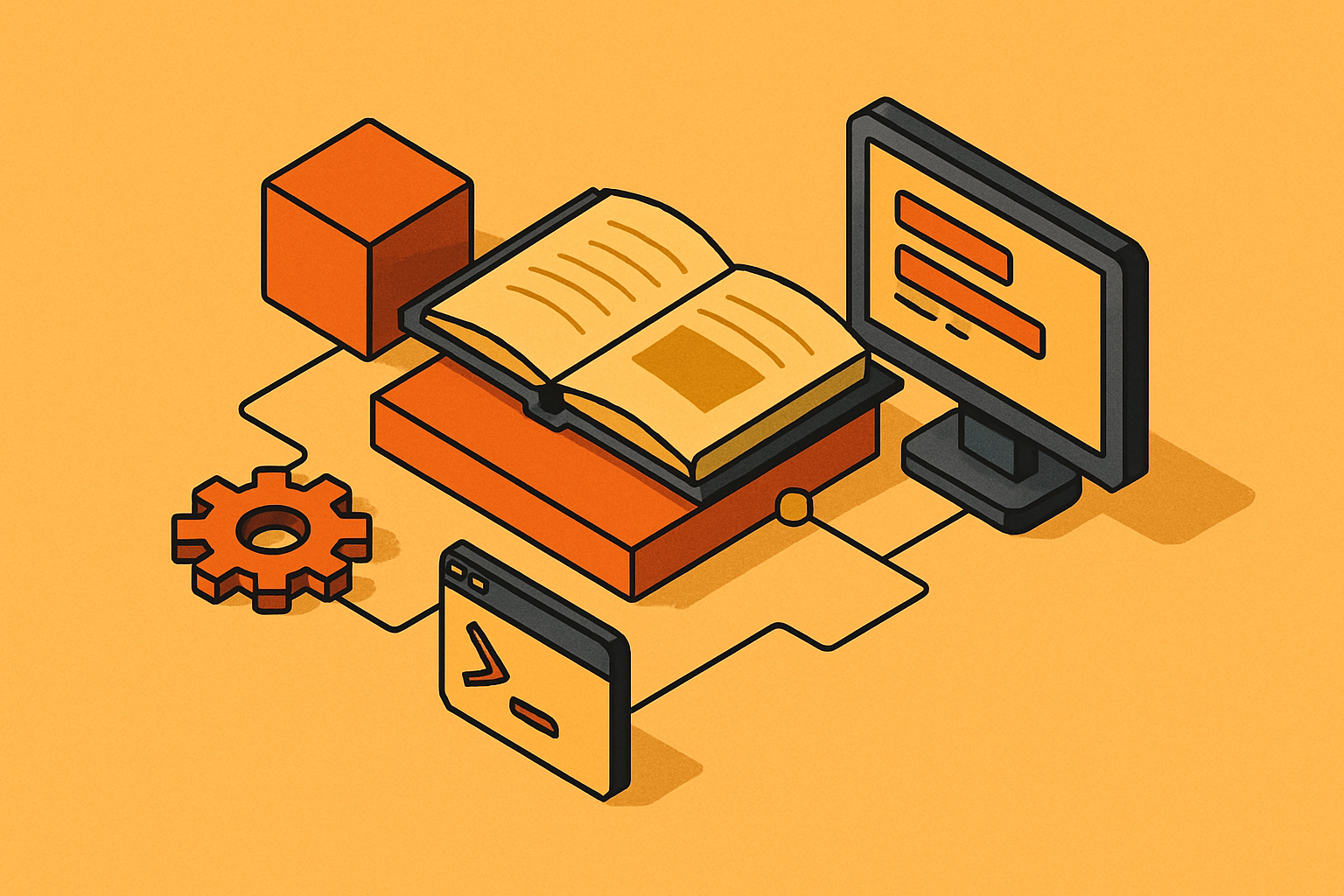
Runbooks are documented, repeatable operational procedures: preconditions, required inputs, remediation steps, verification commands, escalation criteria, post-incident actions. Most teams that use the word don't actually have one. They have a Confluence page nobody's touched since spring, or a Slack thread someone bookmarked once and never opened again, and they call it a runbook because admitting there's no plan feels worse. Cortex's State of Production Readiness report found that 42% of senior engineering leaders name runbooks as a key part of their production readiness process. Flip that number around and most teams are still working without one that actually qualifies. This piece is about that gap, between what gets called a runbook and what actually holds up when a system is on fire.
Where runbooks came from and why the original design logic still holds
The discipline didn't start in software, and it's worth remembering that. Aviation checklists and nuclear-industry procedures got there first, decades before anyone was paging an on-call engineer, and the format they settled on was deliberate: short steps, no ambiguity, explicit verification after each one, clear triggers for when to escalate. No prose. No narrative framing explaining why the step exists. The checklist exists because skilled, well-trained people make predictable mistakes under stress, and the only real defense is a procedure that doesn't depend on memory or improvisation in the moment things go sideways.
Distributed UNIX systems carried that discipline into network operations centers through the late 1980s and 1990s, where playbooks taped up at physical terminals adapted the same logic to keep systems running. Google's SRE org pushed it further in the 2000s: runbooks got versioned, reviewed, stored next to the code they governed, treated as engineering artifacts instead of support documents nobody owned.
What changed across those three eras was the environment, not the underlying need. A mainframe operator in 1985 and an SRE debugging a Kubernetes cluster today are solving the same problem with the same tool. A runbook that reads like a design doc, heavy on background and rationale, has already failed a test that aviation and nuclear engineers set decades before cloud computing existed.
The components that make a runbook executable rather than decorative
An executable runbook has a fixed set of parts, and each one earns its place by preventing a specific, predictable failure. Leave one out and you can usually guess what breaks first.
Preconditions state what has to be true before anyone starts: which environment, which service, which state the system needs to be in. Skip this and you risk running the right fix on the wrong system, which is worse than doing nothing at all. Required inputs come next: credentials, service names, environment variables, so the engineer isn't hunting for a password at 3 a.m. while a customer-facing service is down. Then the remediation steps themselves, written as literal commands rather than descriptions of commands, with a verification step after each one so the engineer confirms the fix actually worked instead of assuming it did and moving on. Escalation criteria define exactly when to stop following the runbook and call for help. Without that line drawn in advance, engineers keep running a procedure that isn't working, out of nothing more than false confidence in the document itself.
A production readiness gate worth adopting requires four things before a service's first deploy: a logging baseline, a rollback path, an SLO draft, and a runbook. Architectural explanation, the "how we got here" story, belongs in a design doc and has no business in a runbook. The runbook is the operator's instrument; the design doc is the engineer's notebook. Conflating the two is exactly how runbooks balloon into fifteen-page documents nobody trusts during an actual outage.
Ownership matters as much as content, maybe more. A runbook without a named owner and a last-reviewed date is already decaying, whether anyone's noticed yet or not. SRE practice treats runbooks as code for this reason: they live in Git, they get reviewed, they go through pull requests like anything else governing production behavior.
How runbooks fit into the moment an incident actually begins
Every incident moves through the same sequence, detect, diagnose, mitigate, restore, verify, and a runbook's job is to give explicit guidance at each phase so nobody's improvising the sequence itself while the system is down.
Without one, the engineer reconstructs context from nothing: scrolling through Slack, checking dashboards, sometimes pulling up a call recording from the last time this happened to remember what worked. That reconstruction is where the real time gets lost in most incidents, not in the fix itself, which is often trivial once someone actually knows what to do.
The link between alert and runbook is where this either works or falls apart. An alert that fires with no linked runbook forces improvisation at the exact moment an engineer is least equipped to think clearly, half-asleep, adrenaline up, trying to remember what they did six weeks ago for the same page. Alerts should carry a direct link to the relevant runbook, full stop; nobody should be searching for a procedure while a service is actively down. Deployment annotation does something similar from the other direction: marking deploys on dashboards means an error spike right after a release gets correlated to that release immediately, instead of triggering an hour-long investigation that eventually arrives at the same conclusion a timestamp would have given for free.
The value of a runbook isn't only the procedure it contains. It's the orientation phase it eliminates entirely, the minutes or hours an engineer would otherwise burn just figuring out what's happening before they can even start fixing it.
The toil that builds up when runbooks are stale or missing
Neubird's operational data puts engineering teams at roughly 40% of their time spent on operational work: incident response, capacity management, runbook execution, manual investigation. That's nearly half the week gone to keeping the lights on instead of building anything new, and it's the kind of number that should alarm anyone signing off on headcount.
Stale or absent runbooks feed alert fatigue in a fairly direct way. No validated procedure means improvised responses, which means noisier alerts, which means engineers stop trusting the signal and start tuning pages out. An engineer who's learned that most alerts resolve on their own, or require the same undocumented workaround every time, is far more likely to miss the one page that's an actual crisis. That's the mechanism, not a vague correlation, by which alert fatigue turns into an outage nobody caught until customers noticed.
Toil compounds in a specific, almost arithmetic way here. The same manual fix performed by hand ten times is ten separate chances for someone to fat-finger a step; the same fix captured once in a validated runbook is one chance, validated, then repeatable without that risk resetting every time.
This is a systems problem before it's a discipline problem. If updating a runbook takes more effort than shipping the fix it describes, the runbook will always lag behind the system, no matter how conscientious the team is about documentation. Runbook maintenance has to live inside the deployment workflow itself. Treat it as documentation work engineers get to "eventually," and you get eight-month-stale Confluence pages. Every time.
What runbook automation actually means along the maturity spectrum
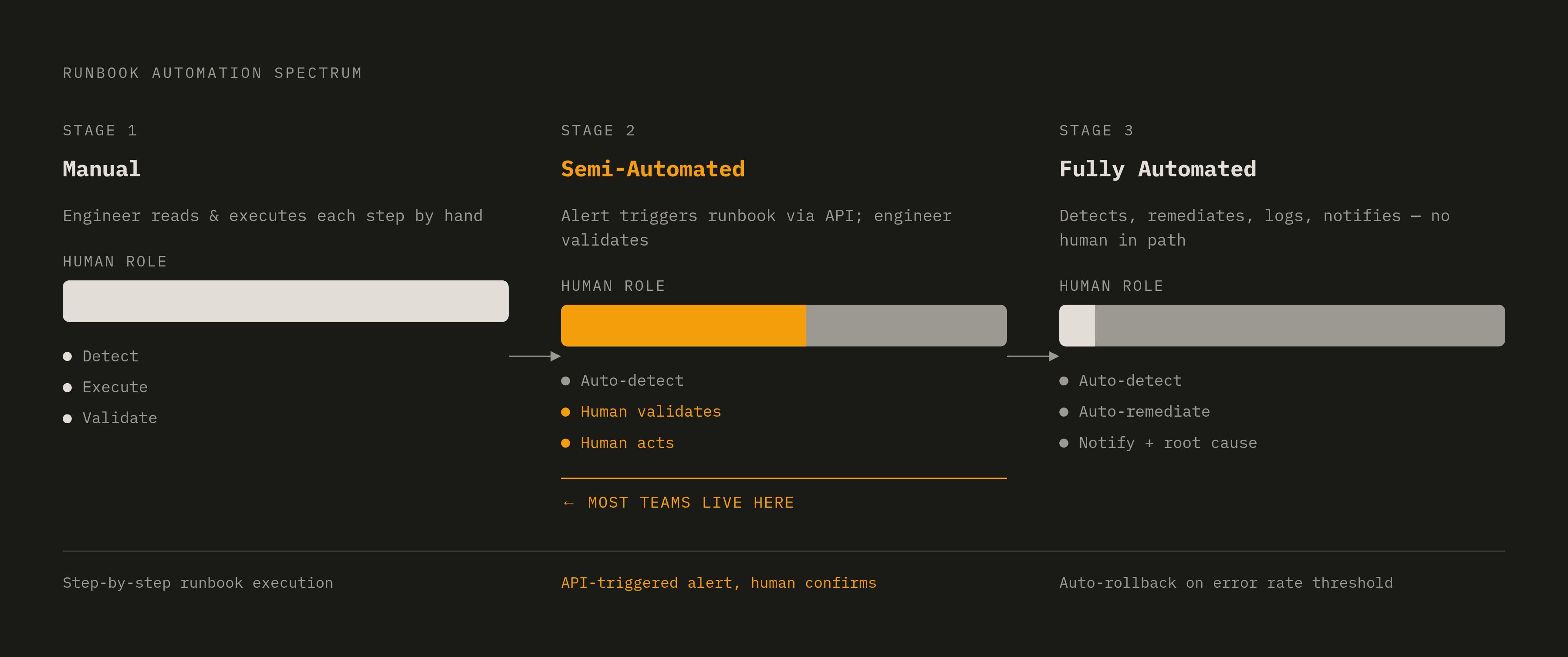
Automation here is a spectrum, not a switch, and most teams sit somewhere in the middle without quite realizing it, or without admitting it out loud.
At the manual end, an engineer reads the runbook and executes each step by hand. That's already an improvement over nothing since it standardizes behavior, but it still needs a human acting on every single line. Semi-automated sits in the middle: a monitoring system detects a condition and triggers the runbook through an API or a ticketing system, and the engineer validates and acts rather than reading and typing from a blank page. Fully automated closes the loop entirely: the system detects, remediates, collects logs, and notifies the team with root-cause context already attached. No human sits in the execution path, though someone's still watching the outcome, as they should be.
A few concrete examples. Service restart: detect the alert, restart the service, collect logs, notify the team with context, no keyboard touched by a human anywhere in that chain. Database failover: monitor replica lag, promote the secondary, update DNS, verify connectivity, in that order, automatically. Deployment rollback: canary health checks fail, and the rollback fires on its own once error rate crosses a defined threshold, no war room, no 2 a.m. bridge call.
There's a compliance dividend that comes along for free here, and it's structural rather than a nice accident. Every automated workflow action writes to the incident timeline, and that timeline becomes the audit trail that SOC 2 and ISO 27001 evidence demands. Teams building this for reliability reasons find the audit trail follows naturally from the same automated workflow.
Some tools are pushing automation earlier in the pipeline, before an incident even has a chance to trigger anything. Automated post-deploy verification that checks a release against real production telemetry, services like One Patch, which verifies pull requests against live production telemetry after they deploy, fit here, can collapse detect-diagnose-fix into the deployment workflow itself. The runbook stops being something triggered reactively after a page and becomes something that fires preemptively, before the page would ever have happened.
How AI changes what a runbook can do — and what it requires in return
AI-assisted root-cause analysis changes the diagnose phase specifically, and it's probably the most concrete gain in this entire discussion. Instead of an engineer manually digging through logs, metrics, and dashboards hunting for the correlated signal, AI correlates across all three at once and surfaces the probable cause, then suggests the relevant runbook, whether that's a rollback or a feature flag toggle.
The model taking shape through 2025 and into 2026 goes further still: specialized agents working in concert, one isolating the correlated deployment, one tracing the failure path, one drafting the root-cause summary, one executing the rollback. What used to demand 60 to 90 minutes of manual post-mortem reconstruction — reviewing Slack threads, monitoring data, and call recordings — gets compressed dramatically when the agents are working correctly.
That last clause, "when working correctly," carries the entire risk of the arrangement. Deloitte's 2026 AI report found that only 20% of organizations have mature AI governance models in place, meaning the large majority of organizations deploying agentic workflows lack that level of governance maturity around what those agents are actually allowed to touch.
This is where the runbook takes on a job it never had before: it becomes the agent's permission boundary, not just a human's checklist. It has to specify explicitly, not by inference, what actions the agent may take, what systems it may touch under real access control rather than ambient trust, and when it has to stop and ask a human instead of deciding on its own. Research surveying deployed agents found sandboxing or VM isolation documented for only 9 of 30 surveyed agents. Most agentic systems running in production today have no structural containment if something goes wrong, which is a fairly stark number to sit next to the enthusiasm around agentic AI right now.
Autonomy has to be earned in increments, not granted wholesale on day one. Start with agent-assisted suggestions a human still has to approve. Add automation only for failure modes the team has seen enough times to actually trust, not ones that just seem simple on paper. Expand scope only alongside a full audit trail and a human fallback for anything ambiguous. Done that way, every autonomous fix that works correctly becomes a reusable, validated runbook entry of its own, so the system gets safer and faster over time instead of demanding constant manual babysitting to keep pace with itself.
What separates a runbook that reduces MTTR from one that collects dust
Four things separate the living document from the static one. It's validated: the steps have actually run against the real system and been confirmed to work, not just written down and assumed correct by whoever typed them. It's versioned: a change to the system triggers a review of the runbook, rather than the runbook quietly drifting out of sync while nobody notices. It's linked, so the alert that fires points straight to it and the deployment that ships checks against it automatically. And it has a named owner, someone accountable for its accuracy, not an anonymous team distribution list.
DORA's 2025 research, drawn from nearly 5,000 respondents, turned up something that doesn't get repeated enough: AI adoption worsened change failure rate and deployment rework rate even as individual productivity went up. Faster individual output didn't translate into more reliable releases. It went the other direction entirely. That's exactly the gap automated production verification and disciplined runbooks exist to close, because speed without a validated recovery path just means failing faster and with more confidence.
The test is simple enough to run on any team today. Ask when a given runbook was last executed against production, and ask who owns it. If neither question gets a clean answer, that's a static document wearing a runbook's name, whatever it's called in the wiki.
For teams starting from zero, the fix doesn't need a company-wide initiative or a steering committee. Pick the three failure modes that ate the most MTTR last quarter, write one precise runbook for each, version them in Git, link them from the alerts that would trigger them. Then treat the next incident as the first real validation of the document, not a test of the engineer running it. Production telemetry is the only ground truth that matters here; a runbook that hasn't been checked against actual production behavior is still just a hypothesis, no matter how carefully someone wrote it.