Runbook Template for Production Support Teams
Clear procedures prevent costly delays when alarms wake engineers at 3 a.m.
A runbook earns its keep at one specific moment: an unfamiliar engineer, half-asleep, staring at a page-out with no one else awake to call. That is the only test that matters, and most runbooks fail it. Not because the writers were careless, but because runbooks get built during calm periods, by people who already know the system, and inherited later by people who don't. The gap between those two conditions is where incidents get longer than they need to be.
Three failure patterns recur again and again. The first is a runbook that describes the system instead of prescribing an action: paragraphs about how the payment service is architected, when what's needed is "run this command, expect this output." The second is a missing or vague rollback path. When an engineer isn't sure a rollback will work, or doesn't know the exact command, hesitation sets in, and hesitation at 3 a.m. turns into improvisation, which turns into a second incident stacked on the first. The third is ownership assigned to "the team," which in practice means no one. Runbooks with no named owner don't get updated after the incident that exposed their gaps, and they don't get retired when the system they cover gets decommissioned.
That last point deserves emphasis, because it's counterintuitive. A stale runbook is worse than no runbook at all. An engineer facing no documentation knows to proceed carefully and verify everything. An engineer following a runbook that's eighteen months out of date follows it with false confidence, right up until the command it tells them to run doesn't exist anymore, or worse, still runs but against the wrong target.
Runbook vs. playbook vs. SOP, which one you need during a P1
These three terms get used interchangeably in most engineering orgs, and that habit costs real minutes during a live incident, because grabbing the wrong document means reading the wrong kind of information at the exact moment reading time is the scarcest resource in the building.
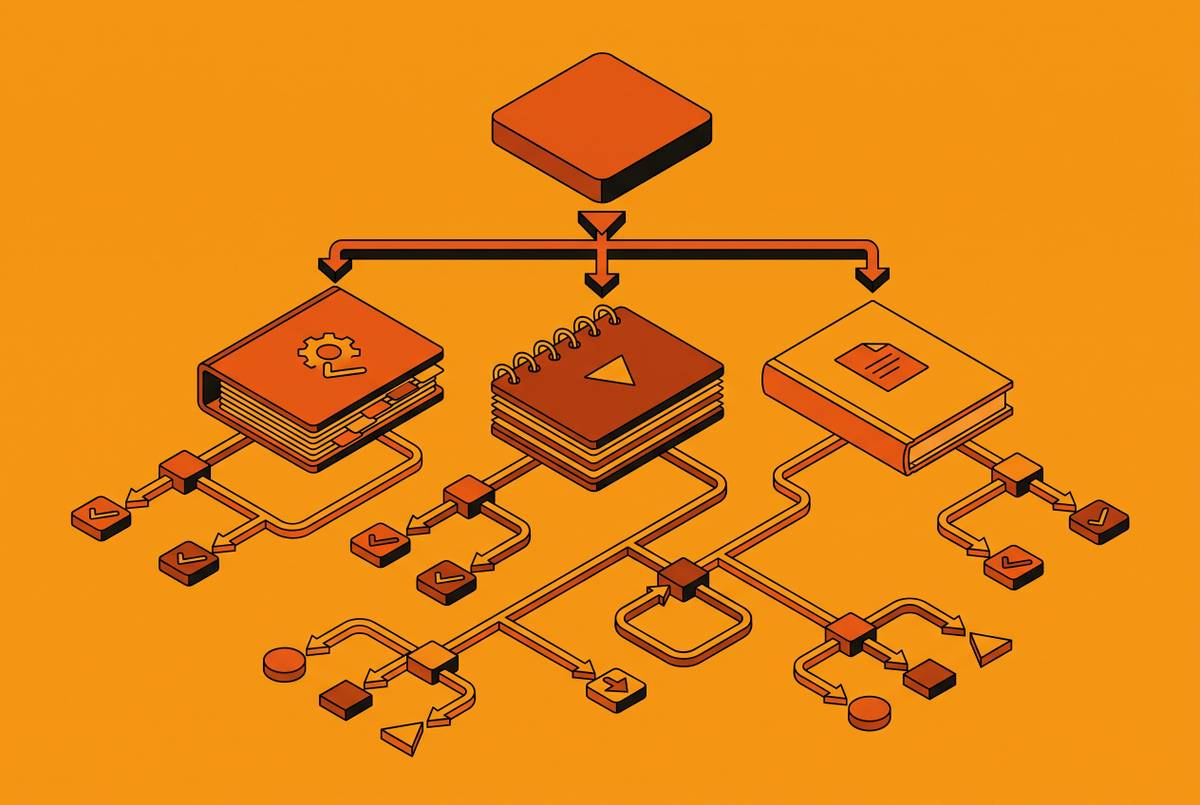
An SOP is broad and compliance-oriented. It exists for operations and audit teams, and its job is consistency across routine business processes, not technical execution under pressure. A runbook is narrow by design: it covers one technical scenario, written as step-by-step execution with conditional branches, aimed squarely at the on-call engineer who has to act, not the auditor who has to review. A playbook sits above both. It's the coordination layer that answers who leads the response, how the team communicates, and when to escalate, but it does not tell anyone which CLI flag to pass. Mixing playbook logic into a runbook, or vice versa, is exactly how a ten-minute fix turns into a forty-minute one.
During a P1, the playbook tells the on-call lead when to page the VP of Engineering and how the incident channel should be structured. The runbook tells the engineer on the keyboard exactly which commands drain traffic from a failing pod. Two different documents, two different jobs, and conflating them is a design mistake, not a naming preference.
The security operations world makes this distinction almost physical. A SOC playbook lays out roles across the analyst, legal, and engineering functions when a breach is suspected. Nested inside it, the runbook for revoking a compromised session token spells out the exact API calls, the audit log entries to check afterward, and the output that confirms the token is actually dead. One document coordinates humans. The other tells a single human exactly what to type.
The eight sections every production runbook must contain
Treat this as a prescription. Every section below is load-bearing. Skip one, and an incident will eventually find the gap, usually at the worst possible time.
Metadata header includes title, version number (start at 1.0 and increment with actual meaning, not cosmetically), last-reviewed date, next-review date, a named document owner, applicable systems, risk level, and estimated time to complete. The version and owner fields are what make accountability enforceable. A runbook owned by "the team" is a runbook nobody updates, because updating it is everybody's job and therefore nobody's.
Trigger conditions name the exact alert, threshold, or observable symptom that activates this specific runbook, not a vague category like "service degradation."" This is where the alert-runbook pairing principle lives: each alert should connect to a runbook covering what the signal means and what to do next. That pairing is what turns a monitoring system from something that just makes noise into something operationally useful.
Prerequisites list the access, credentials, tools, and context an engineer needs before step one. This section exists to prevent the exact failure mode where someone is three steps into a rollback and discovers they don't have the production cluster permissions to finish it. Finding that out mid-incident is a design failure of the runbook, not a personnel problem.
The remaining five sections, execution steps, decision branches, validation criteria, rollback path, and escalation contacts, get built out fully in the worked example below, because they're easier to understand populated than described in the abstract.
A filled-in runbook example: deployment rollback for a failing backend service
Deployment rollback is one of the most common production events any team faces, and it's the scenario where hesitation costs the most, because every minute a bad deploy stays live is a minute of degraded service for real users.
Metadata: Title: "Backend Service Deployment Rollback, API Gateway."" Version 1.2. Owner: named individual, not a team alias. Last reviewed: dated. Risk level: HIGH. Estimated duration: 15 to 30 minutes.
Trigger: Alert name and definition link included directly. Example condition: 5xx error rate crosses a defined threshold for a sustained period. No ambiguity about what "elevated errors" means in practice.
Prerequisites: kubectl access scoped to the production cluster, read access to deployment logs, and the exact Slack channel name for incident communication, written out, not implied.
Steps are written in imperative voice, annotated with the expected terminal output after each command. "Run kubectl rollout undo deployment/api-gateway. Expect output: deployment.apps/api-gateway rolled back." Not "roll back the deployment and check that it worked." The difference between those two sentences is the difference between documentation and execution.
Decision branch: if the rollback command itself fails, the runbook names who to escalate to and in what order, first the deployment owner, then the on-call lead, rather than leaving the engineer to guess who's awake.
Validation is a specific health-check endpoint, the expected HTTP status code, and the latency range that signals genuine recovery, not "check that things look okay.""
The edge case nobody wants to think about is rollback of the rollback: what happens if the rollback itself needs to be undone. Document that path too, because the alternative is inventing it live.
What makes this example work is the specificity, not the topic. Naming the expected output after each command removes the single biggest source of hesitation at 3 a.m.: not knowing whether what just happened is normal.
The four runbook types production teams need
This is a prioritized starting list, not an exhaustive taxonomy, built in the order that returns the most value first. It's a prioritized starting list, built in the order that returns the most value first.
Incident response runbooks come first, because they cover the alert-fires-at-3-a.m. scenario end to end, initial triage, service health checks, communication cadence, and resolution verification. These should be paired one to one with alerts. An alert without a matching runbook isn't an operational tool, it's a noise generator that happens to have a name.
Deployment and rollback runbooks come second. They cover promoting a change across environments and undoing it cleanly when verification fails. Dependencies, plugins, update sets, and manual tasks are exactly the things that break deployments in ways nobody predicted, and a clear runbook removes the surprise by documenting the order of operations and the error handling at each stage in advance. Standardized cutover templates, used consistently across runbook categories, have been shown to cut planning and execution time by as much as half.
Routine operational runbooks round out the set: SSL certificate renewal, scheduled maintenance windows, backup verification, database failover drills. Lower urgency individually, but high in repetition, which makes this the category where semi-automation pays off fastest, since the same steps run often enough to justify the investment in scripting them.
A fourth category to build out as the practice matures is the security and access runbook, covering credential rotation and incident containment, but the first three are where teams should start, because they cover the highest-frequency, highest-cost scenarios first.
How post-deploy verification belongs inside the runbook, not after it
Most teams stop the validation section too early. Confirming a deployment succeeded and confirming the system is actually healthy are two different claims, and treating them as the same one is where a clean-looking deploy turns into a customer-facing incident four hours later.
Shift-right testing, the discipline of moving quality verification into production itself, exists precisely because real traffic and real infrastructure expose failures that pre-merge testing never will. It's a recognized approach now, not a shortcut, because the long tail of production issues only appears under production conditions: real concurrency, real data shapes, real network behavior.
The post-deploy validation block inside a runbook needs to specify three things concretely. Smoke tests: lightweight, automated checks confirming core functionality is intact, ideally running automatically the moment a deploy completes. Observability verification: confirming metrics are being collected, logs are flowing, and traces are being generated, because a deploy that breaks observability should be treated as a failed deploy outright. You can't operate what you can't see, and a system that looks silent might just be blind. Error rate and latency checks with actual thresholds, not "looks reasonable," because the validation step has to be exactly as executable as the steps that came before it.
For teams running canary releases, the runbook's validation block should watch canary metrics as their own distinct signal, separate from the broader fleet, and name the exact condition that triggers an automatic rollback. Vague thresholds here defeat the entire purpose of canarying in the first place.
Alert-runbook pairing and alert noise
The scale of the alert-fatigue problem is documented, not anecdotal. NeuBird AI's State of Production Reliability and AI Adoption report, based on a survey of more than 1,000 SRE, DevOps, and IT operations professionals, found that 80% of organizations say half or fewer of their alerts are actually actionable, and 77% of on-call teams field at least ten alerts a day. Those two numbers together describe a profession that has learned, correctly, to distrust its own monitoring.
Once every alert starts looking like a probable false positive, engineers stop reading them with care, and a runbook attached to an alert nobody trusts simply doesn't get opened when it fires. The best-written runbook in the world is useless if the alert pointing to it has already trained the on-call engineer to ignore it.
The fix starts with a blunt rule: if nobody has acted on an alert in 30 days, delete it. Not tune it, not adjust the threshold, delete it outright. Teams applying that rule alone have cut mean time to acknowledge by more than 40%. The broader sequence matters too, and the order isn't optional. Deduplicate first. Then group and correlate related signals. Add dependency-aware suppression so a downstream service's alerts don't fire independently of the upstream cause. Move toward SLO-aligned thresholds. Only then fix instrumentation at the source. Downstream filtering gives fast relief, but it drifts back into noise over time if the underlying instrumentation never gets fixed, so source-level correction has to be the last step, not a step skipped entirely.
Runbook automation: what to automate, what to keep human, and in what order
Automation isn't a binary switch between "manual" and "automated." It's a progression, and skipping stages is how teams end up automating things they don't yet trust, which is worse than not automating them at all.
Every runbook starts at manual: a human reads written steps and executes them. It's the easiest level to create and, not coincidentally, the easiest to let drift, since any small deviation in the environment, a changed hostname, a rotated credential, becomes a point of failure the runbook didn't anticipate.
Semi-automated is the level most mature teams should be aiming for across their highest-frequency runbooks. An engineer triggers a script, reviews its output, and decides what happens next. This keeps human judgment exactly where it belongs, at the branching points, while removing the tedious, error-prone parts of typing the same commands correctly at 3 a.m.
Fully automated is the end state, where an event fires the runbook and the procedure runs start to finish with no human in the loop. It's also the level that demands the most trust, because the logic has to be right every single time, not most of the time, and that kind of confidence only gets earned by watching the semi-automated version run cleanly, repeatedly, over a long enough stretch that its edge cases have already surfaced.
Reaching for full automation on a runbook that's never been run manually even once is a mistake. Automation doesn't fix an unreliable procedure, it just executes the unreliable procedure faster, and with no one watching.