Runbook vs SOP for Engineering Teams
Structure and trigger determine whether your incident response doc saves time or wastes it.
Two engineering teams can produce documents that look identical on the page, both numbered, both formatted with the same headers, and only one of them will save an on-call engineer at 3 AM. Formatting isn't what separates them. Whether the document was built for a schedule or built for a fire decides whether it works when it's needed, and most teams get this wrong in a specific, avoidable way: they let the label at the top of the doc, not its actual structure, decide what goes inside it.
Under pressure, most engineers grab whatever doc exists. The label rarely matches the content. A bloated SOP filed in the incident channel slows response, because nobody wants to read six pages of audit language while a payment processor is down. A panic-written "runbook" with no branching logic fails just as badly, because the on-call engineer doesn't need paragraphs of prose. He needs a decision tree: if X, do A; if Y, do B. Get the trigger wrong at the design stage, and no amount of formatting saves the document later.
This is an MTTR problem. A ResearchGate paper on runbook engineering and SOP design in high-availability environments found that well-designed documentation reduces mean time to resolution and gives teams the structure they need to automate responses. The NeuBird AI State of Production Reliability and AI Adoption Report found that 83% of organizations juggle four or more tools during a live incident. Wrong or missing documentation doesn't sit neutral in that environment. It actively worsens the tab-switching, because the responder now has to hunt for the right doc across four systems while the clock runs.
What a runbook is and what an SOP is
An SOP is the standing document for how a recurring task gets done correctly, every time, by anyone assigned to do it. It's triggered by a schedule or by the job itself. You follow it because it's Tuesday and the production line is running. It covers the whole task, start to finish, and its audience is broad, including the person doing the work today, the trainer onboarding someone new, and the auditor checking six months from now that the process was followed. A procedure for a daily database backup is an SOP. So is a monthly security patch audit, or the steps for creating a new user account.
A runbook is built around a trigger. Something breaks, or an alert fires, and the runbook tells the responder what to do next. Atlassian's ITSM runbook template, cited by sopx.io, describes the purpose as documenting procedures for recurring ITSM alerts and outages so a team can respond to system alerts quickly and efficiently. A runbook covers the response to one condition, not an entire task, and its audience is the person on duty right now, under time pressure, who may not be the person who wrote it or even the last person who responded to it. A CPU spike runbook linked from an alert, a database failover runbook, a payment-processor failure response: these exist because something specific went wrong, not because a calendar said it was time.
Every runbook is a procedure, but not every procedure is a runbook. Scope, trigger, audience, and lifecycle set them apart, and conflating those four is where most documentation libraries collapse under their own weight.
One more term gets mixed in here, usually by teams trying to cover every base: the playbook. Playbooks are for unpredictable scenarios that require adaptive strategy, situations where the responder has to reason through options rather than follow a fixed branch. Runbooks and SOPs, by contrast, cover defined, repeatable situations. That's a real distinction, but a separate one from the runbook-versus-SOP question, so this piece sets playbooks aside.
The four dimensions that separate them in practice
Trigger is the first and sharpest line. An SOP responds to planned recurrence, a schedule or the normal cadence of a job. A runbook responds to an unplanned incident or a named abnormal condition, such as an alert, an outage, or a cold-chain excursion. The diagnostic question that cuts through most confusion is simple. Did something go wrong, or is this just Tuesday?
Audience is the second dimension, and it changes what the document is allowed to assume. An SOP's audience is anyone who performs the task, plus trainers and auditors who need the reasoning behind the steps, not just the steps. A runbook's audience is whoever is on duty right now, and that person might be a junior engineer paged at 3 AM who has never touched this particular system before. Runbooks have to assume zero prior context and zero time to think. There's no room for "as discussed in the onboarding deck."
Scope narrows the same way trigger does. An SOP covers the whole recurring task from beginning to end. A runbook covers the response to one condition, and it's shaped by the event, not by the process. Teams that write runbooks like broad SOPs end up with documents that don't fit on one screen during an outage, which defeats the entire point of writing one.
Lifecycle is where the two diverge most sharply, and it's the dimension teams tend to ignore. SOPs change on planned review cycles, quarterly or on some similar cadence, with a continuous-improvement mindset behind the edits. Runbooks change reactively: a response reveals a missing step, and the runbook gets updated the following week, not the following quarter. Runbooks need version control even more than SOPs do, because after-incident edits are the norm rather than the exception. A stale runbook is worse than no runbook at all, since it hands the responder false confidence right when confidence needs to be earned.
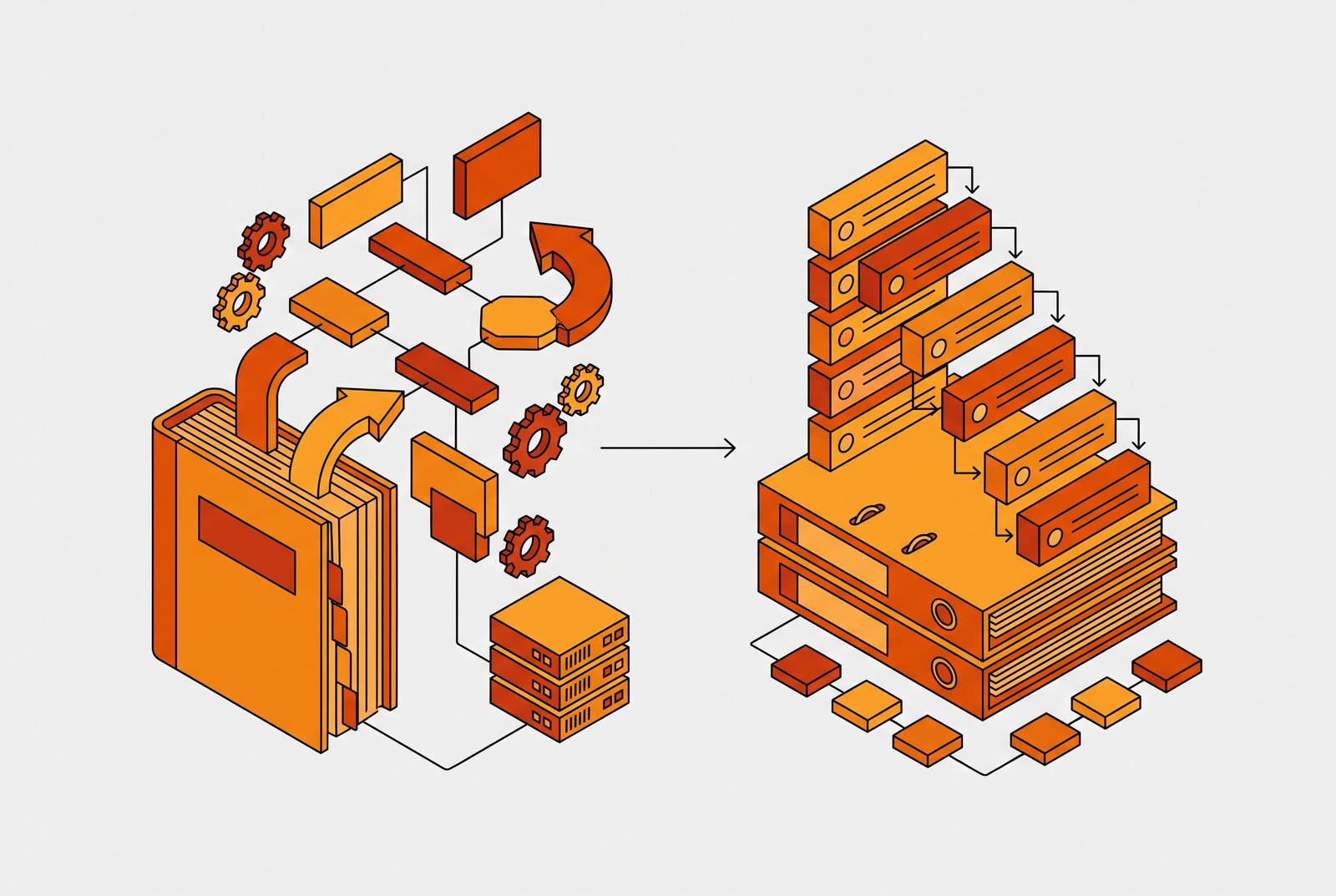
The mindset difference between SOPs and runbooks is that SOPs assume repetition and runbooks assume urgency; this difference produces the four dimensions of distinction between the two, a conclusion that follows directly from how each document type is built. That single sentence explains almost every structural choice that follows, and it points to a practical build order: write the SOP first to document how the system is supposed to behave under normal conditions, then add runbooks for the failure modes actually encountered in practice, an approach sopx.io identifies as the natural write sequence. Keep the two linked, so a responder can move from one to the other without opening a new tool mid-incident.
What a runbook must contain that an SOP never needs
Three structural elements separate a working runbook from a glorified checklist, and skipping any one of them is where teams go wrong. Decision-tree logic comes first: explicit branching, if X do A, if Y do B. SOPs rarely need this, since the process they describe is predictable and linear. Runbooks always need it, because failure modes branch by nature, and a document that ignores the branch forces the responder to improvise exactly when improvisation is most dangerous.
A communications plan comes second: who tells customers, when, and through which channel. Irrelevant for a routine database backup. Essential for an incident, because the gap between detection and customer communication determines how much the outage becomes a trust problem stacked on top of a technical one.
A postmortem link comes third. Every runbook use should trigger a postmortem, and the runbook itself should carry a link to the postmortem template, so the habit sits inside the document rather than depending on memory or goodwill once the fire's out.
SOPs need the opposite additions, things that would only clutter a runbook. Compliance and audit-trail language serves auditors, not responders, and has no business in a document meant to be read in under thirty seconds during an outage. Training scaffolding, the context behind why a process works the way it does, helps onboarding and distracts during an incident. Compliance language in a runbook produces a document nobody reads fast enough to use.
Runbooks themselves sit on a spectrum. Manual runbooks are written documents showing exact steps for a human operator. Semi-automated runbooks pair the document with some automatic triggers. Fully automated runbooks run automatically without any operator interference. Scribe identifies these three levels as the standard spectrum of runbook automation. High-availability environments are moving toward automation-ready documentation as the baseline. Version control matters for both SOPs and runbooks, but for a runbook it's non-negotiable: a runbook that hasn't been updated since its last use is a liability wearing a resource's clothes. It's a liability wearing a resource's clothes.
Where runbooks fit into alert-driven incident response
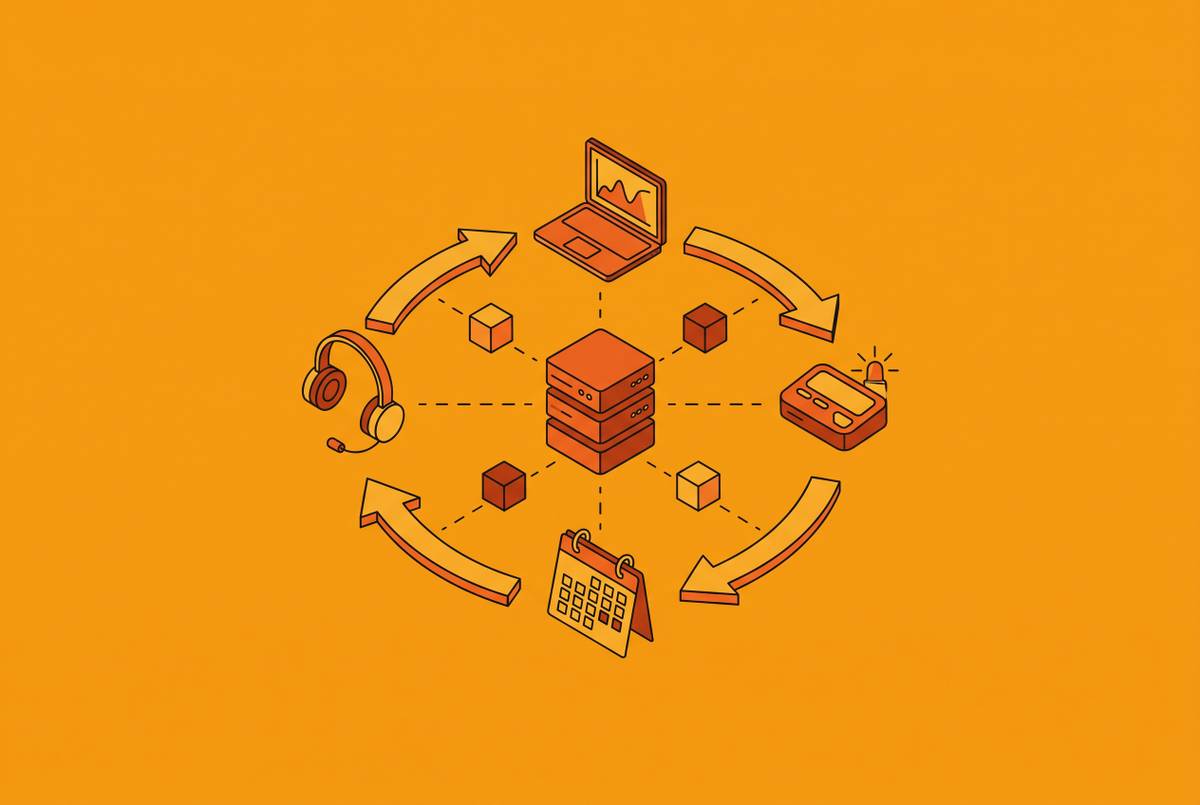
The canonical path looks like this: monitoring fires, the alert links directly to a runbook, the responder follows the decision tree, the incident resolves, and the postmortem updates the runbook for next time. That loop is the entire value proposition of a runbook, and it breaks the moment any link in the chain goes missing or slow.
That matters more than it used to. The NeuBird AI State of Production Reliability and AI Adoption Report found that 77% of on-call teams field at least ten alerts a day, and 80% say half or fewer of their alerts are actually actionable. In a landscape already that noisy, a runbook that's hard to find, or slow to navigate once found, is functionally absent. Quality of writing doesn't matter if nobody can locate the thing fast enough to use it.
The same report found that 44% of organizations had outages tied to alerts that were ignored or suppressed. Responders learn, over time, not to trust alerts that lack a clear runbook link and a clear next action, which accounts for part of the reason. An alert that's fired ten times before with no useful path attached teaches the team to mute the eleventh one rather than investigate it. An alert that's fired ten times before with no useful path attached teaches the team to mute the eleventh one rather than investigate it, a rational response to a broken chain. It's a rational response to a broken chain.
Google's Site Reliability Engineering guidance, cited in sopx.io, states the underlying principle directly: having up-to-date playbooks with instructions on how to debug and mitigate issues speeds up incident response significantly. In the Managing Incidents chapter, Google credits a prepared incident management strategy, one structured to scale and exercised regularly, with reducing MTTR and giving staff a less stressful path through emergent problems. The word "regularly" carries the real weight in that sentence. A runbook nobody has touched since the day it was written isn't the same document as one a team actually drills against.
How agentic development is changing the runbook calculus
Production environments now include AI agents that take irreversible actions: committing code, triggering deploys, modifying infrastructure, without a human reviewing every step. CISA's May 2026 "Careful Adoption of Agentic AI Services" joint Five Eyes guidance describes these agents as credentialed identities in their own right, connected to GitHub repositories, payment flows, and accounts-payable workflows. That's a different production reality than the one most runbook practices were built to handle.
Traditional monitoring has a structural blind spot here, and it's not a small one. According to Mastra.ai's analysis of AI agent observability, traditional application monitoring has a structural blind spot with agents: it was built for deterministic systems, not for tool-calling agents that can complete a request and still produce wrong outcomes, exhaust resources, or drift silently off-task. A green status check confirms the request finished. It says nothing about whether the agent did the right thing.
There's an underreporting problem layered on top of that blind spot. The State of AI Agent Security report from Gravitee, cited by Mastra.ai, found that 88% of organizations running AI agents reported some form of incident, yet researchers attribute that gap to underreporting and detection failure, not to any real improvement in security. Fewer confirmed incidents next to more deployed agents is a visibility gap dressed up as progress. It's a visibility gap dressed up as one.
For runbooks, this changes the calculus in a concrete way. Every fix an AI agent executes autonomously becomes a candidate for a runbook entry: a pre-approved task that fires on trigger, cutting recurring toil while leaving a traceable, reviewable path behind it. Runbooks start functioning as the guardrail itself, since the agent's permitted set of actions is bounded by what exists in the runbook library. Anything outside that library needs a human sign-off before it runs. Logs and audit trails, following the invariant-checks principle from runtime verification practice, become the mechanism that catches the moment an agent drifts off its runbook instead of executing it as written.
A decision guide for what to write next
Four questions settle what to write before a single word gets typed.
What triggers this? A calendar event or a normal job means write an SOP. An alert, an outage, or a named failure mode means write a runbook.
Who reads it under pressure? If the reader might be a junior engineer paged at 3 AM with zero prior context, the document is a runbook, and it needs a decision tree, not prose. If the reader is trained staff running a routine they know cold, it's an SOP.
How wide is the scope? A document covering a whole recurring process, start to finish, is an SOP. A document covering the response to one specific condition is a runbook, and trying to make one document do both jobs is how you end up with something too long to use mid-incident.
When does it change? Something on a planned review cycle is an SOP. Something that changes the week after someone hits a gap trying to use it is a runbook, and the postmortem link belongs in it from day one, not bolted on after the fact.
The sequencing follows from those four answers: write the SOP first, since it documents how the system is supposed to behave under normal conditions. Add runbooks for the failure modes actually encountered. Keep the two linked, so a responder can move from normal-state documentation to incident response without leaving the tool they're already in. SOPs live linked from wherever the routine work happens. Runbooks live linked from the on-call handoff and the alert fields themselves, sopcompare.com notes, the same platform with a different tag, not a different tool.
Most documentation libraries fail in one of two directions, and the fix in each case is the same: stop treating the two documents as interchangeable. Teams that treat everything as an SOP lose the decision-tree structure a runbook needs, and their responders end up improvising during incidents that should have had a clear branch waiting for them. Teams that treat everything as a runbook drown their library in panic docs that never get reviewed, never get reused, and eventually get ignored the same way noisy alerts get ignored. Keeping the two labels honest, tied to trigger and audience rather than habit, is the only thing that keeps either document doing the job it was built for.