Runbook vs Playbook vs SOP Decision Framework
Decide between runbook, playbook, and SOP based on urgency, predictability, and who's reading.
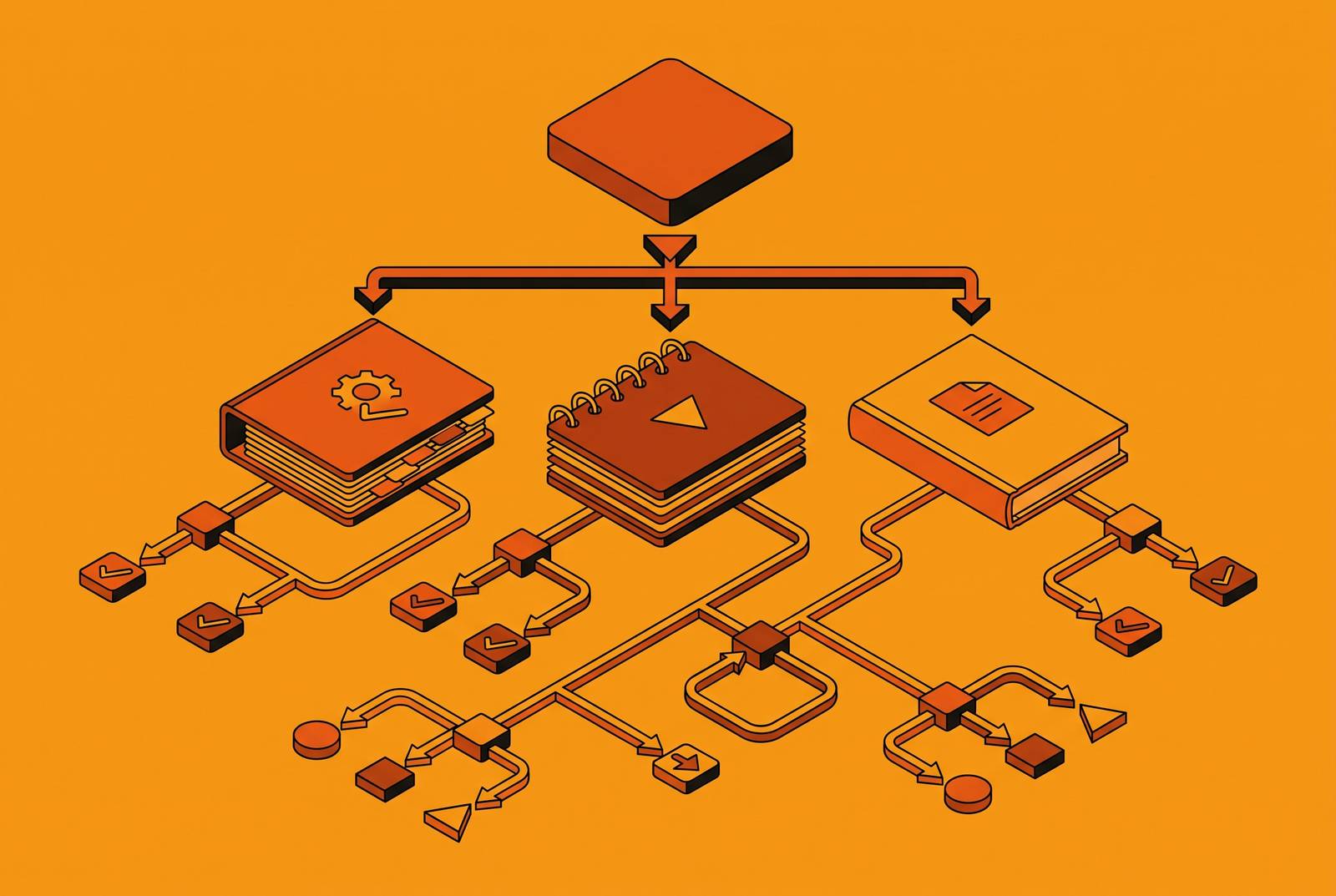
Runbooks, playbooks, and SOPs occupy a hierarchy defined by urgency, audience, and scope rather than being interchangeable, and choosing the wrong format for the moment is itself an operational risk. What follows is a decision framework for which document a given situation actually calls for, and how the three are supposed to work together instead of competing for the same page in a wiki.
Operational risk from treating runbooks, playbooks, and SOPs as synonyms
It's 2 a.m., a service is down, and an on-call engineer opens a doc. That's not a hypothetical: it's the condition every one of these documents is eventually judged under, and most of them are judged badly, because most teams write "runbook," "playbook," and "SOP" as though they're rotating synonyms across their wikis, Confluence spaces, and incident tools.
When a playbook, strategic, role-based, full of conditional branches, is handed to a solo engineer mid-incident, they get context without a single command to run. Handing a runbook, narrow and command-level, to an incident commander trying to coordinate five teams during a crisis gives them steps with no framework for who does what. Handing an SOP written for a compliance auditor to someone reading it under incident pressure adds friction exactly where speed matters most.
None of this stems from a documentation shortage. Most teams have plenty of pages. The trouble is that they wrote one document where the situation actually demanded two or three distinct ones. What follows isn't another round of definitions to memorize: it's a decision framework covering what conditions call for each document type and how the three work together rather than compete.
Definitions of each document, grounded in function, not label
Definitions matter less here than function: each document answers a different question, and each gets read under different conditions.
A runbook answers "what do I type." It's a step-by-step procedure for one specific, well-understood technical task, recycling a connection pool, failing over a replica, running a rolling restart. It's read mid-incident, by one person, often under pressure, sometimes by someone who was asleep ten minutes earlier NeuBird AI 2026 State of Production Reliability and AI Adoption Report. It assumes the diagnosis is already done; the job left to do is reliable execution, not investigation. Runbooks come in three automation tiers: manual, where the operator walks through every step by hand; semi-automated, where some triggers fire on their own; and fully automated, where no operator is needed at all. The test for what belongs in one is blunt: if a line doesn't help the responder decide or act in the next sixty seconds, it belongs in a different document.
A playbook answers "who does what, and when." It's a strategic guide for an entire category of event, a major outage, a ransomware incident, a data breach, and it defines severity levels, roles (incident commander, scribe, subject-matter experts, stakeholder liaison), communication paths, and the points where the team has to make a decision. It runs on conditional logic, if the situation turns out to be A, escalate this way; if it turns out to be B, escalate that way. It's built to coordinate a group of people moving through uncertainty together, and it's read by the whole response team at the keyboard.
An SOP answers "how do we do this the same way every time." It's a formal, repeatable instruction for a routine business task, written for consistency and, often, for an auditor to review later. It gets read in calm conditions, by whoever owns the process, and that person doesn't need to be technical at all: offboarding an employee's accounts, processing a data access request, running the monthly financial close all qualify. Because SOPs govern routine work, their inputs, steps, and outputs tend to be well defined and predictable, and they show up in whatever format suits the audience, step-by-step guides, flowcharts, org hierarchies, checklists.
Boiled down: SOPs keep the business consistent, runbooks keep systems running, and playbooks keep teams aligned when things break.
The hierarchy: SOP contains runbook contains playbook's raw material
None of this is metaphorical. The three formats nest inside each other by scope, and the nesting tells you something real about how they're supposed to be used together.
The SOP is the widest category: any documented, repeatable way of doing a thing, whether or not an incident is involved. A runbook is really a technical, operationally-focused SOP scoped to one specific scenario, sometimes carrying its own conditional branches ("if the health check still fails, escalate"), but narrower and more urgent than a general SOP. A playbook sits above both once an incident is underway: it's the strategy layer that decides when and which runbooks get pulled off the shelf.
During a serious incident, this plays out as a chain of command, more or less. The playbook governs the shape of the whole response, roles, severity classification, who talks to whom, when to escalate. The individual runbooks are the tools responders reach for to execute each concrete step the playbook is calling for. SOPs are the baseline from which both were derived, which matters most in regulated environments where an auditor eventually wants to see where the procedure came from.
That nesting is also why "just write an SOP for everything" doesn't hold up. SOPs are built for calm conditions and trained users; they assume time, context, and consistency, and none of those assumptions survive contact with a degraded service and a pager going off at 2 a.m.. The inverse fails too: a playbook that tries to script every command runs too long to follow under pressure, and a playbook that stays purely strategic leaves the responder standing there with context and no action to take. These formats aren't three ways of writing the same thing.
The decision framework: three questions that route you to the right format
None of this needs to be a taxonomy exercise. It's a routing question, and the article gives a concrete decision framework for what conditions call for each document type and how the three work together rather than compete.
Question one: the reader is either responding to an alert, an outage, or a live event unfolding right now, or they are doing planned, routine work. A live event points toward incident documentation, a runbook or a playbook. Planned, recurring, routine work points toward an SOP.
Question two: is the situation already understood, with a known fix, or is it unpredictable, with the right response still uncertain? A known fix that just needs repeatable execution calls for a runbook. A genuinely uncertain situation, one that needs coordination across roles and judgment calls along the way, calls for a playbook.
Question three: who's actually going to read this, one engineer alone at a keyboard, or a multi-role response team? A single engineer executing steps needs a runbook. A team coordinating, commander, subject-matter experts, communications, sometimes legal, needs a playbook. A process owner trying to keep something consistent, often for compliance reasons, needs an SOP.
Needing one consistent way to execute recurring work means starting with an SOP. Needing principles, scenarios, examples, and a set of linked procedures means starting with a playbook. A scannable reference built around audience, situational predictability, automation potential, and compliance role earns its keep here more than another paragraph of explanation would.
Edge cases are where the framework actually gets tested. Disaster recovery documentation looks like a runbook on the surface, step-by-step and procedural, but it often spans multiple teams and multiple decision points. It may therefore need both a DR runbook for the mechanics and a DR playbook that decides when to invoke it. Security incidents almost always need a playbook, since the situation is unpredictable and multi-role by nature, paired with narrow per-tactic runbooks (block this IP, revoke this token), the pattern security operations centers already run on. Deployment procedures usually sit squarely in runbook territory, known steps, repeatable, well suited to automation, though a major cutover involving multiple teams can justify a playbook layer sitting above it. The three-way mapping (per glydehq.com) routes you to the right format by answering three questions.
Common traps teams fall into when they skip the framework
Skipping the routing questions causes the same handful of failures to occur over and over.
The first is calling every internal document an SOP. It feels tidy, one label, one template, one place to file things.
The second is stuffing tactical incident steps into a vague playbook. Paragraphs of strategic framing bury the actual commands, producing a document too long to follow under real pressure. An engineer either skips straight to the commands and misses the coordination context around them, or reads the thing top to bottom and burns minutes it didn't have.
The third runs the other direction: handing someone a playbook when what the moment actually demands is a tested runbook with exact steps written out. Strategic framing without a command to run leaves a responder aware of the situation and unable to act on it, and that gap is most dangerous exactly when the person on call is junior or unfamiliar with the service in question.
The fourth is a writing problem more than a format problem: runbooks written for the author instead of a stranger. A runbook should assume its reader has never done this task before and has no way to reach the person who wrote it. "Restart the relevant service" is where mistakes happen. "Run systemctl restart api, then verify with the health check below" is where confidence comes from, because there's nothing left to guess.
The fifth is letting runbooks go stale. A stale runbook is worse than no runbook at all, because it hands a tired engineer false confidence instead of an honest gap.
A parallel connects to this: teams that collapse these formats into one undifferentiated pile of documentation run into the same failure mode as teams with bad alert hygiene. Teams that collapse these formats into one undifferentiated pile of documentation run into the same failure mode as teams with bad alert hygiene: too much signal mixed with too much noise, and the one piece of information that actually matters buried and unreachable at the exact moment someone needs it. Skipping the framework loses the distinction between strategy (playbook), execution (runbook), and consistency (SOP). When everything is an SOP, nothing is optimized for the moment it will actually be read.
What a good runbook contains
Runbooks live under one constraint above all others: the reader may have been asleep four minutes ago, so anything that doesn't help them decide or act in the next sixty seconds doesn't belong on the page.
A working runbook needs a named trigger up front, which alert or symptom sends someone here, and which service it affects, so a responder can confirm within seconds that they've landed in the right document. It needs commands that are copy-paste ready: exact, safe to run in sequence, never "restart the relevant service" but the literal command and the output that means it worked. It needs checkpoints after every step, so the reader knows to keep going or to stop and escalate. It needs an escalation path, who owns the service, when to hand off, what to tell them, because a runbook that dead-ends just pushes the panic to someone else further down the chain. And it needs an owner and a last-reviewed date, so the reader can judge, before they act on it, if the page in front of them can actually be trusted.
Just as important is what to cut. Architecture background and system history are genuinely useful reading on a Tuesday afternoon and a genuine liability at 3 a.m.. Stakeholder communication guidance belongs in the playbook, not here. Decision logic for choosing between competing response approaches belongs in the playbook too. A runbook that tries to hold all of that at once no longer functions as a runbook; the extra weight makes it a slower, worse playbook wearing a runbook's name.
Runbooks are also the format with the most room to automate, running the spectrum from fully manual, where a person walks every step by hand, through semi-automated, where some triggers fire without a human, up to fully automated, where no operator needs to be in the loop. That's a deliberate choice to make for each runbook, made intentionally rather than allowed to happen by default. And the runbooks worth trusting are the ones that get updated by what actually happened in the last incident, not just what someone predicted would happen when the page was first drafted; a runbook that captures what actually worked is worth more than a template filled in once and left untouched. There is a specific list of what does NOT belong in a runbook.
How automated production verification closes the gap runbooks can't
Even a well-written runbook has an honest limit: it only helps once something has already been detected NeuBird AI 2026 State of Production Reliability and AI Adoption Report. The NeuBird AI 2026 State of Production Reliability and AI Adoption Report, a survey of more than 1,000 SRE, DevOps, and IT operations professionals, found that 78% of organizations experienced incidents where no alert fired at all. No runbook, however well written, does anything for an incident nobody knew to look for.
Alert fatigue makes the gap wider, not narrower. The same report found that 80% of organizations say half or fewer of their alerts are actually actionable, and 77% of on-call teams field at least ten alerts a day NeuBird AI 2026 State of Production Reliability and AI Adoption Report. Runbooks bolted onto noisy, low-signal alerts train teams to skip the alert entirely, which means the runbook attached to it never gets opened when it's actually needed.
Both numbers share a harder problem: a green CI pipeline is not the same thing as a working production system. A pull request merges cleanly, the tests pass, the deploy goes out, and a regression is live anyway. The runbook for that regression may already exist, sitting untouched, because nothing yet has told anyone to go open it. Production telemetry gathered after a deploy is the only real ground truth available; everything that happens before that point, tests, review, staging, is necessary and still not sufficient. Automated verification that watches production behavior right after a deploy, rather than waiting on a threshold-based alert to fire, is what closes that gap: it turns "an alert eventually told someone" into "the system caught the regression the moment it appeared," which is the only way a runbook gets opened before the outage instead of well into it.