Production Signal Triage When the On-Call Engineer and the Deploying Dev Are Different People
When deployers and on-call responders differ, context must travel through systems, not people.
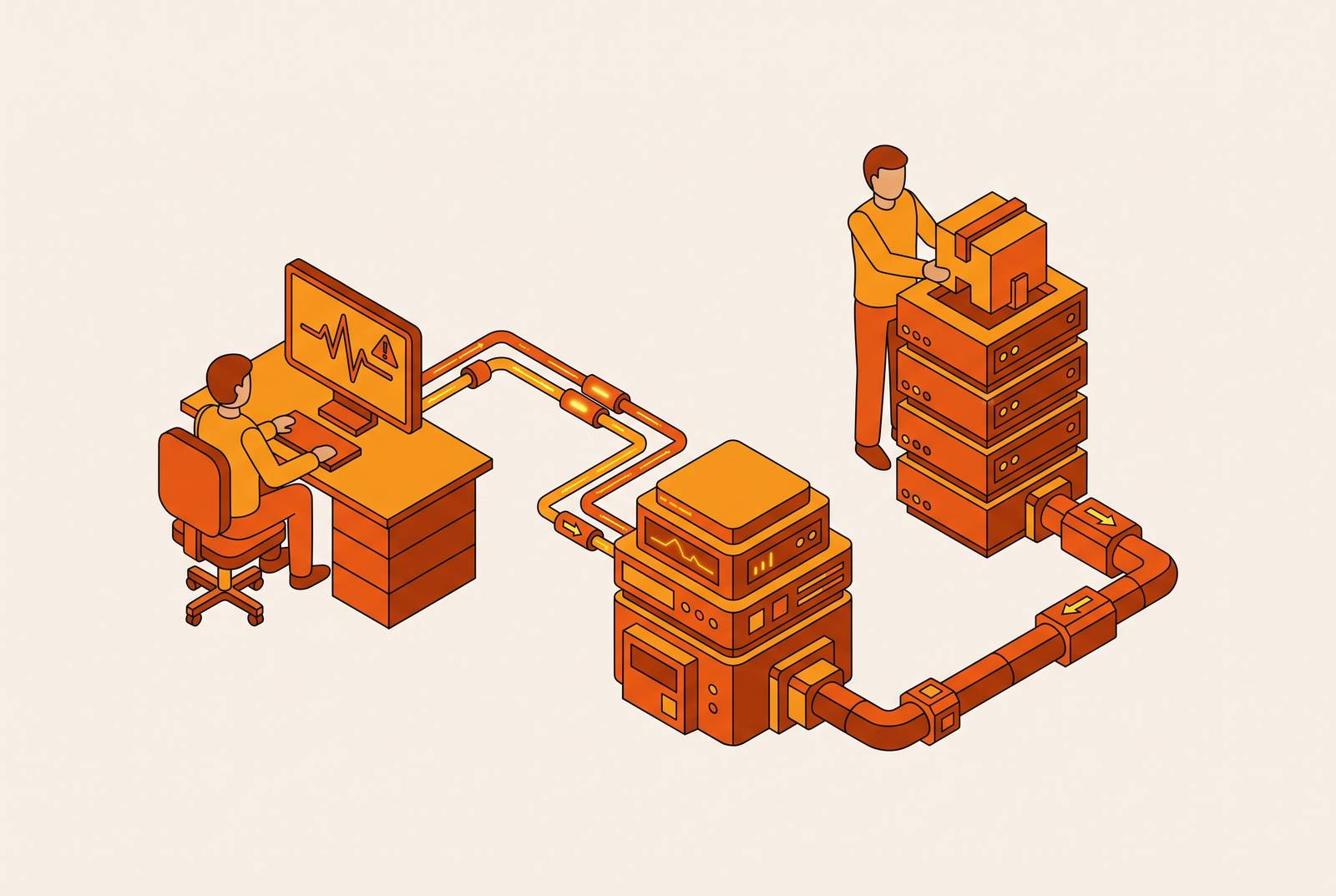
The failure mode in split-ownership incidents has a precise shape: the engineer who gets paged inherits the alert, but not the understanding needed to act on it. That gap is a design defect, not a staffing defect, and it can be fixed the way any design defect gets fixed: by changing the system that produces it. In traditional structures, Ops teams deploy and monitor code they did not write. That arrangement generates the familiar Dev/Ops blame cycle, where each side points at the other when something breaks and neither one holds the authority or the knowledge to actually fix the system. An Ops engineer staring down a wall of alerts often cannot tell which one matters, because the heuristic for separating signal from noise belongs to whoever wrote the code, not whoever is watching the dashboard.
The problem persists even inside organizations that have tried to erase the Dev/Ops boundary. DevOps teams blur the org chart, but individual engineers still specialize: some live in application code, others in infrastructure, and the deployer-responder split survives at the level of the person even when it has disappeared from the slide deck describing the team's structure. Treating this as a motivation problem, something that better incentives or clearer ownership language would resolve, misdiagnoses the failure. The fix belongs in the systems that generate and carry context from the moment code is written to the moment an alert fires.
Addressing the Split with "You Build It, You Own It
The industry's dominant answer to the context gap is "you build it, you own it," and the logic behind it is sound as far as it goes. Making the deployer the responder collapses the Dev/Ops handoff into a single person, so the context never has to travel anywhere. Developers who know they will be paged for their own code tend to test it more rigorously, and they are frequently the ones who can troubleshoot a given failure fastest, simply because they hold the mental model of what the code is supposed to do. That discipline produces software that's less likely to fail in the first place; it's the quiet, compounding benefit of the policy: better code, not just faster firefighting.
Large companies have built real, working versions of this idea, and they differ from each other in instructive ways. All three are legitimate solutions to the same problem, and none of them transfers cleanly to a different organization. Adopting a practice because Google or Amazon uses it is risky precisely because the practice was shaped by constraints, scale, and history specific to that company, and a smaller organization copying the surface structure without the underlying context may find the policy doesn't fit the problem it actually has.
The limits appear fastest on small teams. And ownership alone, absent noise hygiene and tooling consolidation, doesn't close the gap so much as relocate the blame, moving it from Ops onto the developer rotation instead of eliminating it. The condition that breaks the model cleanly is the combination of rotating coverage and high deploy frequency: once a team is shipping multiple times a day with a rotating on-call schedule, the responder on duty at any given moment is statistically unlikely to be the author of the most recent change, no matter how the team's ownership policy reads on paper.
Why agentic development makes the authorship gap structurally permanent
AI coding agents, tools like Claude Code and Cursor running in agent mode, now participate in the deploy pipeline as an ordinary part of how software gets written. That changes the nature of the deployer-responder split. When an agent merges and deploys code that no human on the on-call rotation wrote or reviewed, the split stops being a scheduling inconvenience that a better rotation could smooth over. It becomes a permanent structural condition, because there is no longer a human author on the other end of a page.
The authorship gap in this case looks like the classic Dev/Ops split, but worse. An on-call engineer triaging a regression introduced by a human colleague can still, in principle, walk down the hall or ping them on Slack and ask what the change was supposed to do. Governance frameworks built for human-authored pull requests were not designed with these properties in view, and they don't translate cleanly to a world where the "deployer" has no badge, no calendar, and no pager.
This is a present condition, not a speculative one: agentic coding is a normal part of how production code ships today, and it has created a class of deployer who will never appear on an on-call rotation. The practical consequence is blunt. Any incident response strategy that depends, even partly, on being able to page the person who wrote the code has already stopped being a universal strategy. Whatever replaces it has to work when there is no such person to page.
What context the on-call engineer actually needs at the moment the alert fires
The on-call engineer's problem at 2am is the absence of three specific signals: what changed, when it changed, and how the system behaved before and after the change went live. Supply those three things automatically, and the identity of whoever wrote the code becomes far less important to how fast the incident gets resolved.
The first move after an alert fires is to confirm the problem is real and gauge how bad it is, usually by checking logs and metrics before doing anything else. The fastest route to a working hypothesis is correlating the alert with a recent deployment: if an error spike lines up with a deploy timestamp, the responder has a plausible cause within minutes rather than hours. That correlation only works, though, if the deployment data is actually sitting next to the metrics the responder is already looking at. Tagging every deployment with its Git commit SHA, its timestamp, and its environment, and then surfacing those tags as annotations directly on the monitoring dashboards, lets a responder check whether a spike aligns with a deploy without needing to understand anything about the code itself. Canary monitoring adds a second layer: tracking error rate and latency for a canary release separately from the stable version gives the responder a built-in before-and-after comparison, again without requiring any grasp of what the change was trying to accomplish.
Without these two things in place, the responder is stuck reconstructing the deployment timeline by hand, opening separate tools for logs, metrics, and deploy history, lining up timestamps manually, and burning minutes against the SLO while doing work a machine could have done at deploy time. The context an on-call engineer needs is structured, machine-readable evidence that already existed the moment the code shipped and simply wasn't attached to the alert that eventually fired.
The Deployment Pipeline as the Right Place to Build That Context
Context that lives only in the head of the person who deployed the code cannot be retrieved at 2am, because that person may be asleep, on vacation, or, increasingly, not a person. Context that gets built into the pipeline at deploy time travels with the alert automatically, regardless of who happens to be holding the pager when it fires. That single distinction is the hinge the rest of this argument turns on.
DevOps teams have long leaned on a specific advantage: incident responders who wrote the code in question tend to resolve issues faster, because familiarity with the system substitutes for investigation. That advantage evaporates the instant the responder isn't the author, which is precisely the condition split-ownership teams and agentic pipelines both produce. The deployment pipeline is the one point in the entire software lifecycle where the deployer's knowledge and the system's live telemetry are both available at the same moment, which makes it the natural place to capture and encode the context a responder will need later, long after the deployer has moved on to something else.
Post-deploy verification, the practice of automatically comparing production telemetry against a pre-deploy baseline immediately after every merge, produces a structured record of what actually changed in the system's behavior, not merely what changed in the code. That record doesn't ask the on-call engineer to have written the code, to understand whatever agent generated it, or to reconstruct a timeline from scratch. Instrumenting against open standards, such as the OpenTelemetry GenAI conventions, rather than proprietary vendor SDKs, keeps telemetry coherent across services and leaves teams free to switch tools later without re-instrumenting everything from scratch.
A serious objection is that this all sounds like ordinary observability, which most mature teams already have in some form. Most teams do have observability data. Few have connected that data to the deployment event itself in a way that would surface it automatically at the moment of triage. The gap is the missing structured link between a specific deploy and the alert that eventually results from it.
What automated production verification looks like for split-ownership teams
Automated production verification closes the context gap by doing the comparison work at deploy time and handing the result to whoever ends up getting paged, rather than by training every possible responder to understand code they may never have seen. One Patch builds its product around exactly that idea. It sits between pull requests and the live production environment, automatically verifying every PR against real telemetry once it deploys, so the comparison between pre-deploy and post-deploy behavior already exists before any human needs to look for it.
When a regression occurs, the platform catches it before a human has to be paged at all in many cases, and the on-call engineer who does get paged receives an alert that already carries a structured account of what changed and how the system's behavior compares to its pre-deploy baseline. The platform is built specifically around the split-ownership condition this piece has been describing: the responder doesn't need to be the author, because the correlation work that would otherwise depend on the author's memory has already been done by the time the page goes out. One Patch's pricing reflects the same design intent, charging per incident resolved rather than per seat, which keeps the vendor's incentive pointed at the same outcome the on-call engineer actually wants: fewer incidents that require a human to sit down and triage them manually. The platform is aimed at backend-leaning teams, platform engineers, on-call engineers, and developer tooling leads managing high deploy frequency against rotating coverage, and it consolidates signals, production telemetry, deploy metadata, and candidate remediation, that would otherwise require opening several separate tools in the middle of an outage.
The responder who didn't write the code needs access to the signals that were available at deploy time but never made it onto the alert: deployment metadata, pre- and post-deploy telemetry, and regression markers.
The general pattern holds regardless of which tool a team uses: link every deploy to a telemetry snapshot taken before and after it ships, surface that linkage automatically the moment an alert fires, and generate a candidate fix where possible rather than leaving the responder to start the investigation cold. Established DevOps incident management practice already calls for automating workflows and integrating monitoring, ticketing, and chat tools so the right people get notified. Automated production verification is what makes those integrations actually useful, rather than simply faster at delivering the same undifferentiated noise.
On-Call Rotation Design and Pipeline-Level Context
Pipeline-level context doesn't eliminate the need for thoughtful rotation design, but it lowers the cost of the split-ownership condition enough that a team can build a sustainable rotation without requiring every responder to have personally written the code they're triaging. The two fixes, tooling and rotation, work as complements rather than substitutes.
On-call burnout rarely comes from the rotation schedule itself. It comes from the combination of high alert volume, low context, and the cognitive load of reconstructing what happened without the right tools in hand, and when one team ends up absorbing more incident response than another, that team loses the capacity to do its actual day job well. Alert fatigue is a tooling failure more than a discipline failure: responders who can't trust that an alert represents something real and actionable start ignoring alerts outright, while responders whose alerts arrive with structured context and a pre-validated severity signal attached have far less reason to tune out. Runbooks stay valuable, but they have a ceiling. A runbook written for a known failure mode offers nothing to a responder facing an incident introduced by an AI agent that followed a code path no human ever planned for. Automated post-deploy telemetry comparison doesn't replace runbooks, it covers the territory runbooks were never built to anticipate.
The postmortem process that follows an incident, where DevOps teams update runbooks and monitoring based on what they learned, is only as good as the incident record feeding it, and a deploy pipeline that's well instrumented from the start produces a richer record automatically, without anyone needing to reconstruct it after the fact. The sequencing that follows from all of this is straightforward: instrument deploys with telemetry annotations and automated post-deploy comparison first, address rotation design and escalation policy second, and let runbook and process improvements follow from the richer incident record the pipeline is now generating on its own. The teams with the most at stake are the ones growing fast enough that today's deployer won't be next week's on-call engineer. For those teams, pipeline context is what makes the rotation viable.