Keeping a PR Open Until Production Telemetry Clears the On-Call Queue
Linking code review to production health signals closes the gap between deployment and verification.
A pull request closes when CI passes and the branch merges. That is the habit, and it is reasonable. But CI answers only whether code compiles and passes synthetic tests in a controlled environment. It says nothing about whether production behaves acceptably under real traffic. Keeping a PR open until production telemetry confirms health redefines the PR as a living contract between a change and its real-world consequences, and that shift is what finally connects the on-call queue to the engineering workflow that created the risk.
Why "merged" and "verified" have always been two different moments
The conventional deploy handoff treats code as done at the moment it leaves the developer's hands. A merge lands, the CI badge turns green, the PR closes, and the change enters a state of presumed correctness. This ritual is so embedded in engineering culture that questioning it feels almost perverse. Yet the questions CI answers are narrow, and they are the only ones it was ever designed to answer: does the code compile, and does it pass synthetic tests in an environment that resembles production only superficially.
The signals that actually matter arrive later, and only against live users. Crash rate deltas, error rate changes, latency against an SLO, rollback triggers, these are the measurements that tell an engineer whether a change is safe, and none of them exists before deployment. A merge is therefore a bet placed on behalf of production, not a verification of production. The gap between the two moments has always existed. What is new is that the volume of code crossing the gap is growing faster than any human review process can absorb, and the gap is becoming the most consequential part of the pipeline.
What agentic coding does to the verification gap
Agentic coding shifts the bottleneck from writing code to verifying it, and nothing in the classic CI/CD pipeline was designed to absorb that shift. Agents produce pull requests at rates that saturate human review capacity, with Faros AI's AI Engineering Report 2026 recording a 199.6% average increase in time spent in review and a 441.5% increase at the median. The result is that code reaches production not because it was judged ready, but because the queue moved on. Verification becomes a casualty of throughput.
The structural problem runs deeper than volume. The auditor cannot be the creator, a principle that applies as fully to a coding agent as to a person. Whoever writes the test suite only tests for what they already thought of, which means agent-generated coverage is systematically biased toward the bugs the agent did not make. The blind spots are precisely where the risks accumulate. Agentic systems operating on production infrastructure introduce qualitatively more severe risk categories, privilege escalation, irreversible action execution, cascade failure, because autonomy amplifies the blast radius of any design flaw. The 2026 Singapore Consensus on Global AI Safety Research Priorities and CISA's May 2026 guidance on agentic AI both register the same recognition: enterprises are deploying agentic systems while security practices remain immature. Validated deployment, the practice those frameworks point toward, is another name for confirming production health before a change is declared done. OnePatch and similar automated post-deploy verification systems address exactly this escalation by investigating production behavior in real time against live telemetry and catching regressions before an on-call engineer ever sees a page. That is the only scaling model that can keep pace with agentic code volume.
How alert noise and on-call toil are symptoms of the same unverified merge
Most alert noise is not a monitoring configuration problem. It is a verification gap made audible. Changes that were never confirmed safe in production generate the spurious signals that exhaust on-call engineers, because the underlying regressions are real even when their presentation is confusing. The phone rings, the engineer investigates, and the trail leads nowhere actionable, because the change that caused the signal was never evaluated against production ground truth in the first place.
The evidence that toil is rising despite increased AI investment points to the same root cause. Teams that skip verification discipline and bolt on AI alerting do not eliminate noise. They accelerate it, applying faster analysis to a firehose of unverified changes. The behavioral consequence is predictable and documented: desensitization. Engineers stop trusting the pager after enough false alarms, which is a rational response to a broken system, not a people failure. Alert volume and toil are downstream of a single root cause, changes that entered production without a production-grounded definition of done. The path forward is not faster alert triage. The anonymous, unverified change is the problem. OnePatch has reported sharp drops in spurious alerts for teams that operationalize post-deploy telemetry gates, because fewer unvalidated changes reach production in the first place.
What a PR-as-living-contract actually means in practice
Treating a PR as a living contract means its closure condition is not "CI passed and the branch was merged." It is "production telemetry confirms the change did not degrade the system." This distinction requires a pre/post-deploy separation that most workflows blur beyond recognition. Pre-merge gates answer whether the code is structurally sound. Post-deploy gates answer whether production is behaviorally healthy after real traffic has exercised the change. They are different questions, and only the second one determines whether a contract has been fulfilled.
The blocking checklist is specific, and it should not be vague. Error rate delta within budget, latency within SLO, crash rate stable, rollback trigger not fired, these are the stamps that close the contract, not the green CI badge. The failure mode that matters most in this model is an instrumentation gap. A service that lacks distributed tracing creates blind spots where the contract cannot be evaluated, meaning a PR may stay technically open not because something is wrong but because the signal does not exist to say it is right. Context propagation breaks at asynchronous boundaries, message queues, background jobs, manually spawned threads, and getting propagation right on every hop is most of the real work of making post-deploy telemetry trustworthy enough to serve as a merge gate. The contract is only as strong as the signal it can read.
How real teams have operationalized the post-deploy gate
Real teams are implementing this concept in structurally different ways, and that convergence is the strongest evidence that the pattern is genuine engineering practice rather than abstraction. The sINte3/vehicle-soft repository offers a clear example, dated September 25, 2026, where a pull request introduces an explicit RELEASE_GATE that separates post-deploy QA debt from pre-deploy blockers. After a deployment, each row in the gate is either removed when live checks close with a journal entry, or moved to a "Накопленная post-deploy QA" section. Debt is not declared done, and it does not block unrelated releases, but it becomes a blocker for any release that depends on an unverified item or touches the same risky area. Other teams use OpenSpec task files that record production evidence before a PR closes, or checklist-driven roadmap stages with blocking runtime checks. Across all these cases, the common pattern is identical: the PR records the production evidence required, tracks whether it has arrived, and treats outstanding stamps as blockers, not as follow-up tickets that may never be resolved.
Why the strongest objection — that post-deploy gates penalize correct deploys — has a specific, solvable form
The objection is real and deserves to be taken seriously. Telemetry latency, noisy observability stacks, and poorly tuned thresholds can generate false positives that keep a PR in limbo after a correct, safe deploy. A reliability mechanism that becomes a velocity killer will be abandoned, and the engineers who raise this objection have usually seen exactly that failure. The answer is not to abandon the gate but to fix it in the right order. Deduplicate and correlate alerts first, then add dependency-aware suppression, then move to SLO-aligned thresholds, then fix instrumentation at the source. Downstream filtering gives fast relief but drifts back into noise. Source-level instrumentation produces a lasting reduction.
A second structural objection concerns who owns the signal. Assigning post-deploy telemetry ownership to the PR author conflates the roles of implementer and verifier, reintroducing the bias that the auditor-cannot-be-the-creator principle describes. The person most likely to miss a regression is the one who wrote the change. The answer to this objection is automation, not additional review headcount. If a system rather than the PR author evaluates the telemetry against pre-defined thresholds and updates the gate, the conflict of interest is removed. The verifier does not need to be human. It needs to be independent.
What automated production verification changes about who closes the contract
Manual post-deploy checklists solve the verification gap for individual PRs, and for small teams moving slowly they are genuinely better than nothing. They do not scale to the volume that agentic development produces, because a checklist still requires a human to remember, perform, and record the check. Automation is what makes the contract model viable at speed. The right architecture places production telemetry evaluation between the PR and its final closure state automatically, so that every PR is verified against real telemetry after it deploys, regressions are caught before anyone has to page, and fix PRs are opened autonomously when something breaks.
OnePatch operates precisely in that architectural position, sitting between pull requests and the live production environment. It verifies every PR against real telemetry after deployment, catches regressions before they surface as on-call alerts, and opens fix PRs autonomously. The PR stays open until production signals health, without requiring the engineer to watch the dashboard. This addresses the auditor-cannot-be-the-creator problem directly, because the evaluation is performed by a system that never saw the diff, using production ground truth rather than the author's assumptions. It also addresses the on-call toil problem, because verified merges generate fewer spurious alerts when the change was confirmed safe before it became the on-call queue's problem. AI-assisted root-cause analysis is changing what "telemetry clears" means as well. It is no longer merely that no alert fired, but that the system confirmed no anomalous pattern is attributable to this changeset. As AI-assisted RCA matures, the definition of a cleared gate becomes more precise and less dependent on threshold tuning.
How to instrument your pipeline so post-deploy gates have something real to evaluate
A post-deploy gate is only as trustworthy as the telemetry it reads. A change in a service with no distributed tracing cannot be cleared, and a signal that is not propagated across asynchronous boundaries cannot attribute a regression to its source. The instrumentation prerequisite has three layers. First, distributed tracing coverage must span all services in the blast radius of a given change. Blind spots in microservice deployments are common, especially for newly introduced services deployed before instrumentation is complete. Second, context propagation must work across every asynchronous boundary, HTTP clients, message queues, background jobs, manually spawned threads, because most tracing gaps in multi-service architectures stem from dropped or transformed trace context during inter-service calls. Third, alert thresholds must be SLO-aligned, distinguishing "metric moved" from "SLO is at risk." Gates tuned to raw metric thresholds produce false positives. Gates tuned to SLO burn rate produce actionable signal.
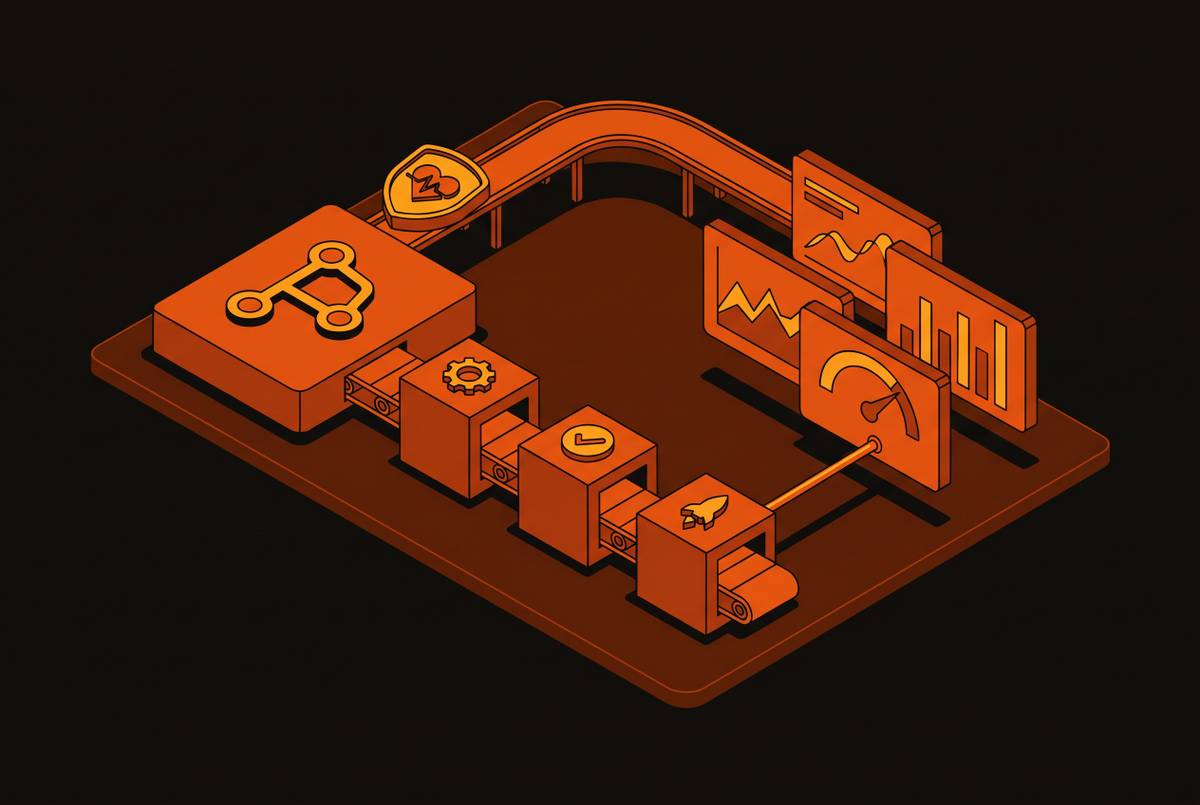
The full lifecycle that makes the gate trustworthy has a clear sequence. CI runs unit tests, then static analysis and security scans, then the merge gate evaluates results. If it passes, deployment proceeds. A post-deploy canary runs runtime SLI checks, and the final step is either promotion or a rollback trigger. Each step produces a specific class of signal, and the post-deploy stage is the only one with access to production ground truth. A practical calibration baseline is the 90-day rule: if engineers are performing the same manual post-deploy check repeatedly, that check is automation waiting to happen. Recurring manual verification is evidence of a gap in the instrumentation or the gate definition, not evidence that the check is valuable.
Connecting the on-call queue back to the PR that created the risk
The production verification model creates a feedback loop that the conventional handoff explicitly breaks. When a regression appears in the on-call queue under the traditional model, the PR that caused it is closed, the engineer who wrote it has moved on to other work, and the incident begins with a human paging, diagnosing, correlating a change, and coordinating a rollback. Under the contract model, the PR is still open, the engineer who wrote it is still in context, and the system can open a fix PR autonomously rather than convening a war-room Slack thread. This changes the economics of on-call in a way that is concrete and measurable. Incidents that currently require a human to page, diagnose, correlate, and roll back become incidents that the system catches at the gate, before they surface as pages at all.
Speed and stability are correlated when verification is automatic and production-grounded. They diverge when verification is manual, deferred, or absent. The PR-as-living-contract is the operational expression of that correlation. For the on-call engineer, the consequence is straightforward: fewer pages, faster attribution when something does break, and fix PRs that arrive before the incident is declared. The feedback loop is closed, and the queue is finally connected to the workflow that created the risk.