Blocking PR Merges on Live Error Rate Thresholds After the Fact
Production telemetry determines whether the last deploy is healthy enough to merge the next PR.
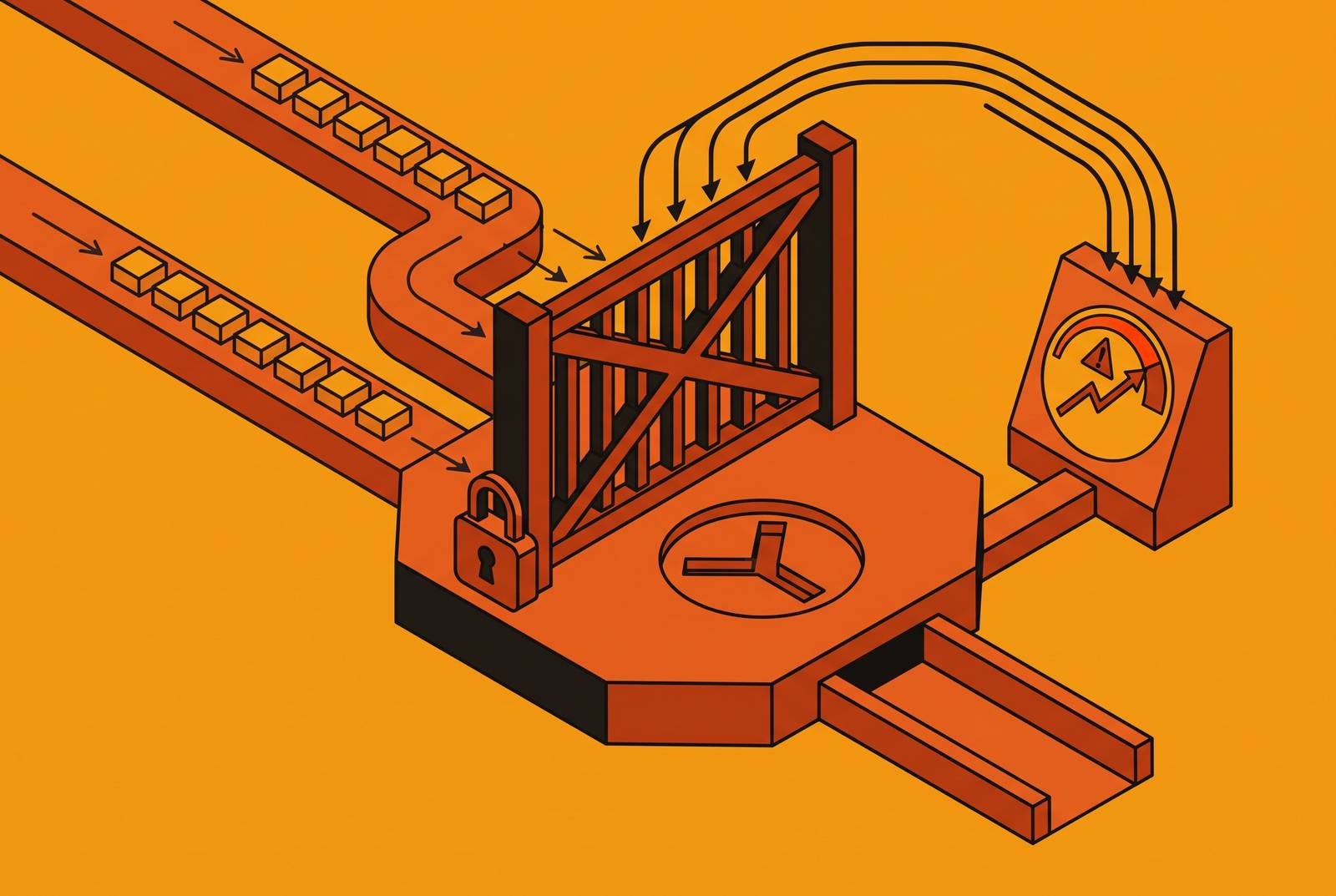
Automated post-deploy verification tied to pull requests uses live production telemetry to check whether a deployed change held, then blocks later PR merges against that service when error rates cross a set threshold. The deployed SHA connects the production signal to the change under evaluation. Passing tests cannot show whether the last deploy is healthy under real traffic, so this supplies what pre-merge checks lack.
Why pre-merge checks cannot tell you whether the last deploy held
Linters, unit tests, static analysis, and policy checks check a proposed change before production sees it. Linters and type checks catch syntax errors, type errors, and style violations. Unit tests cover the logic someone thought to test, leaving gaps in coverage of production data shapes, traffic patterns, and scale conditions. OPA evaluates the Terraform plan JSON, but some information is unavailable at plan time. A plan file also cannot establish whether a running service is currently unhealthy.
Progressive delivery addresses a different part of this gap. Argo Rollouts reads live metrics during rollout analysis, including after a canary deploy has reached some users. Its blue-green pre-promotion analysis can run before production traffic switches, but the change has still been deployed after merge. That provides valuable protection at the rollout stage. Post-deploy verification systems, including OnePatch, make the missing production signal available after a PR lands, when code checks alone no longer establish whether the running service is healthy.
What post-deploy error-rate blocking actually does and how it closes the gap
Post-deploy error-rate blocking turns the health of the current deploy into a condition for merging the next PR against that service. Consider a deploy that goes out at 14:00. Its error rate crosses the threshold at 14:07, and a PR targeting the same service is gated at 14:08. That PR remains blocked until health is re-established or the incident is resolved, even if its own CI checks pass.
This extends a release feedback loop across three moments. Before deployment, the release decision can account for the remaining error budget. During deployment, real-time errors can be compared with SLOs as traffic shifts. After deployment, a burn rate above the agreed limit can slow the rollout or block the next merge. The last step is the important connection, because a canary gate alone does not carry rollout health back into source control.
A merge block is therefore distinct from a rollback. It does not undo the deployed change or claim that the next PR caused the incident. OnePatch detects post-deploy regressions and opens fix PRs for review, keeping the production signal in the remediation workflow.
How threshold decisions determine whether the gate is signal or noise
Calibration is the hardest practical decision because the threshold determines what the gate interrupts. A loose threshold lets real regressions pass, while a tight one blocks healthy changes often enough to erode trust, much as frequent pages cause alert fatigue. The goal is a gate whose interruptions reliably correspond to a production condition worth stopping for.
The comparison must fit the service and the workload. Candidate error rate can be evaluated against the stable rate plus a defined tolerance, while P99 latency can be compared with the concurrent baseline. Teams may also need to set a floor for automated quality metrics. MLflow's canary deployment guidance says to agree on rollback thresholds before traffic shifts begin. For AI and LLM workloads, its rollback criteria also cover decreases in automated evaluation scores, drops in coherence, and increases in toxicity, because request errors alone do not capture every failure.
A latency-sensitive payment service and a background batch job should not inherit the same SLO floor merely because they share a deployment pipeline. Semgrep's blocking policy guidance offers a transferable rollout principle by recommending high-confidence, high-severity cases first, initially in monitor or comment mode. For the error-rate gate, that means logging what it would block and checking false positives before it starts blocking. Once blocking begins, those reviews must continue so that gate firings inform calibration. A threshold is an operating policy that requires ongoing review.
The instrumentation gaps that undermine the gate before it fires
Calibration needs a signal teams can trust, but gaps in instrumentation can make even a sound policy fail. Automated root-cause analysis often assumes that services have full distributed trace coverage. Real microservice deployments commonly contain components without that coverage. If an error-rate spike cannot be traced to a specific service, the most recent deploy can become the apparent cause without being the actual cause.
Auto-instrumentation can capture database calls and HTTP requests without knowing which spans represent “processing a payment” or “running a fraud check”. Those business processes require manual span instrumentation. Without it, the gate can miss failures that matter to the business while reacting to infrastructure noise. A healthy-looking request metric is not a substitute for coverage of the operation whose success matters.
OpenTelemetry provides vendor-neutral instrumentation, while schema discipline for agent workloads determines which gen_ai.* attributes are mandatory, which are opt-in, and how custom attributes are tagged. Making those decisions early avoids later refactoring across dozens of call sites. Before a gate starts blocking, teams should check coverage for each service and find where attribution is still uncertain. Services with known blind spots belong in monitor-only mode until their traces support a trustworthy blocking decision.
How do you connect live service health after a deploy to the pull request pipeline
The architecture connects three components, which are a telemetry layer, a threshold evaluation layer, and a source-control integration. The telemetry layer produces a real-time error-rate stream aggregated by service and deploy SHA. That deploy identity connects the observed behavior to the change under evaluation. The comparison uses the concurrent baseline rather than a historical average, and updates often enough to catch a canary regression before it gets full traffic. Without those boundaries, the evaluator lacks the context needed to distinguish the candidate from the stable deployment.
The data flow can be followed from production to the blocked PR. First, production telemetry shows an error-rate spike for the service and deployed SHA. Next, a policy engine or pipeline step compares that signal with the service's defined tolerance. It then emits a pass or fail result to the source-control integration. Finally, that integration uses the failed state to set a required status check on later PRs for the same service, which blocks them from merging even if their other CI checks pass.
Harness Continuous Delivery and GitOps illustrates policy enforcement at another boundary. It enforces OPA rules at sync/save time through the Harness UI or API, while auto-syncs and direct cluster-level syncs are outside those policies. A post-deploy error-rate gate extends the enforcement pattern into the period when live behavior is available. Its policy must also define cooldown periods and human escalation alongside a failure threshold. If automated rollback occurs, the gate should reflect the reverted deployment once it stabilizes instead of remaining blocked on the pre-rollback error rate.
The cascading rollback problem and other failure modes teams must design around
The strongest objection to automated gating is that its response can create another production problem. A rollback that overshoots can cause a new error-rate spike, which triggers another rollback if the pipeline has no cooldown. That cascading rollback loop makes the recovery mechanism a source of instability. Clear rollback thresholds, cooldown periods, and human escalation rules are needed to break the cycle. The merge gate must track recovery without repeatedly counting its effects as new evidence against the original deploy.
Defining one fixed burn-rate threshold is simpler than maintaining policies that fit heterogeneous services, but that simplicity produces both false positives and false negatives. Enforcement at scale therefore depends on maintaining those distinctions. Ownership matters just as much, because a gated service without a clear escalation path can stall indefinitely. A block with no route to resolution is an operational failure even when the original signal was correct.
Explainability is another requirement for trust. Engineers need to see which metric crossed which threshold and what condition will lift the block. A message such as “service X error rate is 2.3× baseline, gate will lift when rate returns below threshold for five consecutive minutes” makes both the cause and the recovery rule legible. Automated scoring alone is not enough to supply that confidence. METR's agentic coding study found that large increases in pass rates between model versions also came with more cases in which maintainers flagged core functionality issues despite patches passing the automated grader. Monitor, comment, and then block is a way to expose those weaknesses before the gate gains authority.
Why agentic code generation makes post-deploy error-rate gates a safety control, not a developer experience feature
Autonomous coding agents change the stakes because they can generate and merge PRs without per-PR human review. At machine cadence, an insufficient review window can become an absent one. An agent whose patches pass automated graders but cause production regressions has no reason to stop unless a production signal interrupts the workflow. The error-rate gate supplies that interruption at the next merge boundary. Its purpose is no longer just to improve developer workflow, but to limit how far a regression can compound.
When a deployment causes a threshold breach, the system generates a remediation PR, routes it for review, and holds subsequent deploys until the fix is validated. The repair remains subject to review rather than gaining authority merely because it was generated in response to an incident. With OnePatch, automatic production verification after every deploy and autonomous fix PR generation provide an example of the verification-and-remediation part of that design. The broader architectural requirement is to connect those capabilities to the merge control.
This also changes the unit of work presented to the on-call engineer. Instead of an isolated alert that requires context to be reconstructed across tools, the workflow presents the production failure with a proposed code change for review. However, neither an automated grader nor a generated fix replaces live verification. Production telemetry must establish whether the deployed repair held, just as it must for the change that caused the incident.
What teams shipping at speed should set up first
Begin by auditing instrumentation coverage per service. Identify which services have full distributed trace coverage and which contain blind spots, then limit the first blocking phase to services with reliable telemetry. Next, define service-specific thresholds against the concurrent baseline. Agree on them before traffic shifts begin, with input from the on-call team that will handle gate firings. This establishes both the evidence and the policy before either can interrupt delivery.
Then run the gate in monitor-only mode. Send the error-rate signal to a dashboard, log what would have been blocked, and review false positives with the team over two to four weeks. Once the signal is understood, enforce selectively on the highest-traffic, most incident-prone services where compounding a regression carries the clearest cost. Expand to lower-risk services after the signal earns trust. Before the first enforced block, decide who gets notified, how long the gate holds before it needs a human override, and whether threshold recovery or manual approval lifts it.
For agentic development, establish reliable coverage, agreed thresholds, a monitor period, selective enforcement, and an explicit recovery policy before authorizing an autonomous agent to open PRs against a production service. The cost of skipping them is the next 2 AM page for a regression that passed every pre-merge check.