Platforms That Treat Real User Traffic as the Final Merge Approval for Every Release
Live traffic, not green tests, decides whether a release stays.

Automated post-deploy PR verification against live production telemetry makes observed behavior, rather than a green test run, the final release gate. Progressive delivery exposes a small cohort, checks error rates and latency against explicit thresholds, then expands exposure or rolls back. Argo Rollouts and Flagger can automate that production decision, but holding a pull request open until it passes is a separate workflow requirement whose support by the tools described here has yet to be established.
Why AI-generated code volume broke the release system most teams are running
“More code but not more software” captures the failure mode. Release systems were designed for a world where writing code was the expensive step. AI coding agents loosened that constraint, pushing the bottleneck downstream into review and release. Faros AI’s The Acceleration Whiplash report found that high-AI-adoption teams completed materially more tasks and epics, yet deployments per week fell and incidents per pull request rose sharply.
Harness’s 2026 State of DevOps Modernization found that the heaviest AI coding users had both the highest rate of deployments needing remediation and the longest time to recovery. The 2025 DORA Report described AI as an amplifier of existing engineering strengths and weaknesses, with delivery instability rising even as throughput rose. Blanket review mandates do not resolve that imbalance. A LeadDev and Harness survey found that a majority of organizations imposed such mandates, while a substantial share reported spending more time on review than before AI adoption and release sizes grew.
Under that policy, a copy change and a payment-routing change have the same claim on the time of scarce senior reviewers. That encourages larger, rarer releases with more risk batched inside them. Review remains a pre-production filter, and every filter leaks. How many users a defect reaches and for how long is still a release engineering problem.
Why AI features specifically cannot be tested to confidence before release
AI features add uncertainty that more time spent on review cannot remove. A conventional feature has a pass/fail line, while an AI feature produces a distribution of behavior across prompts, data, and users. Staging cannot show how well a feature works across that production distribution. Confidence must develop through observation on a controlled slice of users. Test coverage helps check the code, but teams still need evidence of how it behaves for users.
The release surface also extends beyond code. A model version bump, prompt edit, retrieval index change, or configuration tweak can change behavior without an accompanying code diff. A gate attached only to the pull request therefore cannot cover every consequential change. Approval must cover the behavior users see as well as the artifact that passed a test suite.
That changes what a rollout must measure. Error rate on the new code path, latency, task completion, and negative feedback rate each show a different side of how well an AI feature works for its users. These success criteria must be defined before exposure begins. Releasing to everyone at once would instead turn the entire user base into an uncontrolled experiment, without a protected population to limit the consequences.
What deploy/release separation actually means and why it is the load-bearing concept
Take a checkout change deployed behind a feature flag. The artifact can run on production infrastructure while most users continue to receive the existing checkout behavior. Deployment has happened, but broad release has not. A small cohort can receive the new path first, with exposure switched off in seconds if the observed metrics deteriorate.
Progressive delivery depends on this separation between where code runs and who experiences its behavior. When deploy equals release, the whole user base participates in the initial bet. When the two are separate, release becomes a sequence of measurable exposure decisions. Reviewers can then concentrate on correctness, design, and maintainability rather than serving as the sole barrier against production failure.
There is an important limit to that protection. In a flag-based deployment, the new branch is present on every replica even when the flag resolves off for most traffic. Both branches must compile and work correctly, and initialization outside the flag can still affect every host. A connection pool, background timer, or shared-state mutation can still cause harm when users cannot enter the new path. This is why the model pairs naturally with trunk-based development, moving the exposure gate from merge time to runtime evaluation.
The three delivery patterns and what kind of risk each one is built to catch
A rollout can begin with a small canary ring, proceed through successively larger rings, and reach full exposure only after each phase passes its gate. A breach can trigger automated rollback at any phase. Within that progression, canaries, rings, and percentage ramps serve different purposes. They are complementary controls.
A canary exposes a small slice of real users to discover failures caused by production traffic shape. Those include malformed inputs absent from synthetic tests, cache key collisions at production concurrency, and third-party timeouts hidden by staging mocks. Ring deployments instead organize exposure by population, moving from internal users to early adopters and then general availability. Their ordering helps uncover population-specific defects, such as a locale-dependent rendering bug or a permission regression affecting a legacy plan, among users for whom remediation is least costly.
A percentage ramp governs the increase in exposure. Linear or exponential increments, with SLO gates between them, take a successful canary toward full release without abandoning observation after the first favorable result. Rings determine who is eligible, while the ramp determines how much of that eligible population receives the change. Blue/green deployments address a related but different need by running two identical production environments and switching traffic between versions in seconds. That approach fits infrastructure-level changes where per-user targeting is not the concern.
How feature flags function as the control surface for all three patterns
Feature flags make release a runtime configuration decision. They do not deploy the artifact. Instead, evaluation decides which behavior an eligible user gets, so teams can choose a cohort and set exposure percentages on the same deployed code. The infrastructure establishes where a version can run, while the flag controls access to a particular feature.
That control depends on stickiness across requests and replicas. As the rollout percentage climbs, a given user must continue to see the same variant. Otherwise, the user experiences inconsistent behavior and canary analysis suffers from cross-contamination. Expensive initialization must also sit behind the evaluation call rather than beside it, so an inactive path does not allocate resources or mutate shared state across every host.
Release flags and kill switches have different operational requirements, so routing a kill switch through the same cache as a release flag can undermine its safety role. Authorization is equally fundamental. A kill switch nobody is authorized to flip is decoration.
Lifecycle discipline prevents temporary controls from becoming permanent ambiguity. Each flag needs an owner, an expiry, and a default variant, with obsolete rollout branches removed. Without that discipline, reviewers must work through more and more branches without knowing which ones are in use in production.
How do you automatically verify a deployment succeeded using real production metrics?
Automated rollback closes the evidence loop by making a failed gate enforceable without someone watching a dashboard. Before exposure begins, the rollout needs explicit success criteria, including an error-rate threshold, a p99 latency limit, and a hold period at each traffic increment. The controller can then promote or abort against those conditions. A successful deploy alone is not the approval signal.
Argo Rollouts and Flagger integrate with metrics stacks including Prometheus, Datadog, and New Relic, and can automatically abort a rollout when a predefined threshold is breached. These are the named options for automated production verification here. A requirement to keep a PR open until production stabilizes includes both the telemetry decision and a separate workflow condition governing closure.
The decision is only as trustworthy as its inputs. An AI feature needs numerical health criteria specific to its behavior rather than borrowed from a generic SLO template, and its disabled state needs a defined, tested fallback. A rollback that leaves users in an undefined experience can create its own incident. Non-emergency rollback exercises, including chaos engineering focused on that path, test whether the escape route actually works.
Without real-time per-variant breakdowns of error rates, latency percentiles, and business KPIs, a controller cannot reliably distinguish healthy exposure from a harmful change. You cannot automate a gate you cannot measure.
Where human judgment still belongs in a progressive delivery system
Human judgment defines the boundaries within which automated promotion is allowed. It determines the acceptable risk, the exposed population, and the conditions that require intervention. Automation then gathers evidence and follows those decisions the same way each time.
A copy change does not warrant the same gate as an authentication change. Authentication, payments, data migrations, infrastructure, and changes touching personal data require named code-owner review, a staged rollout with explicit hold points, and a tested rollback plan before merge. These rules cover decisions whose effects go beyond what a good latency chart can show.
Ownership must extend to disabling the feature. Every AI feature needs a named owner who can turn it off, a written condition for doing so, and a defined fallback experience. These belong in the definition of done beside the acceptance criteria. Teams must also choose the cohort and set the numbers that define healthy behavior before the rollout begins, because a controller cannot decide which users it is safe to expose.
Authorization must also survive an inconvenient incident. If the on-call engineer at 2am does not know whether disabling the feature is permitted, whom to ask, or what users will see afterward, the technical toggle is insufficient. The operational control consists of the switch, the authority to use it, and the behavior it restores.
How to sequence the implementation without building automation on unmeasured signals
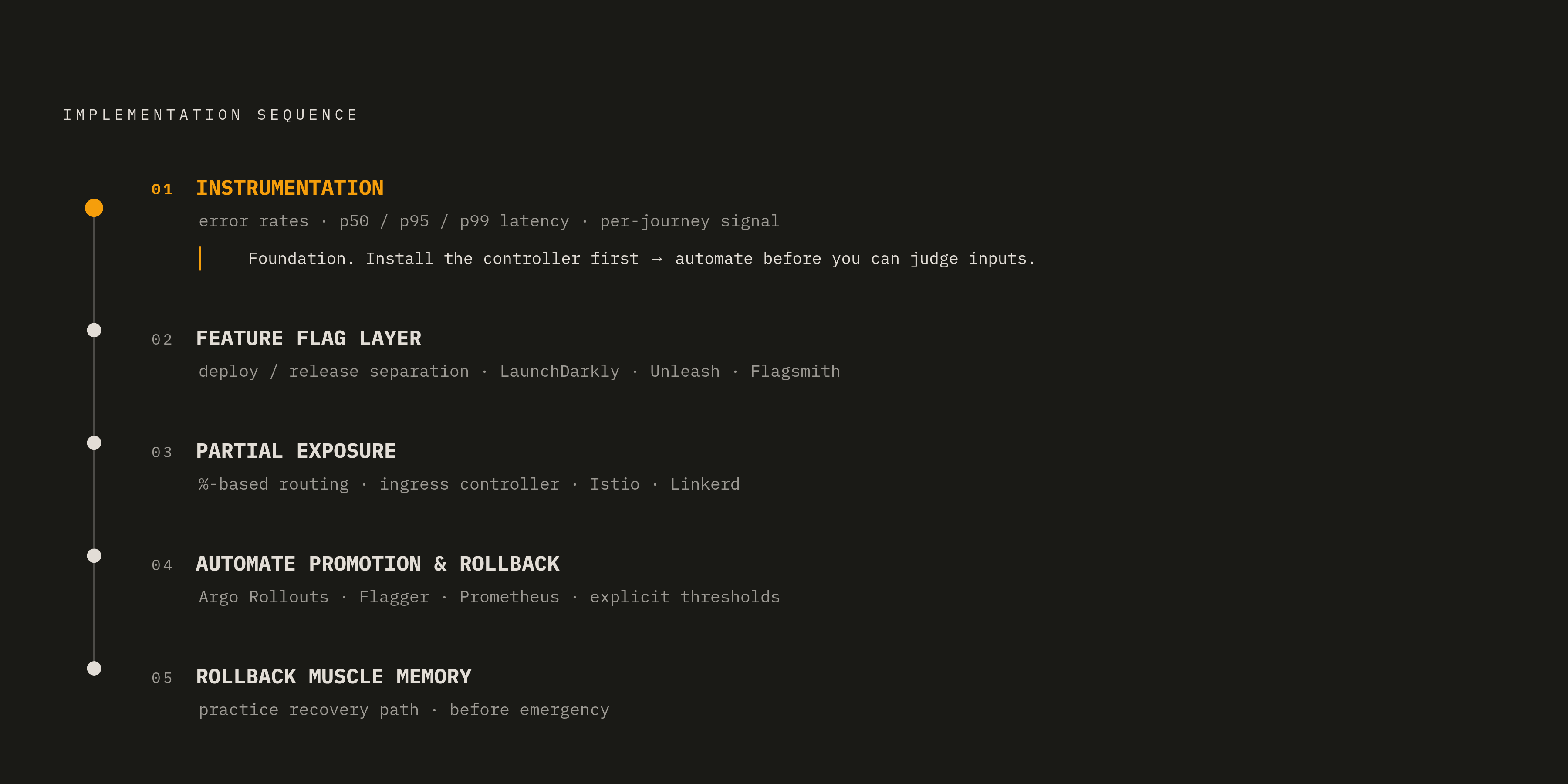
For a team starting this transition, instrumentation comes first. Measure baseline error rates, latency at p50/p95/p99, and at least one business-level signal for each critical user journey before changing how deployments work. Installing the controller first would leave the team automating decisions before it can judge their inputs.
The second step is a feature flag layer, which provides deploy/release separation before investment in canary infrastructure. The provider options are LaunchDarkly, Unleash, Flagsmith, GrowthBook, or another feature flag provider that fits the existing stack. Selection should be accompanied by taxonomy discipline, with an owner, expiry, and default variant on every flag from day one. This makes the first release control accountable as well as technically available.
The third step extends partial exposure to entire services. Once flag-based release is familiar, percentage-based routing can be introduced through an ingress controller, a service mesh such as Istio or Linkerd, or a dedicated release operator. This addresses a different scope from individual feature evaluation. It allows infrastructure-level traffic splitting to complement the application’s runtime controls.
The fourth step is to automate promotion and rollback. Explicit error-rate and latency limits, together with a hold period at each increment, can be wired into the rollout controller. Argo Rollouts and Flagger with Prometheus are the named automation layer for this stage. By this point, the team has both a way to limit exposure and measurements on which to base the next decision.
The same ordering applies to growth engineering functions that instrument GTM and marketing systems with production-software discipline. A content change, site architecture change, or campaign parameter is not “shipped” until real signals confirm it. The evidence gate belongs at the growth layer as well as the product layer. In both settings, the fifth step is to build rollback into muscle memory through non-emergency practice, exercising the recovery path before it is needed under pressure.