Why Jira and ServiceNow Tickets Don't Reduce On-Call Load
Tickets log the work but can't page, escalate, or remediate.
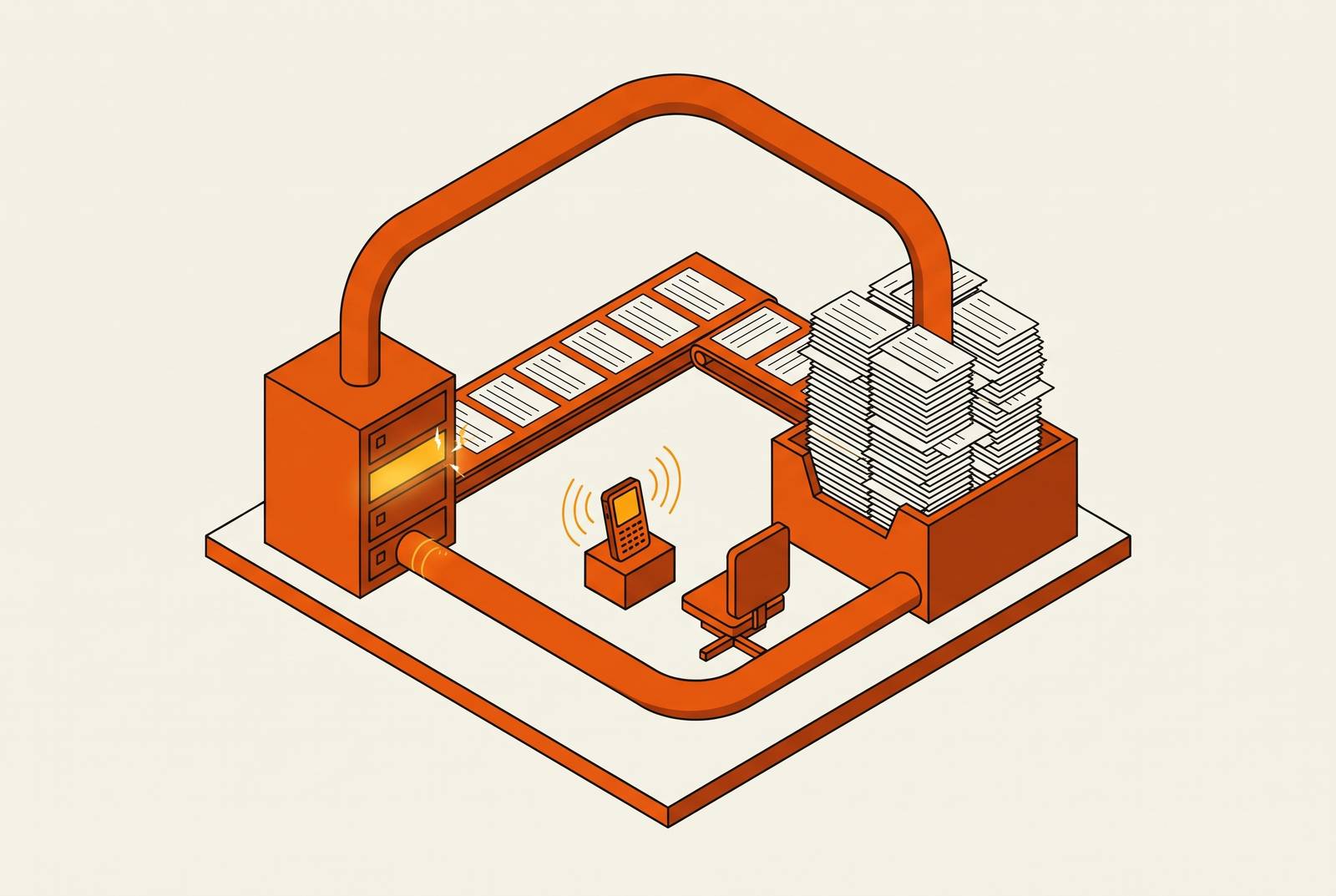
Jira and ServiceNow tickets record the work teams do, but filing them does not ease the load on those on call. Until teams separate logging from routing, acknowledgment, and automated remediation, a well-maintained backlog can grow in parallel with an overloaded pager.
Why ticketing systems exist and what they were built to do
Jira and ServiceNow preserve the state of work across time. Jira organizes that work around projects and issue types, giving each issue a place in a structure built for tracking, audit, and handoff. ServiceNow follows ITIL standards through Incidents, Problems, and Change Requests, with categorization, assignment groups, and business rules enforcing a formal record lifecycle. Both make work durable and accountable.
That durability serves work that outlasts a single response. A ticket can keep track of who is responsible and the handoff state as an incident is resolved, then help teams review it once the disruption has passed. The record answers what happened and who is responsible. Those are different questions from who must be reached now, through which channel, and what should happen if that person does not respond.
The structural mismatch between record systems and on-call routing
On-call routing requires a time-bounded signal. The signal must reach the person currently responsible, enter an acknowledgment loop, and follow an escalation path if it remains unanswered. Persistence alone cannot provide that behavior. Treating a ticket notification as an on-call mechanism is therefore a category error.
Jira notification schemes illustrate the distinction. A scheme can email a group, but that push-based notification has no concept of rotation, shift, or whether someone has already acknowledged the alert. When the “Platform Team” group receives an email, every member is notified regardless of who is on call.
ServiceNow has a different limit in what it requires a record to contain. API requests that omit required fields bypass client-side validation by default, and rejection depends on explicitly configured server-side enforcement through Data Policies or Business Rules. Requiring an urgent signal to meet the record schema slows the response when it needs to move quickly. Connecting the platforms also takes ongoing work, because point-to-point connectors must keep separate ticket lifecycle state machines running as well as transfer fields once.
What actually happens at 2 AM when an incident ticket fires
An incident ticket delivered by email at 2 AM exposes what a notification cannot do. In a ticket-email workflow without a signal layer, there is no native SMS, voice call, mobile push with acknowledgment, or escalation when the first recipient fails to respond. The email has been sent, but the response has not been secured. The ticket can remain unread until the on-call engineer is already fielding a customer call.
A June 2025 Latenode community thread describes an engineer encountering this boundary after moving an on-call setup to Jira Service Management. Schedules were working, but ordinary support tickets sent through the portal did not follow the alert automation path. The engineer wanted ticket creation to notify whoever was on call. The missing connection was between the request and the signal.
The discussion describes workarounds involving Smart Values and a manually updated “Current On-Call” custom field, webhooks to external paging tools, and automation rules that accidentally notified entire teams. Each workaround adds engineering work around the same boundary. These attempts show that ticket intake and on-call response are distinct workflows. When incident communication also lags, support engineers receive duplicate reports that can remain as artificial backlog after the incident resolves.
The specific gaps JSM's on-call features do and don't close
Jira Service Management, or JSM, does provide genuine signal-layer features. Routing rules direct alerts by priority or service type, escalation policies forward unacknowledged alerts, and schedules restrict notifications to people who are on call. These are substantial improvements over raw ticket notifications. Their existence also sharpens the architectural distinction, because they perform work that the ticket record itself cannot.
Availability depends on the plan. Atlassian’s escalation policy documentation says that notifying the next user in a schedule and repeat escalation are among the functions that need Premium or Enterprise and are unavailable on Free or Standard. Heartbeats and incident work in Slack and Teams through ChatOps war rooms also need Premium, though Slack and Teams intake is available on Free. Intake is not the same as incident coordination. A team can therefore have a way to receive requests without having the escalation behavior or response workspace it needs under load.
Schedule visibility presents another operational distinction. Changes such as creating a schedule, adding a rotation, or overriding a shift are not surfaced in an activity log within the schedule interface itself. The audit trail is in the separate Operations audit log. Status pages are also gated to Enterprise, while teams on other plans must pay separately for Statuspage.io, adding another coordination surface during an incident. Atlassian is shutting down OpsGenie on April 5, 2027, with JSM and Compass as the official replacements, so teams using OpsGenie need to evaluate these plan boundaries against their on-call requirements before that date.
Why AI triage and alert grouping reduce noise but leave the routing problem intact
Atlassian Intelligence adds AI triage, ticket summarization, and alert grouping. Grouping makes a genuine structural improvement by collapsing individual alerts from one infrastructure event into a smaller set of grouped alerts, which can optionally be escalated into incidents. That reduces the volume presented for attention. On its own, it does not decide who should respond or what happens when nobody acknowledges the alerts that remain.
A grouped alert still needs routing, a reachable recipient, an acknowledgment window, and escalation logic. Summarization can make the information easier to take in, but it cannot replace those mechanisms. AI features help with work inside the workflow, but the boundaries between its systems may stay the same.
Atlassian’s native ServiceNow integration shows how those boundaries persist. It is scoped to on-call alerting rather than synchronization of tickets, comments, or custom fields, and multiple ServiceNow integrations for different JSM teams require code changes. The engineer can therefore still face the “alt-tab” response model. Updating Jira, notifying Slack, and updating the status page remain separate actions that are prone to omission under pressure. Grouping alerts does not join those coordination steps into a single response workflow.
How the compliance and security operations world ran into the same wall first
Security and compliance teams ran into the same gap between finding a problem and acting on it. They named it the “last mile” problem. A platform detects a failing control, such as an unencrypted bucket or a terminated employee who still holds access, and creates a row in a dashboard. A compliance manager then copies that finding into a Jira ticket, where it waits in a queue. Detection has succeeded, but remediation still depends on a manual handoff.
The dashboard and ticket can both describe the failure correctly while leaving the path to action unchanged. The bottleneck sits between knowledge and execution. Improving field mapping addresses only how the finding is represented.
The architectural response is to decouple internal remediation logic from each external provider’s schema. ServiceNow, Jira, and Linear represent work through incompatible models, including Incidents and their respective Issues, so direct connectors otherwise inherit separate lifecycle state machines. A unified abstraction layer instead lets the platform create a “Remediation Task” and translate it into the customer’s ticket format underneath. The relevant lesson for on-call is that the workflow responsible for action should not be defined by ticket formats.
What separating the signal layer from the record layer looks like in practice
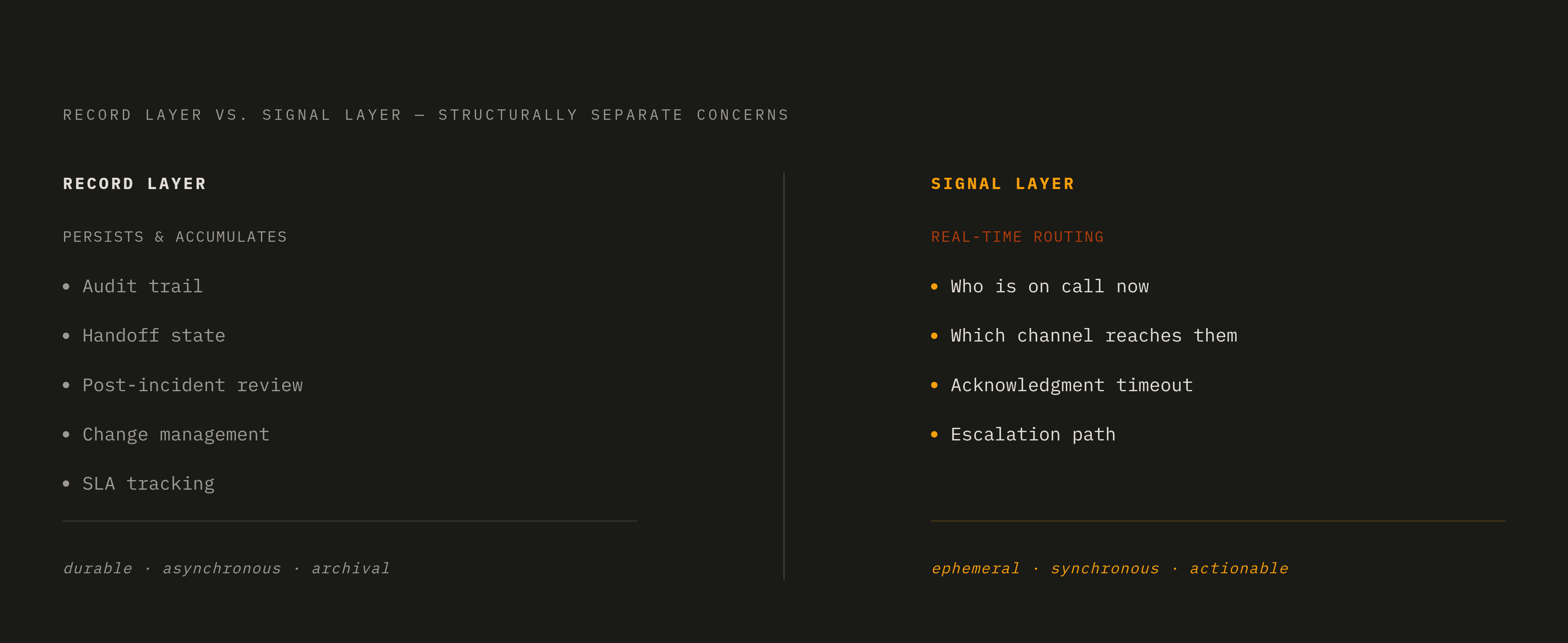
The practical direction is to treat signal routing as a distinct engineering concern, with its own tooling, acknowledgment model, and escalation logic. The record layer handles the audit trail, handoff state, post-incident review, change management, and SLA tracking. These are forms of work that persist and accumulate. The signal layer handles who is on call now, which channel reaches them, how long to wait for acknowledgment, and when to escalate to the next person in the rotation.
JSM’s routing rules, escalation policies, and schedules are signal-layer primitives even though they sit within a service management platform. The evaluation is whether those primitives are complete enough and exposed clearly enough for the team to rely on them under load. Buying a separate product is not the principle. Keeping the response contract distinct from the record lifecycle is.
An automated alert-to-ticket pipeline is one concrete way to bridge the layers. The alert system handles routing and acknowledgment, and a ticket is created in the record system after the signal has been acknowledged. The record documents the incident already in progress rather than making the ticket queue responsible for waking someone. This preserves the audit trail without forcing the interruption through the record workflow.
Communication needs a similar connection to the response. Teams can connect a status page to the service desk to cut down on duplicate reports caused by late updates. Fewer duplicate reports make the queue a more accurate account of genuine work. This addresses a different source of load from alert routing, but follows the same division of responsibility.
Why the agent era makes this separation more urgent, not less
As agents take on monitoring, triage, and remediation, they need an explicit interface to the response workflow. An agent routing an incident needs a structured API that exposes who is on call, which escalation policy applies, and whether the alert has been acknowledged. A queue to poll exposes records without necessarily exposing the decisions and state required to control an urgent response.
Routing logic that only a human can read and configure through a notification scheme is not accessible to an agent in the same way. Automation therefore increases the importance of defined boundaries. The agent needs callable operational functions. Otherwise, automated detection can create work faster while leaving the handoff to action unresolved.
GTM and growth engineering teams are encountering a related gap when task boards and campaign trackers are used as execution engines. A signal and its resulting action remain separated by a manual handoff, repeating the pattern found in compliance workflows. Across these teams, the workflow needs to be instrumented and the signal separated from the record. Composable primitives for monitoring, routing, escalation, and record-keeping can then be connected through APIs, allowing agents to operate each layer through a defined interface.